
 100% FREE ACCESS
6th Standard CBSE Syllabus & Materials
6th Standard CBSE
CBSE 6th Social Science The Value of Work - New Sample Question Papers Study Material - QB365 Set A
NEW6th Standard CBSE
CBSE 6th Social Science Family and Community - New Sample Question Papers Study Material - QB365 Set A
NEW6th Standard CBSE
CBSE 6th Social Science India's Cultural Roots - New Sample Question Papers Study Material - QB365 Set A
NEW6th Standard CBSE
CBSE 6th Social Science India,That is Bharat - New Sample Question Papers Study Material - QB365 Set A
NEW6th Standard CBSE
CBSE 6th Social Science Timeline and sources of history - New Sample Question Papers Study Material - QB365 Set A
NEW6th Standard CBSE
CBSE 6th Social Science Oceans and Continents - New Sample Question Papers Study Material - QB365 Set A

Published on: 26/11/2019
Components of Food
Download CBSE Class 6th Standard CBSE Science question papers, sample papers, important questions, and previous year solved papers in PDF format. Get free study materials, NCERT solutions, and exam preparation resources for Class 6th Standard CBSE Science
Questions + Answers key
Take MCQ Science Test
1.
Sarthak advises his mother not to sieve wheat flour before making dough. Can you state why?
2.
'Modernisation has led to the development of life style disorders'. Find out what life style diseases are. How can they be prevented?
3.
Identify the cause of disease known as beri-beri.
4.
Do people of all ages and different professional backgrounds need some type of diet?
5.
Is there a situation called overnutrition?
6.
Why are parents advised to discourage their children from eating chips and junk foods?
7.
Why should we eat a balanced diet? Name the vitamin that gets destroyed on heating.
8.
Minerals and vitamins are needed in very small quantities by our body as compared to other components, yet these are important parts of a balanced diet. Explain the statement.
9.
Can you test and identify which of the following food items are fatty foods, i.e. food which is rich in fats? How will you test them?
Pulses, oil, wheat grains, butter, meat, rice, chapati, cucumber, pizza, poori and groundnuts.
10.
Name two sources of animal fats. From where are they derived?
11.
(a) Which components of food are known as protective foods?
(b) Which food provides water to our body?
(c) Why should vegetables not be washed after cutting? Why should food not be overcooked?
12.
Observe the items given in fig. carefully and answer the questions that follow.
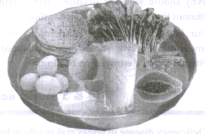
(a) Food item rich in carbohydrates is _______
(b) Egg is a rich source of protein, the mineral, ________ and vitamin _________
(c) _______ is a rich source of fat.
(d) Milk provides ________, vitamin D and ________ (mineral)
(e) _______ (fruit) is a rich source of vitamin A.
(f) Spinach is a good source of the mineral _________
(g) Both eggs and ________ are rich in ________.
13.
List all the sources and importance of the following minerals in food.
(a) Calcium
(b) Magnesium
(c) Potassium
(d) Zinc
(e) Iron
14.
Manvi was going to her friend's birthday. She enjoyed parties but today she was not feeling good. When her friend's mother observed this, she asked Manvi whether she is all right. Manvi told her that she has not eaten any food from the morning as she waited for the party. Manvi's friend told her to sit down and have some food. She obeyed and finished her food.
(a) Why was Manvi not feeling well?
(b) Name the components present in food. Out of these components, which are energy yielding ones?
(c) What values do you observe in Manvi?
15.
The energy-providing nutrients are:
Carbohydrates
Fats
Carbohydrates and fats both
Proteins
16.
Which vitamin deficiency causes rickets?
Vitamin A
Vitamin B
Vitamin C
Vitamin D
17.
Cyanocobalamin is vitamin
B12
B1
B2
K
18.
Minerals and vitamins present in food are
protective
energy giving
body building
roughage
19.
Which of the following sources of protein is different from others?
Peas
Grams
Soybeans
Cottage cheese (paneer)
1.
The wheat flour contains husk, which is rich in carbohydrates, so Sarthak advises his mother not to sieve wheat flour before making dough.
2.
'Modernisation' has led to the development of life style disorders. The life style disorders are obesity, fatigue, loss of vision, mental weakness etc. These disorders occur due to junk foods like pizza, burger etc. They can be prevented by taking balanced diet including carbohydrates, fats, proteins, vitamins and minerals.
3.
Deficiency of vitamin-B1 causes disease beri-beri.
4.
No, the people of all ages and different professions require different types of nutrients according to their physical work.
5.
Yes, when there is more intake of food it can lead to condition like obesity indicating overnutrition.
6.
Parents are advised to discourage their children from eating chips and junk foods due to following reasons:
(i) Junk foods cause obesity
(ii) They may cause loss of appetite.
(iii) They cause mental problems.
(iv) These food items lead to wastage of money.
7.
Our body needs all the nutrients in the right amount, hence we should eat a balanced diet. Vitamin C gets destroyed on heating.
8.
Though minerals and vitamins are needed in very small quantities by our body yet these are important parts of balanced diet because
(i) vitamins are necessary for good eyesight (vitamin-A), growth (vitamin-B1), keeping teeth gums and joints healthy (vitamin-C) and normal growth of bones (vitamin-D).
(ii) minerals are needed in our body for building bones and teeth (calcium and phosphorus), formation of blood (iron), coagulation of blood and functioning of muscles (calcium) and functioning of thyroid gland (iron).
9.
Fats can be tested by a simple test:
(i) Take small amounts of all food materials one by one.
(ii) Place them on a clean white paper and rub with mild force.
(iii) Hold the paper towards light.
(iv) A greasy, translucent spot if appears, indicates the food component rich in fats.
Out of all food items, following are fat rich foods: Oil, butter, meat, pizza, poori, groundnuts.
10.
The two sources of animal fats are- Meat and cheese
(i) Meat from different animals like hens, pigs, etc.
(ii) Cheese from milk produced by cones.
11.
(a) Vitamins and minerals
(b) Tea, coffee, fruits, vegetables etc.
(c) Vegetables contain vitamins and minerals
which get washed away if vegetables are washed after cutting them.
Food should not be overcooked to prevent the loss of nutrients from it.
12.
(a) chapati
(b) calcium, D
(c) Butter
(d) protein, calcium
(e) Papaya
(f) iron
(g) peas, proteins.
13.
(a) The main sources of calcium minerals are milk, cheese, eggs and green vegetables. It also found in flour and bread.
It helps in formation of bone, teeth and blood clotting.
(b) Magnesium is found in cheese, green vegetable, bread and fish.
It helps in energy transfer and muscles activity. It works with calcium and vitamin-C.
(c) Potassium is found in meat, fruit, eggs, milk, etc.
The main function of potassium is balance in tissue fluid and blood. It also helps in nerve impulse conduction.
(d) Zinc is mainly found in onions, liver and green vegetables.
It works as a enzyme activator in our body.
(e) Iron is found in green vegetables, fresh fruits, etc.
Iron is needed to make haemoglobin present in red blood cells which carry oxygen from the lungs to the body parts.
14.
(a) Manvi had not eaten any food since morning. She was tired as no energy giving food has been eaten by her. Lack of food leads to no energy and restlessness.
(b) The components present in food are carbohydrates, proteins, vitamins, fats and minerals.
Carbohydrates and fats are energy yielding components in food.
(c) Manvi is humble, fun loving girl who realised her mistakes. She respects her olders and tries to follow instructions given by them.
15.
(c)
Carbohydrates and fats both
16.
(d)
Vitamin D
17.
(a)
B12
18.
(a)
protective
19.
(d)
Cottage cheese (paneer)

6th Standard CBSE Syllabus & Materials
6th Standard CBSE
CBSE 6th Social Science Locating Places on the Earth - New Sample Question Papers Study Material - QB365 Set A
NEW6th Standard CBSE
CBSE 6th Science A Journey Through States of Water - New Sample Question Papers Study Material - QB365 Set A
NEW6th Standard CBSE
CBSE 6th Science Temperature and its Measurement - New Sample Question Papers Study Material - QB365 Set A
NEW6th Standard CBSE
CBSE 6th Science Materials Around Us - New Sample Question Papers Study Material - QB365 Set A



CBSE 6th Standard CBSE Subjects
CBSE Standards




