
 100% FREE ACCESS
6th Standard CBSE Syllabus & Materials
6th Standard CBSE
CBSE 6th Social Science The Value of Work - New Sample Question Papers Study Material - QB365 Set A
NEW6th Standard CBSE
CBSE 6th Social Science Family and Community - New Sample Question Papers Study Material - QB365 Set A
NEW6th Standard CBSE
CBSE 6th Social Science India's Cultural Roots - New Sample Question Papers Study Material - QB365 Set A
NEW6th Standard CBSE
CBSE 6th Social Science India,That is Bharat - New Sample Question Papers Study Material - QB365 Set A
NEW6th Standard CBSE
CBSE 6th Social Science Timeline and sources of history - New Sample Question Papers Study Material - QB365 Set A
NEW6th Standard CBSE
CBSE 6th Social Science Oceans and Continents - New Sample Question Papers Study Material - QB365 Set A

Published on: 21/11/2019
Food: Where does it Come from
Download CBSE Class 6th Standard CBSE Science question papers, sample papers, important questions, and previous year solved papers in PDF format. Get free study materials, NCERT solutions, and exam preparation resources for Class 6th Standard CBSE Science
Questions + Answers key
Take MCQ Science Test
1.
What are the main sources of our food? Name four food items that we get from animals.
2.
People living in different regions of India show variations in food habits. How do we conclude this?
3.
Two set ups are prepared from pulses, one set up shows dry seeds while other is sprouted. Which seeds will have more nutritious value sprouted or normal seeds?
4.
Cooking of food is necessary. Why?
5.
Name two ingredients in our food that are not obtained from plants or animals. Mention one source for each ingredient.
6.
Ravi does not eat enough food per day. His mother advised him to eat enough food.
(a) What are the functions of food?
(b) What values were shown by his mother?
7.
What are sprouted seeds? How are they eaten?
8.
(i) Identify and write the names of plants that provide us with
(a) fruits
(b) cereals/grains
(c) pulses
(d) vegetables
(e) oil or fat
(ii) Is oil/fat possible to derive from animal sources? If yes, give an example.
9.
Why do organisms need food? Write two reasons.
10.
(a) 'A' is liquid white food product which is obtained from some animals. It is processed into many other products and is an important ingredient of sweets. Name the food 'A'. Also name the products made from it.
(b) The product in first part comes from animal yet it can also be called as a plant product indirectly. How?
(c) Name some food items derived from animals.
11.
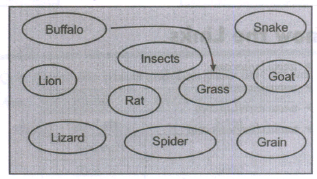
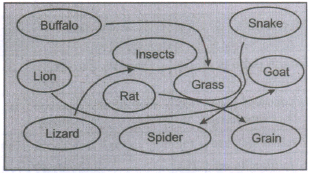
Connect the animal with the food it eats by an arrow using different colours in Fig. One is done for you.
12.
Ashu is visiting a slum area as a part of his homework assignment. He reaches the place and observe that people are very poor and their living conditions are bad. He asks questions to residents and realises that due to drought there is no food available to them and that people are hungry and children are under nourished. Ashu promises them that he will try to help and next day bring food and other amenities along with his freinds.
(a) Do you think food is responsible for some of consequences faced by villagers?
(b) Why do all living organisms require food?
(c) Name the condition which arises due to lack of food or undernourishment.
(d) What values can you observe in Ashu?
13.
Rajni went to Chennai to visit her friend. She noticed that the climate was very hot and the food available was so different than at home. Coconut is used extensively and rice is included in all meals. Her friend's mother explained these differences to Rajni.
(a) What changes were observed by Rajni in regard with food habits?
(b) Food habits of all places are different. What do you understand by food habits?
(c) List one dish commonly made in South India. Identify its ingredients, and separate plant and animal derived ingredients.
(d) Do you observe any values in Rajni? Name them.
14.
Given below is a list of edible plants
(i) Banana
(ii) Pumpkin
(iii) Lady's finger
(iv) Brinjal
Which pair of plants has two or more edible parts?
(i) and (ii)
(ii) and (iii)
(iii) and (iv)
(i) and (iv)
15.
Below are the names of some animals.
(i) Cow
(ii) Sheep
(iii) Horse
(iv) Ox
Which of the above are the sources of milk for human beings?
(i) and (iii)
(i) and (ii)
(ii) and (iii)
(iii) and (iv)
16.
Carrot and radish food obtained from plants are examples of
stem
roots
leaves
flowers
17.
Select one of the following that is a cereal.
Rice
Tea
Onion
Beans
18.
Honeybee makes honey from
pollen
petals
nectar
bud
19.
Name two aquatic plants eaten as food.
20.
Form pairs of words in group A with words in group B. A—Mustard plant, Nectar, Beetroot, carnivore, omnivore. B-- Honey, sugar, oil, humans, tiger.
21.
Why are humans considered omnivores?
22.
Which cereal-fields have rows of plants?
23.
How many ingredients are needed to prepare a dish of boiled rice? Name the ingredients.
1.
The main sources of our food are plants and animals. The food items which we get from animals are milk, eggs, meat and chicken.
2.
Food habits depend on availability, lifestyle, environment of the regions people live in, thus leading to variations in food habits.
3.
Sprouted seeds will have more nutritious value.
4.
We cook food so that it can be used by our body easily.
5.
The two ingredients in our food that are not obtained from plants or animals are
(i) Salt It is obtained from oceans and rocks.
(ii) Water It is obtained from river/tap/pond/lake/rain.
6.
(a) The functions of food are as follows:
(i) It helps in the growth and development of a living organism.
(ii) It provides energy to do physical work.
(iii) It helps to perform body functions.
(b) Love, caring.
7.
Sprouted seeds are the seeds with seedlings. Seeds are first soaked in water for one day. The water is drained and the seeds are kept wrapped in a wet cloth and left for one more day. After sprouting, they can be eaten raw. They can also be boiled. They can also be made into a tasty snack by adding spices to them.
8.
(i) (a) Fruits-Banana, grape, pear.
(b) Cereals/Grains- Rice, maize, ragi.
(c) Pulses- Gram, peas, beans.
(d) Vegetables- Carrot, capsicum, ginger.
(e) Oil or fat-Mustard, groundnut and sunflower.
(ii) Yes, oil can be derived from animal sources, e.g. cod liver oil derived from fish.
9.
Food is needed by organisms for the following reasons
(i) Food provides us energy to perform various functions of body to sustain life.
(ii) Food helps us to protect the body against various diseases and infections.
10.
(a) The food is milk, we obtain it from cow and buffalo mainly.
The products made from it are curd, sweets, etc.
(b) Milk comes from cow but since, cow feeds on the plants and uses it to grow and produce milk.
(c) Food items derived from animals include meat, egg, honey, etc.
11.
12.
(a) Yes, without food there is no energy in people and their body cannot fight against infections.
(b) Food is required because it gives us energy to carry out all life processes.
It helps in growth and maintenance of body.
(c) Malnutrition.
(d) Ashu is sincere, caring and a helpful boy. He is eager to provide his support and encourages his friends in helping him to help villagers.
13.
(a) Food habits of people in Chennai were different as they used coconut oil for cooking and coconut is extensively used in preparing other dishes. Rice was part of every meal, they consume less or no chapatis.
(b) Food habits refer to particular interest towards certain types of food. It is commonly influenced by location, climate and availability.
(c) Sambhar dal is very common. Its main ingredients are dal, condiments, vegetables and oil. All of these ingredients are plant products.
(d) Rajni is friendly, observant and knowledge seeking girl. She is aware of her surroundings which is very important.
14.
(a)
(i) and (ii)
15.
(b)
(i) and (ii)
16.
(b)
roots
17.
(a)
Rice
18.
(c)
nectar
19.
()
20.
()
21.
()
22.
()
Paddy and Wheat.
23.
()
Two ingredients are needed to prepare a dish of boiled rice. These are rice and water.

6th Standard CBSE Syllabus & Materials
6th Standard CBSE
CBSE 6th Social Science Locating Places on the Earth - New Sample Question Papers Study Material - QB365 Set A
NEW6th Standard CBSE
CBSE 6th Science A Journey Through States of Water - New Sample Question Papers Study Material - QB365 Set A
NEW6th Standard CBSE
CBSE 6th Science Temperature and its Measurement - New Sample Question Papers Study Material - QB365 Set A
NEW6th Standard CBSE
CBSE 6th Science Materials Around Us - New Sample Question Papers Study Material - QB365 Set A



CBSE 6th Standard CBSE Subjects
CBSE Standards




