
 100% FREE ACCESS
6th Standard CBSE Syllabus & Materials
6th Standard CBSE
CBSE 6th Social Science The Value of Work - New Sample Question Papers Study Material - QB365 Set A
NEW6th Standard CBSE
CBSE 6th Social Science Family and Community - New Sample Question Papers Study Material - QB365 Set A
NEW6th Standard CBSE
CBSE 6th Social Science India's Cultural Roots - New Sample Question Papers Study Material - QB365 Set A
NEW6th Standard CBSE
CBSE 6th Social Science India,That is Bharat - New Sample Question Papers Study Material - QB365 Set A
NEW6th Standard CBSE
CBSE 6th Social Science Timeline and sources of history - New Sample Question Papers Study Material - QB365 Set A
NEW6th Standard CBSE
CBSE 6th Social Science Oceans and Continents - New Sample Question Papers Study Material - QB365 Set A

Published on: 31/10/2019
Download CBSE Class 6th Standard CBSE Science question papers, sample papers, important questions, and previous year solved papers in PDF format. Get free study materials, NCERT solutions, and exam preparation resources for Class 6th Standard CBSE Science
Questions + Answers key
Take MCQ Science Test
1.
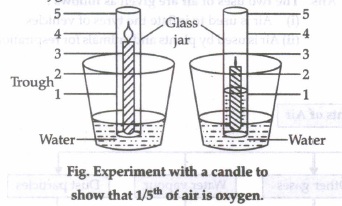
Give an experiment to show that one-fifth of air is oxygen.
2.
Suggest an activity to prepare a magnetic compass by using an iron needle and a bar magnet
3.
What are the adaptive features of a lion that help it in hunting?
4.
How can we find the length of a curved line? Explain.
5.
During summer holidays, a group of children collected a lump of salt, green grass, broken glass piece, a small thermocol box, pen, iron nail, glass. marbles, hair, naphthalene ball, a piece of sugar candy (mishri) and tried to group them on the basis of properties given in table. Help them in filling the table.
| Name of material | Appearance (Hard/Soft) | Transparency (Transparent/Translucent/Opaque) | Floats/Sinks in water | Soluble/Insoluble in water |
6.
Sarita was interested in knowing more about plants and its parts. She started exploring and collecting plants. She wanted to preserve them, so that she can have a good collection of plants.
(a) Suggest the steps to help her in identifying plants.
(b) Is there any other method to identify plants Explain.
(c) What are the values shown by Sarita?
7.
During an educational trip of Class VI, students went to the handloom house. Their science teacher wants to show how fabrics are made from yarn. Children were taking lot of interest in the process of weaving by hathkargha (handloom). Their teacher explained the two types of looms and working of that looms. Some girls learned the process, how two sets of yarns are woven to make a fabric. The trip was very knowledgeable and children enjoyed a lot.
Read the following passage and answer the given questions:
(a) Explain the process of weaving.
(b) Name the device used for making yarns.
(c) What values are shown by teacher and students?
8.
Radha came back from school hungry and went to her mother in kitchen. Radha's mother was peeling vegetables. She noted that the peels were very thick and her mother then started washing vegetables. Radha asked her to stop washing the vegetables. Her mother was surprised and asked why? Radha told her all she knew about how nutrients are washed away if we peel and then wash them?
(a) If thick peels are removed from vegetables, what happens?
(b) Washing of vegetables after peeling is not a good practice. Can you tell why?
(c) What are those components that get washed away?
(d) Give two examples of vitamins and minerals containing food.
(e) Do you think Radha has any values? Name them.
9.
Rajni went to Chennai to visit her friend. She noticed that the climate was very hot and the food available was so different than at home. Coconut is used extensively and rice is included in all meals. Her friend's mother explained these differences to Rajni.
(a) What changes were observed by Rajni in regard with food habits?
(b) Food habits of all places are different. What do you understand by food habits?
(c) List one dish commonly made in South India. Identify its ingredients, and separate plant and animal derived ingredients.
(d) Do you observe any values in Rajni? Name them.
10.
(a) On which process sprouting is based on?
(b) List benefits of sprouting.
1.
Take a candle and fix it at the centre of a glass vessel. Add some quantity of water in the vessel. Now place an empty dry glass jar over it. Mark five lines at an equal distance above the water surface. Now, carefully light the candle and cover the glass jar. Wait for a few seconds and how the flame will be extinguished due to absence of oxygen to bum.
Now, we can observe that the water level raised in the glass jar is 1/5 of the volume of air present in the glass jar
This experiment shows that one-fifth of air is oxygen
2.
Following steps are used to prepare a magnetic compass by using an iron needle and a bar magnet:
(i) Take a small piece of cork, and the magnetised needle (which can be magnetised by using a bar magnet).
(ii) Take a cup filled with water and let the cork float on it; the needle should not touch the water.
(iii) Now, compass is ready to work. Note the direction in which the needle points when the cork is floating.
(iv) Rotate the cork in different directions. Note the direction in which the needle points when the cork begins to float again without rotating. We see that the needle always points in the same direction, when the cork floats without rotation
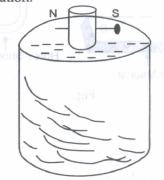
Activity showing magnetic compass by using iron needle and a bar magnet
3.
There are following adaptive features of a lion that help it in hunting:
(i) Light brown colour of skin, which helps it to hide in dry grasslands when it hunts for prey.
(ii) Eyes in front of face, which help it to know the correct location of its prey.
(iii) Powerful paws and long claws, which help it . to catch and kill the prey
4.
Draw a curved line CD. Take a thread and make a knot at one of its ends. Keep the knot made in the thread on point C of the line. Place a small portion of the thread along the line, keeping it tight using your fingers and thumb. Keep on stretching the thread on the curved line till you take the thread to the point D of the line. Make a mark on the thread where it touches the other end of the line at point D. Now, stretch the thread along a metre scale and the length between the knot in the beginning and mark on the thread is measured through scale. This measured length on scale will give you the length of the curved line CD.
5.
The complete table is shown as below:
| Name of the material | Appearance (Hard/Soft) | Transparency (Transparent/Translucent/Opaque) | Floats/Sinks in water | Soluble/Insoluble in water |
| Lump of salt | Hard | Opaque | Sinks | Soluble |
| Green grass | Soft | Opaque | Floats | Insoluble |
| Broken glass piece | Hard | Transparent | Sinks | Insoluble |
| A small thermocol box | Soft | Opaque | Floats | Insoluble |
| Pen | Hard | Opaque | Sinks | Insoluble |
| Iron nail | Hard | Opaque | Sinks | Insoluble |
| Glass marbles | Hard | Transparent | Sinks | Insoluble |
| Hair | Soft | Opaque | Floats | Insoluble |
| Naphthalene ball | Hard | Opaque | Sinks | Insoluble |
| A piece of sugar candy (mishri) | Hard | Translucent | Sinks | Soluble |
6.
(a) Sarita can follow the following steps:
(i) Collect plant twig with flowers.
(ii) Press the8m in papers/magazines.
(iii) Change the paper/magazine every day for 5-6 days.
(iv) When plants are well pressed and dried place them on white plane paper sheet.
(v) Stick the plants to sheet with cello tape.
(vi) Try to identify the plant.
(vii) Take help of teachers/seniors for plant identification.
(b) Yes, plants can also be identified on the basis of the nature of their stem and size.
(c) Inquisitive, scientific attitude and love for nature.
7.
(a) The process of making a fabric (or cloth) by arranging yarns (long threads) passing in one direction with other yarns at right angles to them, is called weaving. Thus, weaving involves two sets of yarns arranged at right angles to one another.
(b) Device for making fabrics by weaving yarns or threads is called a loom.
(c) The teacher is very knowledgeable and dedicated, having patience and helpful. Children are inquisitive and obedient.
8.
(a) Many vegetables contain most of the nutrients just below their skin surface. Thick peeling may lead to their removal.
(b) Washing of vegetables after peeling or cutting removes the water soluble vitamins and minerals from them and lowers their nutritive value.
(c) These components are called nutrients like minerals (iron, calcium, phosporous) and vitamins (B, A, C, D, E).
(d) Vegetables like tomatoes, potatoes, green leafy vegetables, etc.
(e) Yes, Radha is sincere, observant, helpful and knowledgeable. She used her knowledge in right place and stopped her mother for doing incorrect work.
9.
(a) Food habits of people in Chennai were different as they used coconut oil for cooking and coconut is extensively used in preparing other dishes. Rice was part of every meal, they consume less or no chapatis.
(b) Food habits refer to particular interest towards certain types of food. It is commonly influenced by location, climate and availability.
(c) Sambhar dal is very common. Its main ingredients are dal, condiments, vegetables and oil. All of these ingredients are plant products.
(d) Rajni is friendly, observant and knowledge seeking girl. She is aware of her surroundings which is very important.
10.
(a) Sprouting is based on germination process.
(b) (i) Sprouts contain more vitamins and higher protein content.
(ii) They form easy and nutritious snacks.

6th Standard CBSE Syllabus & Materials
6th Standard CBSE
CBSE 6th Social Science Locating Places on the Earth - New Sample Question Papers Study Material - QB365 Set A
NEW6th Standard CBSE
CBSE 6th Science A Journey Through States of Water - New Sample Question Papers Study Material - QB365 Set A
NEW6th Standard CBSE
CBSE 6th Science Temperature and its Measurement - New Sample Question Papers Study Material - QB365 Set A
NEW6th Standard CBSE
CBSE 6th Science Materials Around Us - New Sample Question Papers Study Material - QB365 Set A



CBSE 6th Standard CBSE Subjects
CBSE Standards




