
 100% FREE ACCESS
6th Standard CBSE Syllabus & Materials
6th Standard CBSE
CBSE 6th Social Science The Value of Work - New Sample Question Papers Study Material - QB365 Set A
NEW6th Standard CBSE
CBSE 6th Social Science Family and Community - New Sample Question Papers Study Material - QB365 Set A
NEW6th Standard CBSE
CBSE 6th Social Science India's Cultural Roots - New Sample Question Papers Study Material - QB365 Set A
NEW6th Standard CBSE
CBSE 6th Social Science India,That is Bharat - New Sample Question Papers Study Material - QB365 Set A
NEW6th Standard CBSE
CBSE 6th Social Science Timeline and sources of history - New Sample Question Papers Study Material - QB365 Set A
NEW6th Standard CBSE
CBSE 6th Social Science Oceans and Continents - New Sample Question Papers Study Material - QB365 Set A

Published on: 07/09/2019
Fun with Magnets
Download CBSE Class 6th Standard CBSE Science question papers, sample papers, important questions, and previous year solved papers in PDF format. Get free study materials, NCERT solutions, and exam preparation resources for Class 6th Standard CBSE Science
Questions + Answers key
Take MCQ Science Test
1.
A tailor was stitching buttons on his shirt. The needle has slipped from his hand onto the floor. How can you help the tailor to find the needle?
2.
Mention the name of magnet used in electrical bell
3.
Mention a way to magnetise a magnetic material with a natural magnet.
4.
When South pole of a magnet comes in contact with South pole of other magnet, than what happens?
5.
State the ways through which a magnet can be demagnetised.
6.
Explain how will you test that the 'tea dust' is not adulterated with iron powder.
7.
Kanchan is a class VI student. She has to show an activity in school exhibition. But, she has no idea. Her friend Suresh advised her to do an activity in which rope stands without any support with the help of magnet and ask her to take a small rope, a magnet, a cup and a stand.
(a) State the values that Suresh reflect here?
(b) Name some non-magnetic materials.
8.
Suggest an arrangement to store a U-shaped magnet. How is this different from storing a pair of bar magnets?
9.
A toy car has a bar magnet laid hidden inside its body along its length. Using another magnet, how will you find out which pole of the magnet is facing the front of the car?
10.
A bar magnet is cut into two pieces A and B from the middle as shown in figure.

Will the two pieces act as individual magnets? Mark the poles of these two pieces. Suggest an activity to verify your answer.
11.
You are provided with two identical metal bars. Out of the two, one is a magnet. Suggest two ways to identify the magnet.
12.
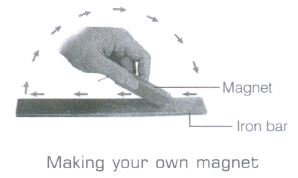
Describe the steps involved in the magnetising of an iron strip with the help of a magnet.
13.
Copper cannot be magnetised.
14.
Heating cannot destroy the magnetic properties of a magnet.
15.
Strength of a magnet is weaker at the poles.
16.
A magnet attracts the ______________materials.
17.
A shepherd named _______________ discovered the magnet.
18.
The South pole of earth's magnet is near the geographical ________________pole.
19.
A freely suspended magnet always points in the
upside down
East-West direction
North-South direction
Any direction by chance
20.
Magnets have a shape of
cylindrical
horse-shoe
ball-ended magnet
All of these
21.
A bar magnet is immersed in a heap of iron filings and pulled out. The amount of iron filings Clinging to the
North pole is almost equal to the South pole
North pole is much less than the South pole
North pole is much less than the South pole
magnet will be same all along its length
22.
How is compass used to find directions?
23.
What will happen if a magnet is brought near a compass?
24.
Do the opposite poles attract or repel each other?
1.
With the help of a bar magnet, we can find the needle.
2.
The magnet which is used in electrical bell is horse-shoe magnet.
3.
A magnetic material can be magnetised by rubbing in a particular direction.
4.
When South pole of a magnet comes in contact with South pole of the other magnet, then it repels each other because like poles always repel each other.
5.
There are following two ways to demagnetise a magnet
(i) by heating
(ii) by hammering
6.
We can do simple experiment for this
(i) Take tea dust on a paper.
(ii) Take a bar magnet in your hand.
(iii) Shake the bar magnet over this dust.
(iv) If some particles are attracted strongly towards this magnet, then definitely tea dust will have iron powder.
7.
(i) Suresh is cooperative, intelligent and creative boy.
(ii) Some non-magnetic materials are plastic, stainless steel, glass, fibre, etc.
8.
It is a suggested way shown in figure below
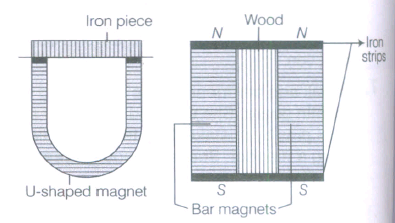
U-shaped magnet is kept along with an iron piece while bar magnets are kept along with iron strips and magnets separated by wood along their length.
9.
If we face North pole towards the front side of the car and the car is attracted, it means its front side pole is South pole and if it is going away, it means its front side is North pole.
10.
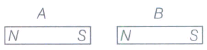
Yes, two pieces will work as an individual magnet because a monopole (single pole) of magnet never exists
11.
The two ways to identify the magnet are
(i) Hang the metal bars with a thread and having its level horizontal one by one and let it stop in any direction. Now, if we move it by"pushing it slowly and it returns to the same direction, it means that it is a magnet otherwise it is an iron bar simply.
(ii) Take some iron filings and move the iron bars over these iron filings one by one. If iron filings are attracted very strongly at poles, then it is a magnet and if it is not attracted, then it is simply an iron bar.
12.
Steps involved in the magnetising of an iron strip are
(i) Take an iron strip which is to be magnetised.
(ii) Keep it in a wooden table.
(iii) Hold one end of bar magnet in your hand and keep the other end of bar magnet at one end of iron bar.
(iv) Without lifting, move the lower end of bar magnet to the end of iron bar.
(v) After reaching end of iron bar, lift the bar magnet and bring it to the same position and repeat the process again and again.
13.
(a)
14.
(b)
15.
(b)
16.
()
magnetic
17.
()
Magnes
18.
()
North
19.
(c)
North-South direction
20.
(d)
All of these
21.
(a)
North pole is almost equal to the South pole
22.
()
The needle of the compass indicates North-South direction, when it comes to the rest. By knowing North-South directions, one can always find out East and West directions.
23.
()
If a magnet is brought near a compass, the south pole of compass is attracted towards north pole of magnet and north pole of compass is attracted towards south pole of magnet.
24.
()
The opposite poles attract each other.

6th Standard CBSE Syllabus & Materials
6th Standard CBSE
CBSE 6th Social Science Locating Places on the Earth - New Sample Question Papers Study Material - QB365 Set A
NEW6th Standard CBSE
CBSE 6th Science A Journey Through States of Water - New Sample Question Papers Study Material - QB365 Set A
NEW6th Standard CBSE
CBSE 6th Science Temperature and its Measurement - New Sample Question Papers Study Material - QB365 Set A
NEW6th Standard CBSE
CBSE 6th Science Materials Around Us - New Sample Question Papers Study Material - QB365 Set A



CBSE 6th Standard CBSE Subjects
CBSE Standards




