
 100% FREE ACCESS
6th Standard CBSE Syllabus & Materials
6th Standard CBSE
CBSE 6th Social Science The Value of Work - New Sample Question Papers Study Material - QB365 Set A
NEW6th Standard CBSE
CBSE 6th Social Science Family and Community - New Sample Question Papers Study Material - QB365 Set A
NEW6th Standard CBSE
CBSE 6th Social Science India's Cultural Roots - New Sample Question Papers Study Material - QB365 Set A
NEW6th Standard CBSE
CBSE 6th Social Science India,That is Bharat - New Sample Question Papers Study Material - QB365 Set A
NEW6th Standard CBSE
CBSE 6th Social Science Timeline and sources of history - New Sample Question Papers Study Material - QB365 Set A
NEW6th Standard CBSE
CBSE 6th Social Science Oceans and Continents - New Sample Question Papers Study Material - QB365 Set A

Published on: 01/10/2019
Getting to Know Plants
Download CBSE Class 6th Standard CBSE Science question papers, sample papers, important questions, and previous year solved papers in PDF format. Get free study materials, NCERT solutions, and exam preparation resources for Class 6th Standard CBSE Science
Questions + Answers key
Take MCQ Science Test
1.
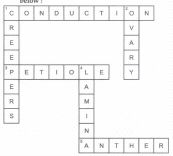
Solve the crossword given in Fig. as per the clues given below it:
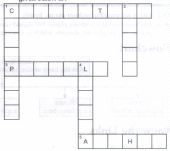
Across
1. The term that describes upward movement of water in a stem.
3. The part of leaf which is attached to the stem.
5. This part is attached to the tip of filament.
Down
1. Plants that are weak and spread on the ground.
2. Ovules are present in this part of flower.
4. Is the broad part of leaf.
2.
Identify the wrong statements and correct them.
(a) Anther is a part of the pistil.
(b) The visible parts of a bud are the petals.
(c) Lateral roots are present in a tap root.
(d) Leaves perform the function of transpiration only.
3.
What are the characteristics of plants?
4.
Describe a leaf.
5.
Draw a labelled diagram of a plant.
6.
Observe the figure of an activity given as figure, carried out with leaves of plants and polythene bag. Now answer the following.
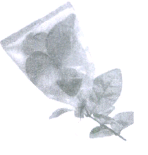
(a) Which process is demonstrated in the activity?
(b) When will this activity show better results on a bright sunny day or a cloudy day?
(c) What will you observe in the polythene bag after a few hours of setting up the activity?
(d) Mention anyone precaution you must take, while performing this activity.
7.
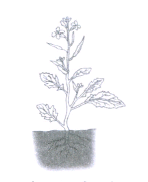
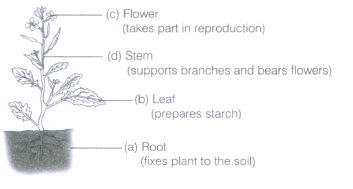
Read the functions of parts of a plant given below:
(a) fixes plant to the soil
(b) prepares starch
(c) takes part in reproduction
(d) supports branches and bears flowers in the diagram given in figure, write the names of the parts whose function you have just read at the appropriate space.
8.
Observe figure and attempt the questions that follow it.
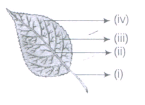
(a) Label the parts (i), (ii), (iii) and (iv) in the figure.
(b) What type of venation does the leaf has?
(c) What type of venation is seen in grass leaves?
9.
Sarita was interested in knowing more about plants and its parts. She started exploring and collecting plants. She wanted to preserve them, so that she can have a good collection of plants.
(a) Suggest the steps to help her in identifying plants.
(b) Is there any other method to identify plants Explain.
(c) What are the values shown by Sarita?
10.
One day, students were asked to perform an activity. They were told to identify the root system in some given plant samples by analysing the venation in leaves. Archana at the same time failed to do so. She got sad and asked her teacher to guide her after the test.
(a) How will you identify the root system by analysing the leaves?
(b) Distinguish two types of venation in leaves.
(c) What are the values shown by Archana?
1.
The solved puzzle as per the clues given is given below:
2.
Wrong statements :
(a) Anther is a part of the pistil.
Correct statement: Anther is a part of the stamen.
(b) The visibleparts of a bud are the petals.
Correct statement: The visible parts of a bud are the sepals.
(d) Leaves perform the function of transpiration only.
Correct statement: Leaves perform the functions of both photosynthesis and transpiration.
3.
Characteristics of plants are :
(i) They cannot move from one place to another.
(ii) They can prepare their own food.
(iii) These are the living organisms on the earth which are responsible for the formation of food for all the living forms directly or indirectly.
(iv) All other organisms on the earth depend on the plants and their products for their survival.
(v) Plants grow in the soil from where they take nutrients for their growth and propagation.
4.
A leaf is a thin expanded outgrowth arising from the node of a stem. The part of a leaf by which it is attached to the stem is called a petiole. The broad green part of the leaf is called lamina. The lines on the leaf are called veins. The thick vein in the middle of the leaf is called the midrib. The design made by the veins on the leaf is called venation. H the design is net-like, it is termed as reticulate venation whereas if the veins are parallel to each other, it is termed as parallel venation.
5.
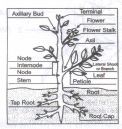
6.
(a) The process demonstrated in the activity is transpiration.
(b) The activity will show best results on a bright sunny day because transpiration is maximum in sunlight.
(c) After a few hours of setting up the activity, one can observe small droplets of water inside the polythene bag.
(d) A major precaution one must take while performing the activity is that the polythene bag should be cleaned and its mouth should be sealed properly. Also, the twig should be fresh with 10-12 leaves.
7.
Functions of parts of a plant are
8.
(a) In the given figure:
(i) Petiole (ii) Midrib (iii) Lamina (iv) Vein
(b) The leaf has reticulate venation, the veins in leaf occur in an irregular way forming a net-like structure.
(c) Grass leaves have parallel type of venation. The vein run parallel to each other on both sides of midrib.
9.
(a) Sarita can follow the following steps:
(i) Collect plant twig with flowers.
(ii) Press the8m in papers/magazines.
(iii) Change the paper/magazine every day for 5-6 days.
(iv) When plants are well pressed and dried place them on white plane paper sheet.
(v) Stick the plants to sheet with cello tape.
(vi) Try to identify the plant.
(vii) Take help of teachers/seniors for plant identification.
(b) Yes, plants can also be identified on the basis of the nature of their stem and size.
(c) Inquisitive, scientific attitude and love for nature.
10.
(a) The leaves with reticulate venation have tap roots. Whereas leaves with parallel venation have fibrous roots. We can identify the roots by keeping these points in mind.
(b) There are two types of venations seen in different plants.
(i) Reticulate venation In such type, the veins make a network of veins around the main midrib, e.g.sunflower, mustard, etc.
(ii) Parallel venation In such type, the veins run parallel along the main midrib, e.g. maize, wheat, etc.
(c) Archana is a responsible, student. She is attentive towards her studies and has scientific attitude.

6th Standard CBSE Syllabus & Materials
6th Standard CBSE
CBSE 6th Social Science Locating Places on the Earth - New Sample Question Papers Study Material - QB365 Set A
NEW6th Standard CBSE
CBSE 6th Science A Journey Through States of Water - New Sample Question Papers Study Material - QB365 Set A
NEW6th Standard CBSE
CBSE 6th Science Temperature and its Measurement - New Sample Question Papers Study Material - QB365 Set A
NEW6th Standard CBSE
CBSE 6th Science Materials Around Us - New Sample Question Papers Study Material - QB365 Set A



CBSE 6th Standard CBSE Subjects
CBSE Standards




