
 100% FREE ACCESS
6th Standard CBSE Syllabus & Materials
6th Standard CBSE
CBSE 6th Social Science The Value of Work - New Sample Question Papers Study Material - QB365 Set A
NEW6th Standard CBSE
CBSE 6th Social Science Family and Community - New Sample Question Papers Study Material - QB365 Set A
NEW6th Standard CBSE
CBSE 6th Social Science India's Cultural Roots - New Sample Question Papers Study Material - QB365 Set A
NEW6th Standard CBSE
CBSE 6th Social Science India,That is Bharat - New Sample Question Papers Study Material - QB365 Set A
NEW6th Standard CBSE
CBSE 6th Social Science Timeline and sources of history - New Sample Question Papers Study Material - QB365 Set A
NEW6th Standard CBSE
CBSE 6th Social Science Oceans and Continents - New Sample Question Papers Study Material - QB365 Set A

Published on: 11/12/2019
Separation of Substances
Download CBSE Class 6th Standard CBSE Science question papers, sample papers, important questions, and previous year solved papers in PDF format. Get free study materials, NCERT solutions, and exam preparation resources for Class 6th Standard CBSE Science
Questions + Answers key
Take MCQ Science Test
1.
Raghav is given a glass bottle with some white substances in it that is either chalk or sugar. How can be find out which of the two is sugar or chalk, without tasting it.
2.
What is decantation?
3.
What is a saturated solution?
4.
Write one purpose of separating substance from a mixture.
5.
When a hot saturated solution is heated, crystals will be formed. Is it correct? If no, correct the statement.
6.
How will you separate a mixture of saw dust and sugar?
7.
How is common salt obtained from sea water?
8.
Describe the process of sieving. Write one of its uses.
9.
What is sedimentation? Give an example.
10.
The best way to carry out the filtration of the mixture of water and sand is to use filter paper not cloth, why?
11.
A mixture of iron nails, salt, oil and water is provided to you. Give step wise method to separate each component from this mixture?
12.
You are provided with a mixture of salt, sand, oil and water. Write the steps involved for the separation of salt, sand and oil from the mixture by giving an activity along with the diagram
13.
Rohit and Raman are best friends. They study in different class but in the same standard, Class VI. One day, they were playing in the school. They were throwing sand on each other. Suddenly Raman asked to Rohit if we mix salt in sand, then how will you separate the mixture of sand and salt?
Rohit was quite intelligent, his science teacher had completed the chapter separation of substances last week. So, he immediately explained the method of separation. Rohit told him that his teacher had shown this activity in the class and same method is applicable for the separation of mixture of sugar and sand.
Read the passage carefully and answer the following questions:
(a) How a mixture of sand and salt is separated?
(b) Name the method(s) which are applicable in the separation of this mixture.
(c) What values are shown by Rohit?
14.
Paheli was feeling thirsty but there was only a pot of water at home which was muddy and unfit for drinking. How do you think Paheli would have made this water fit for drinking if the following materials were available to her?
Alum, tub, muslin cloth, gas stove, thread, pan and lid.
15.
The process of increasing the rate of sedimentation in a suspension by adding some chemical is
Filtration
Crystallisation
Loading
Condensation
16.
In a solution of salt and water, no more salt can be dissolved. If we want to add more salt, it needs to be
Shaked well
Filtered
Alum has to be added
Heated
17.
Clear liquid can be separated from sedimented materials by:
Decantation
Sedimentation
Evaporation
None of these
18.
Sedimentation is followed by which process?
Decantation
Evaporation
Filtration
None of these
19.
Iron filings from a tea mixture can be separated by :
Sieving
Magnet
Filtration
Burning
1.
This can be done by dissolving both of them in water. Sugar gets dissolved in water while or chalk is insoluble in water.
2.
Decantation is a method of separation used after sedimentation in which when insoluble particles settle down, the clear liquid is poured into another container
3.
A saturated solution of a substance is the one in which no more of that substance can be dissolved.
4.
To separate harmful or non-useful substances and to obtain the useful component.
5.
It is not correct as when a hot saturated solution is cooled, crystals will be formed.
6.
Following steps are used to separate a mixture of
saw dust and sugar :
(i) Add water to the mixture
(ii) Sugar present in the mixture dissolves in water but saw dust does not.
(iii) The solution is then filtered through filter paper.
(iv) We will get sugar solution as filtrate and saw dust will remain on the filter paper.
(v) Then the solution is heated and when water evaporates completely, sugar is left behind
7.
Sea water is allowed to stand in shallow pits. Due to solar heat, water in the pits get evaporated. After some days, the water evaporates completely and the solid salts remain in the pits. These salts are further purified to get pure common salt
8.
Sieving is a process used for separating solid components of mixtutres varying in size.
It allows the fine particles to pass through the holes of the .sieve while the bigger particles remain on the sieve. It is used to separate pebbles and stones from the sand
9.
When a mixture is allowed to stand for some time, the heavier components in the mixture settle at the bottom and the process is called sedimentation. For example, when mixture of sand and water is allowed to stand for some time, the particles of sand settle down at the bottom of vessel. The settling down of sand particles is called sedimentation.
10.
Since, clothes may have small holes but filter papers do not have any holes, in fact it has very fine pores in it, hence sand particles settle down on the filter paper while water after very neat pouring reached to vessel.
11.
The method to separate each component from the mixture is given below:
(i) Hand picking: It is used to separate iron nails from the mixture.
(ii) Decantation: The mixture is allowed to stand for some time. The clear liquid is poured to another container to separate oil from the mixture.
(iii) Evaporation: The remaining liquid is allowed to evaporate till residue is obtained. This residue is salt.
12.
A mixture of salt, sand, oil and water can be separated by following steps:
Step I : First of all, the clear liquid is poured into another container by the process of decantation. By this process, oil is separated from the mixture.
Step II : Now filter the mixture by using filter paper, funnel and container by the process of filtration. By this process, sand is separated from the mixture
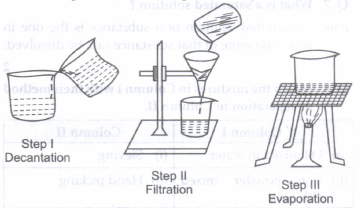
Step III : Finally, the remaining liquid evaporates till the residue in obtained by the process of evaporation. By this process, salt is separated from the mixture.
13.
(a) This is done as follows:
(i) Some water is added to the mixture of sand and salt in a beaker and stirred. Salt dissolves in water to form salt solution, whereas sand remains undissolved. It is then filtered.
(ii) On filtering, sand is obtained as a residue on the filter paper and salt solution is obtained as a filtrate. (iii) The filtrate is evaporated and pure salt is left behind.
(b) The mixture of sand and salt has been separated into its components, i.e sand and salt by doing two methods.
(i) Filtration
(ii) Evaporation
(c) Rohit is knowledgeable and intelligent boy.
14.
Paheli can make this water fit for drinking by work on following sequence:
Filtration using muslin cloth (cotton fabric).
\(\downarrow\)
Swirl with alum and leave water undisturbed for some time.
\(\downarrow\)
The clear liquid above the impurities is poured in another container(decantation).
\(\downarrow\)
Boil for 10 min in covered pan with lid.
\(\downarrow\)
Cool, filter and now, it is fit for drinking.
15.
(c)
Loading
16.
(d)
Heated
17.
18.
19.
(b)
Magnet

6th Standard CBSE Syllabus & Materials
6th Standard CBSE
CBSE 6th Social Science Locating Places on the Earth - New Sample Question Papers Study Material - QB365 Set A
NEW6th Standard CBSE
CBSE 6th Science A Journey Through States of Water - New Sample Question Papers Study Material - QB365 Set A
NEW6th Standard CBSE
CBSE 6th Science Temperature and its Measurement - New Sample Question Papers Study Material - QB365 Set A
NEW6th Standard CBSE
CBSE 6th Science Materials Around Us - New Sample Question Papers Study Material - QB365 Set A



CBSE 6th Standard CBSE Subjects
CBSE Standards




