
 100% FREE ACCESS
6th Standard CBSE Syllabus & Materials
6th Standard CBSE
CBSE 6th Social Science The Value of Work - New Sample Question Papers Study Material - QB365 Set A
NEW6th Standard CBSE
CBSE 6th Social Science Family and Community - New Sample Question Papers Study Material - QB365 Set A
NEW6th Standard CBSE
CBSE 6th Social Science India's Cultural Roots - New Sample Question Papers Study Material - QB365 Set A
NEW6th Standard CBSE
CBSE 6th Social Science India,That is Bharat - New Sample Question Papers Study Material - QB365 Set A
NEW6th Standard CBSE
CBSE 6th Social Science Timeline and sources of history - New Sample Question Papers Study Material - QB365 Set A
NEW6th Standard CBSE
CBSE 6th Social Science Oceans and Continents - New Sample Question Papers Study Material - QB365 Set A

Published on: 20/09/2019
Fibre to Fabric
Download CBSE Class 6th Standard CBSE Science question papers, sample papers, important questions, and previous year solved papers in PDF format. Get free study materials, NCERT solutions, and exam preparation resources for Class 6th Standard CBSE Science
Questions + Answers key
Take MCQ Science Test
1.
Which is the best season for the cultivation of jute? In which part of India is jute grown?
2.
How are synthetic fibres more advantageous and economical than natural fibres?
3.
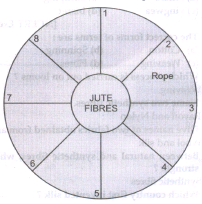
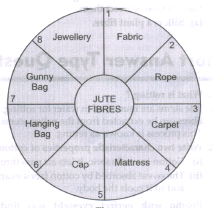
Fill in the names of useful items made from jute fibres in Fig. One such example is given.
4.
What are natural fibres ? Give two examples for each plant and animal fibres.
5.
What did people in ancient times use to cover their body?
6.
Describe the main features of fabric which is made up of coconut fibre.
7.
What happens when the yarns are burnt? Do they shrink away from the flame or melt? What type of odour is given off?
8.
We need clothes. Write some points to specify this statement.
9.
Explain the process of making yarn from fibre.
10.
Classify the following fibres as natural or synthetic:
1.
Rainy season is the best season for cultivation of jute. It is grown in Bihar, Assam and West Bengal.
2.
Synthetic fibres are more advantageous and economical than natural fibres due to following reasons:
(i) synthetic fibres are cheap
(ii) more resistant to water
(iii) high mechanical strength
(iv) easy to wash and handle
(v) dry up quickly.
3.
4.
Fibres obtained from plants and animals are called natural fibres.
Examples of plant fibres: cotton, jute and coconut.
Examples of animal fibres: silk and wool.
5.
In ancient times, people used bark and big leaves of tree or animal skins and fur to cover themselves. Later on, they began weaving twigs, grasses etc. They twisted vines, animal fleece or hairs together into long strands. They were woven into fabrics.
6.
The main features of fabric which is made up of coconut fibre
(i) The fibre in the coconut shell is also known as coir. It is the latest eco-friendly fabric.
(ii) Fabrics made from coconut fibre provide accelerated moisture management and protection from harmful UV (ultraviolet) rays.
(iii) Coconut fabrics are lightweighted, machine washable and naturally fit for comfort, quality and performance, e.g. doormats, brushes, mattresses, etc.
7.
lf these are cotton yarns, they burn but do not shrink or melt. The burning yarn gives an odour similar to burning paper.
The silk yarn shrinks away from the flame and burns but does not melt. It has an odour of charred meat. The wool yarn also shrinks and burns but does not melt. It has a strong odour of burning hair.
The synthetic yarn shrinks and burns. It also melts and gives out an odour similar to burning plastics.
8.
We need clothes because of the following reasons:
(i) They protect our body from heat and cold as well as rain.
(ii) They protect us from harmful bacteria and dirt, etc.
(iii) They make us presentable.
(iv) They help us to maintain body heat.
9.
The process of making yarn from fibres is called spinning. In this process, fibres from a mass of cotton wool are drawn out and twisted.This brings the fibres together to form a yarn.
A simple device used for spinning is a hand spindle also known as takli. Another hand operated device used for spinning is charkha.
10.
Nylon, wool, cotton, silk, polyester, jute
Natural fibres Wool, cotton, silk, jute.
Synthetic fibres Nylon, polyester.

6th Standard CBSE Syllabus & Materials
6th Standard CBSE
CBSE 6th Social Science Locating Places on the Earth - New Sample Question Papers Study Material - QB365 Set A
NEW6th Standard CBSE
CBSE 6th Science A Journey Through States of Water - New Sample Question Papers Study Material - QB365 Set A
NEW6th Standard CBSE
CBSE 6th Science Temperature and its Measurement - New Sample Question Papers Study Material - QB365 Set A
NEW6th Standard CBSE
CBSE 6th Science Materials Around Us - New Sample Question Papers Study Material - QB365 Set A



CBSE 6th Standard CBSE Subjects
CBSE Standards




