
 100% FREE ACCESS
6th Standard CBSE Syllabus & Materials
6th Standard CBSE
CBSE 6th Social Science The Value of Work - New Sample Question Papers Study Material - QB365 Set A
NEW6th Standard CBSE
CBSE 6th Social Science Family and Community - New Sample Question Papers Study Material - QB365 Set A
NEW6th Standard CBSE
CBSE 6th Social Science India's Cultural Roots - New Sample Question Papers Study Material - QB365 Set A
NEW6th Standard CBSE
CBSE 6th Social Science India,That is Bharat - New Sample Question Papers Study Material - QB365 Set A
NEW6th Standard CBSE
CBSE 6th Social Science Timeline and sources of history - New Sample Question Papers Study Material - QB365 Set A
NEW6th Standard CBSE
CBSE 6th Social Science Oceans and Continents - New Sample Question Papers Study Material - QB365 Set A

Published on: 01/10/2019
Globe: Latitudes and Longitudes
Download CBSE Class 6th Standard CBSE Social Science question papers, sample papers, important questions, and previous year solved papers in PDF format. Get free study materials, NCERT solutions, and exam preparation resources for Class 6th Standard CBSE Social Science
Questions + Answers key
Take MCQ Social Science Test
1.
The local time at the longitude 821/2° E is taken as the Standard Time for the whole country of India. It is known as Indian Standard Time (IST).
(i) What is the importance of IST?
(ii) What time zone is India in?
2.
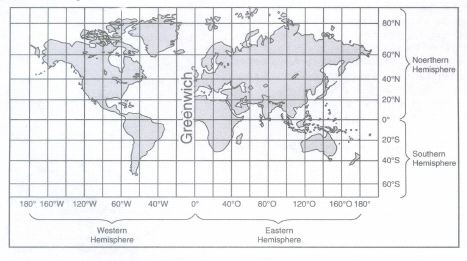
In the world map, mark the following:
(i) Southern Hemisphere
(ii) Eastern Hemisphere
(iii) Western Hemisphere
(iv) Greenwich
(v) Northern Hemisphere
3.
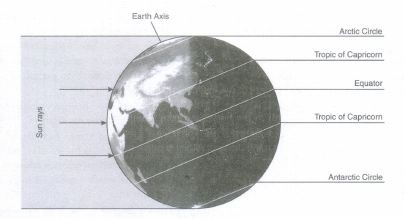
In the given diagram mark the important parallels of Latitudes.
(i) Equator
(ii) Tropic of Cancer
(iii) Tropic of Capricorn
(iv) Arctic Circle
(v) Antarctic Circle
4.
Distinguish between parallels of latitudes and meridians of longitudes.
5.
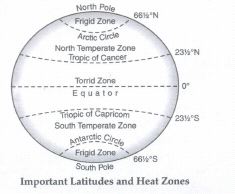
Draw a diagram of the Earth showing :
(i) Equator
(ii) Tropic of Cancer
(iii) Tropic of Capricorn
(iv) Frigid Zone
(v) North Temperature
(vi) South Temperate Zone
(vii) Arctic Circle
(viii) Antarctic Circle
(ix) Torrid Zone
6.
Why is it necessary to have standard time? Also define Indian Standard Time (IST).
7.
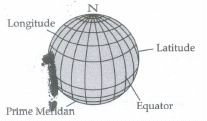
Draw the diagram of a grid.
8.
Which longitude is taken as the International Date Line and why?
9.
How can we calculate time using longitudes?
10.
Explain the important parallels of latitudes?
1.
(i) In India, 82°30' E is taken as a standard meridian because for every 1° longitude time difference is 4 minutes. India's total longitudinal extent is 30°(97° E - 67° E = 300E). So, total time difference is 30 x 4 = 120 minutes or 2 hours, which means the time difference between Gujarat and Arunachal Pradesh would be 2 hrs. To avoid such confusion and to have same time all over the country, we have taken a standard meridian.
(ii) Indian Standard Time (IST) is 5:30 hours (5 hours 30 minutes) ahead of Greenwich Mean Time.
2.
3.
4.
The difference between parallels of latitudes and meridians of longitudes are given below:
| S.No | Parallel of Latitudes | Meridians of Longitudes |
|---|---|---|
|
(i) |
All parallel circles from the Equator up to the poles are called parallels of latitude. | All semi-circles running from North Pole to South Pole are called meridians of longitude |
| (ii) | In total, there are 180° latitudes that is 90° North and 90° South | In total, there are 360° longitudes, that is, 180° East |
| (iii) | 0° latitude is known as the Equator. | 0° longitude is known as the Prime Meridian |
| (iv) | They help to judge the climate of the places | They help to find out the time of places |
5.
6.
It is necessary to have a standard time because:
(i) Different meridians have different time, which makes it difficult to prepare a time table for trains and flights.
(ii) It helps to maintain uniformity of time throughout the country.
Indian Standard Time: In India, the longitude of 82° 30'E is treated as the standard meridian and the local time at this meridian is taken as the standard time for the whole country. It is known as Indian Standard Time (IST).
7.
8.
The International Date Line (IDL) is an imaginary line on the surface of the Earth opposite the Prime Meridian, where the date changes as one travel across the East or West. Roughly along 180° longitude, it almost corresponds to the time zone boundary separating -12 and +12 hours, Greenwich Mean Time (GMT). Crossing the IDL, travelling east results in a day or 24 hours being added and crossing west results in a day being subtracted. The exact number of hours depends on the time zones.
9.
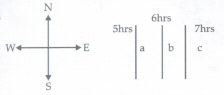
In the figure, three places namely a, b and c are marked. Let us assume that the time difference between' a' 'b' and 'c' is 1 hour each. If the time at a place 'b' is 6 in the morning then the time at 'a' would be 5 in the morning and time at 'c' would be 7 in the morning. The time at place' a' is 1 hour less because it is to the West of 'b' and time at 'c' is 1 hour more because it is to the East of 'b'. This is due to the fact that the Earth rotates from West to East. As the sun rises in the East so place 'c' has 7 am, place 'b' has 6 am and place' a' has 5 am. This shows that time increases as we go towards east and it decreases as we go towards west.
10.
Besides the equator (0°), the North Pole (900N) and the South Pole (90° S) are four important parallels of latitude.
(i) Tropic of Cancer: It is at an angular distance of \(23{1\over 2}°\) from the Equator. It is important because 2 on 21st June, the Sun is directly over it.
(ii) Tropic of Capricorn: It is at an angular distance of 23°,30 S from the Equator. On 22nd December, the sun is over this latitude.
(iii) Arctic Circle: It is at a distance of 66W N of the Equator. On 21st June, there is 24 hours daylight on the parallel.
(iv) Antarctic Circle: It is at a distance of 661/2° S of the equator. On 22nd December, there is 24 hours day-light on this parallel.

6th Standard CBSE Syllabus & Materials
6th Standard CBSE
CBSE 6th Social Science Locating Places on the Earth - New Sample Question Papers Study Material - QB365 Set A
NEW6th Standard CBSE
CBSE 6th Science A Journey Through States of Water - New Sample Question Papers Study Material - QB365 Set A
NEW6th Standard CBSE
CBSE 6th Science Temperature and its Measurement - New Sample Question Papers Study Material - QB365 Set A
NEW6th Standard CBSE
CBSE 6th Science Materials Around Us - New Sample Question Papers Study Material - QB365 Set A



CBSE 6th Standard CBSE Subjects
CBSE Standards




