
 100% FREE ACCESS
6th Standard CBSE Syllabus & Materials
6th Standard CBSE
CBSE 6th Social Science The Value of Work - New Sample Question Papers Study Material - QB365 Set A
NEW6th Standard CBSE
CBSE 6th Social Science Family and Community - New Sample Question Papers Study Material - QB365 Set A
NEW6th Standard CBSE
CBSE 6th Social Science India's Cultural Roots - New Sample Question Papers Study Material - QB365 Set A
NEW6th Standard CBSE
CBSE 6th Social Science India,That is Bharat - New Sample Question Papers Study Material - QB365 Set A
NEW6th Standard CBSE
CBSE 6th Social Science Timeline and sources of history - New Sample Question Papers Study Material - QB365 Set A
NEW6th Standard CBSE
CBSE 6th Social Science Oceans and Continents - New Sample Question Papers Study Material - QB365 Set A

Published on: 10/09/2019
Major Domains of the Earth
Download CBSE Class 6th Standard CBSE Social Science question papers, sample papers, important questions, and previous year solved papers in PDF format. Get free study materials, NCERT solutions, and exam preparation resources for Class 6th Standard CBSE Social Science
Questions + Answers key
Take MCQ Social Science Test
1.
Sea level is taken as zero and why it is used to measure height? Explain with reason.
2.
What is making water bodies unsuitable for use?
3.
Why there is no permanent settlement in Antarctica?
4.
Why is the biosphere important for living organisms?
5.
Why is the earth called the 'blue planet'?
6.
Where is 97 per cent of the earth's water found?
In seas
Under ground
In lakes
In oceans
7.
Which of the following is the smallest continent?
Australia
Europe
Antarctica
Africa
8.
Which is the domain of the earth consisting of gaseous portion?
Biosphere
Lithosphere
Atmosphere
Hydrosphere
9.
Which of the following continents lies completely in the Northern hemisphere?
Australia
Europe
South America
Africa
10.
The continent of North America is linked to South America by
an isthmus
a strait
a canal
11.
Mount ___________ is the world's highest mountain peak.
12.
The ___________ is the world's longest mountain range.
13.
The continent Asia lies in the ___________ and ____________ hemisphere.
14.
The first Indian woman to climb the highest peak was __________ on __________.
15.
The _____________ is a narrow contact zone of land, water and air that support life.
16.
What change was brought about by recent Tsunami?
17.
What is the boundary of Arctic ocean?
18.
What is the role of oxygen in atmosphere?
19.
Which are the three oceans that surround North America?
20.
Which continents are bound by oceans and seas by all sides?
21.
The smaller part of the landmass lies in the Northern hemisphere.
22.
The depth of the sea is more than the highest point on Earth.
23.
The sea level remains the same everywhere.
24.
All the oceans are connected with one another.
25.
All the land masses are connected with one another.
26.
Count the squares given in the picture and answer the following:
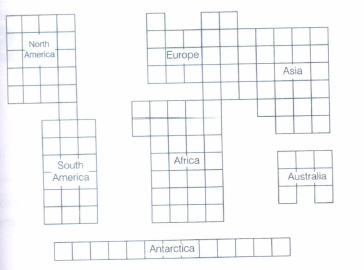
(i) Name the largest continent.
(ii) Which is larger- Europe or Australia?
27.
On the outline map of the world, mark the following?
Europe, Asia, Antarctica, South America, Australia, Indian Ocean, Pacific ocean, Atlantic ocean and Ural mountains.
1.
The level of sea water remains the same everywhere in the world. The elevation of the land is measured from the level of sea, which remains always same and taken as zero.
2.
The pollutants present in water bodies are making it unsuitable for use. The discharge of waste material into lakes and rivers is making the water impure to use and it is also damaging other life.
3.
Antarctica is located in the South Pole region, which is permanently covered with thick ice sheets. The extreme cold condition makes the region without any settlement.
4.
The biosphere is important for living organisms because it contains all the elements required for life, like- air, water and land, which are essential for life.
5.
The earth is called 'blue planet' because of excess of watery surface on it which is around 71 per cent of earth's surface.
6.
(d)
In oceans
7.
(a)
Australia
8.
(c)
Atmosphere
9.
(b)
Europe
10.
(a)
an isthmus
11.
()
12.
()
Andes
13.
()
Northern, Eastern
14.
()
Bachendri Pal, 23rd May,1984
15.
()
biosphere
16.
()
Some parts of Andaman and Nicobar islands were submerged in water due to recent Tsunami.
17.
()
The boundary of Arctic ocean is with Northern coasts of North America and Eurasia.
18.
()
Oxygen is important for existence of life because human beings and animals breathe oxygen for respiration.
19.
()
The three oceans that surround North America are Arctic ocean, Atlantic ocean and Pacific ocean.
20.
()
Africa and Australia are bound by oceans and seas on all sides.
21.
(b)
22.
(a)
23.
(a)
24.
(a)
25.
(b)
26.
(i) Asia with 44 squares is the largest continent.
(ii) Europe (10 squares) is larger than Australia (8 squares).
27.
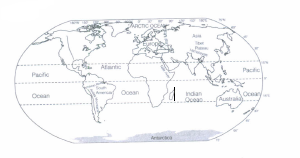
(A) Europe
(B) Asia
(C) Antarctica
(D) Sourh America
(E) Australia
(F) Indian ocean
(G) Pacific ocean
(H) Atlantic ocean
(I) Ural mountains

6th Standard CBSE Syllabus & Materials
6th Standard CBSE
CBSE 6th Social Science Locating Places on the Earth - New Sample Question Papers Study Material - QB365 Set A
NEW6th Standard CBSE
CBSE 6th Science A Journey Through States of Water - New Sample Question Papers Study Material - QB365 Set A
NEW6th Standard CBSE
CBSE 6th Science Temperature and its Measurement - New Sample Question Papers Study Material - QB365 Set A
NEW6th Standard CBSE
CBSE 6th Science Materials Around Us - New Sample Question Papers Study Material - QB365 Set A



CBSE 6th Standard CBSE Subjects
CBSE Standards




