
 100% FREE ACCESS
6th Standard CBSE Syllabus & Materials
6th Standard CBSE
CBSE 6th Social Science The Value of Work - New Sample Question Papers Study Material - QB365 Set A
NEW6th Standard CBSE
CBSE 6th Social Science Family and Community - New Sample Question Papers Study Material - QB365 Set A
NEW6th Standard CBSE
CBSE 6th Social Science India's Cultural Roots - New Sample Question Papers Study Material - QB365 Set A
NEW6th Standard CBSE
CBSE 6th Social Science India,That is Bharat - New Sample Question Papers Study Material - QB365 Set A
NEW6th Standard CBSE
CBSE 6th Social Science Timeline and sources of history - New Sample Question Papers Study Material - QB365 Set A
NEW6th Standard CBSE
CBSE 6th Social Science Oceans and Continents - New Sample Question Papers Study Material - QB365 Set A

Published on: 10/09/2019
Major Landforms of the Earth
Download CBSE Class 6th Standard CBSE Social Science question papers, sample papers, important questions, and previous year solved papers in PDF format. Get free study materials, NCERT solutions, and exam preparation resources for Class 6th Standard CBSE Social Science
Questions + Answers key
Take MCQ Social Science Test
1.
What are the causes of destruction of natural resources?
2.
How are plateaus useful for us?
3.
Define erosion and deposition.
4.
In what manner we can protect natural resources?
5.
Why are mountains thinly populated?
6.
Which one of the following is not popular sport in mountains?
Paragliding
River Rafting
Sailing
Skiing
7.
The mountains differ from plateaus in
Base
Texture
Extension
Elevation
8.
The permanently frozen rivers of ice in mountains are known as
Horsts
Ice sheets
Frost rivers
Glaciers
9.
Mt. Fujiyama is in
Asia
Africa
Europe
Australia
10.
The mountains differ from the hills in terms of
elevation
slope
aspect
11.
The Aravali range is the example of one of the oldest ___________ mountains.
12.
A steep hill with an elevation of more than __________ metres is termed as mountain.
13.
______________ are the storehouse of water.
14.
__________is an important mountain range of Europe.
15.
The ____________ areas are most productive for farming.
16.
African plateau is famous for what?
17.
Name some places in the Himalayas associated with mountain sports.
18.
What are the forces that change the surface of landform?
19.
What is hill?
20.
Give an example of Block mountains?
21.
Write about features of following.
(a) Plateau
(b) Mountain
22.
Many rivers have their source in the glaciers in the plateau.
23.
Mountain system consists of a series of parallel ranges extending over hundreds of kilometres.
24.
The earth hasn't an infinite variety of landforms.
25.
Mountains have a rich variety of flora and fauna.
26.
There are some mountains lying undersea.
27.
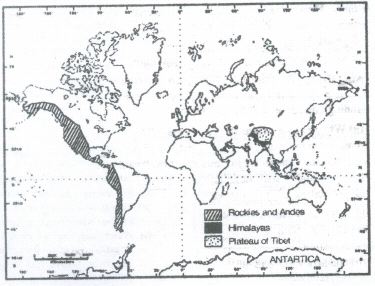
On an outline map of the world, mark the following:
(i) Mountain ranges: Himalayas, Rockies and Andes.
(ii) Plateau Tibet
1.
The use of natural/resources in wasteful manner and pollution done by us are the major causes for the destruction of natural resources. The overuse or exploitation of such resources also cause destruction.
2.
Plateaus are very useful because they are rich in mineral deposits. The soil found in such areas is fertile and good for cultivation. Many plateaus have scenic spots and are of great attraction to tourists.
3.
Erosion The wearing away of the earth's surface is called erosion. The surface is being lowered by the process of erosion.
Deposition The rebuilding of the earth's surface is called deposition. These two processes are carried out by running water, ice and wind.
4.
By creating awareness about the impact of natural resources, we can protect them. The smart and balance use of natural resources can make them available for future generations as well. We must avoid the overuse of these resources by using them in appropriate manner.
5.
The life on mountains is tough due to harsh climate, scarcity of cultivable land and unsuitable conditions for human settlement.
6.
(c)
Sailing
7.
(d)
Elevation
8.
(d)
Glaciers
9.
(a)
Asia
10.
(a)
elevation
11.
()
Fold
12.
()
600
13.
()
Mountains
14.
()
Alps
15.
()
plain
16.
()
African plateau is famous for gold and diamond mining.
17.
()
Mussoorie, Dharmasala, Kullu and Manali are the places associated with such sports.
18.
()
The forces that change the surface of landform are internal processes and external processes.
19.
()
Hill is a land surface higher than surrounding area.
20.
()
Vosges mountain
21.
(a) Plateau A plateau may have one or more sides with steep slopes. It is a flat-topped table land standing above the surrounding area. Plateaus may be young or old. The height of plateaus varies from few hundred metres to several thousand metres.
(b) Mountain A mountain is a natural elevation of the earth's surface more than 600 metres. Mountains are of three types. They are- Fold mountains, Block mountains and the Volcanic mountains.
22.
(b)
23.
(a)
24.
(b)
25.
(a)
26.
(a)
27.

6th Standard CBSE Syllabus & Materials
6th Standard CBSE
CBSE 6th Social Science Locating Places on the Earth - New Sample Question Papers Study Material - QB365 Set A
NEW6th Standard CBSE
CBSE 6th Science A Journey Through States of Water - New Sample Question Papers Study Material - QB365 Set A
NEW6th Standard CBSE
CBSE 6th Science Temperature and its Measurement - New Sample Question Papers Study Material - QB365 Set A
NEW6th Standard CBSE
CBSE 6th Science Materials Around Us - New Sample Question Papers Study Material - QB365 Set A



CBSE 6th Standard CBSE Subjects
CBSE Standards




