
 100% FREE ACCESS
6th Standard CBSE Syllabus & Materials
6th Standard CBSE
CBSE 6th Social Science The Value of Work - New Sample Question Papers Study Material - QB365 Set A
NEW6th Standard CBSE
CBSE 6th Social Science Family and Community - New Sample Question Papers Study Material - QB365 Set A
NEW6th Standard CBSE
CBSE 6th Social Science India's Cultural Roots - New Sample Question Papers Study Material - QB365 Set A
NEW6th Standard CBSE
CBSE 6th Social Science India,That is Bharat - New Sample Question Papers Study Material - QB365 Set A
NEW6th Standard CBSE
CBSE 6th Social Science Timeline and sources of history - New Sample Question Papers Study Material - QB365 Set A
NEW6th Standard CBSE
CBSE 6th Social Science Oceans and Continents - New Sample Question Papers Study Material - QB365 Set A

Published on: 01/10/2019
The Earth in the Solar System
Download CBSE Class 6th Standard CBSE Social Science question papers, sample papers, important questions, and previous year solved papers in PDF format. Get free study materials, NCERT solutions, and exam preparation resources for Class 6th Standard CBSE Social Science
Questions + Answers key
Take MCQ Social Science Test
1.
Why is life on Mars not possible?
2.
What was the method used in ancient times by the people to determine direction?
3.
Write a note on the Sun.
4.
Why is Pluto not considered as a planet?
5.
Why is life found on the Earth?
6.
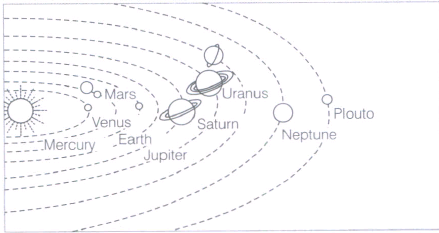
(i) How many satellites does Mars have?
(ii) How many planets are there in above picture?
7.
Write a note on galaxy and universe?
8.
Why is the life existing on the Earth only?
9.
How can we say that asteroids and meteoroids are different from each other? How meteoroids are connected with the Earth?
10.
How is planet different from satellites in origin and characteristics?
1.
(i) As compared to the Earth, Mars has an incredibly harsh environment.
(ii) Its exploration verified that the planet an inhospitable, frigidly cold and an environment. Its surface is littered with craters and grant volcanoes and has planet-wide dust storms.
(iii)The atmospheric pressure is very low and contains virtually no oxygen as well as no protection from the incoming ultraviolet solar radiation.
(iv) The planet experiences extreme fluctuations in temperature from day to night.
2.
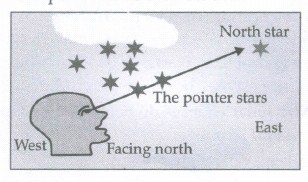
(i) In ancient times, people used to determine direction during the night with the help of stars.
(ii) The North Star indicates the North direction. It is also called the Pole Star.
(iii) It always remains in the same position in the sky.
(iv) We can locate the position of the Pole Star with the help of the Saptarishi.
(v) If we look at the figure given below, we will notice that if an imaginary line is drawn joining the pointer stars and it is extended further, it will point words the Pole Star.
3.
(i) The Sun is a star.
(ii) The Sun is at the centre of the Solar System.
(iii) It is huge and made up of extremely hot gases.
(iv) The Sun is the ultimate source of heat and light for the Solar System.
(v) The distance between the Sun and the Earth is approximately 150 million km.
(vi) Without the Sun, the Earth would be extremely cold and no life would exist.
4.
The Sun is the head of the solar family with nine planets revolving around it. But now, Pluto is no longer considered as a planet because of the following reasons :
(i) A planet is a celestial body that revolves the Sun.
(ii) A planet must not be a satellite.
(iii) It must be big enough to dominate its orbit. Pluto does not adhere to the last part of the definition so, it is called a 'dwarf planet'.
5.
Life is found on the Earth because of the following reasons:
(i) Moderate Temperature: Earth has an average temperature of 22°C, which is suitable for the growth of plants and animals.
(ii) Water: The Earth is the only unique planet where water is found in three forms: ice, gas, and liquid.
(iii) Favourable surrounding/atmosphere: The Earth's atmosphere has a layer called ozone, which protect plants and animals from certain harmful rays of the Sun.
6.
(i) Mars has two satellites.
(ii) There are eight planets in above picture.
7.
Galaxy A galaxy is a huge system of billions of stars and clouds of dust and gases. There are millions of galaxies in the universe. These galaxies altogether make the universe.
Akash Ganga or Milky Way is the example of galaxy. It appears as a river of light flowing in the sky, .
Universe Universe is the combination of millions of galaxies. The size of universe is very difficult to imagine and scientists still are working on it to know more about the universe.
8.
Earth is the only planet on which life exists. The favourable conditions present on the Earth made the life possible here while on other planets these conditions are not present which makes life impossible there.
The conditions which are found on the Earth are as follows:
(i) Presence of air and water, which are essential for survival of life.
(ii) Presence of oxygen on the Earth supports life system.
(iii) Presence of moderate temperature on the Earth neither extremely hot nor extremely cold.
9.
Apart from the planets, asteroids are the tiny celestial bodies which also move around the sun. These bodies are found in large number between the orbits of Mars and Jupiter, These are believed to be the part of a planet that exploded many years ago.
Meteoroids are the small pieces of rocks that move around the sun, These meteoroids sometimes come close to the Earth and tend to drop upon Earth.
During their drop on the Earth, they get heated up and burnt due to friction with air and cause flash of light. Sometimes, it creates a hollow on the Earth if it is not burnt completely.
10.
Satellite is a celestial body that moves around the planet in the same way as the planets move around the sun, A satellite may be artificial or natural.
Some of the planets have different number of satellites, Saturn has maximum number of satellites Artificial satellites are sent in the orbit of the Earth through rocket.
Planets move around the sun in fixed path (orbit). These paths are elongated, The various planets take different time to complete a round of sun depending upon the distance of particular planet from the sun.

6th Standard CBSE Syllabus & Materials
6th Standard CBSE
CBSE 6th Social Science Locating Places on the Earth - New Sample Question Papers Study Material - QB365 Set A
NEW6th Standard CBSE
CBSE 6th Science A Journey Through States of Water - New Sample Question Papers Study Material - QB365 Set A
NEW6th Standard CBSE
CBSE 6th Science Temperature and its Measurement - New Sample Question Papers Study Material - QB365 Set A
NEW6th Standard CBSE
CBSE 6th Science Materials Around Us - New Sample Question Papers Study Material - QB365 Set A



CBSE 6th Standard CBSE Subjects
CBSE Standards




