
 100% FREE ACCESS
6th Standard CBSE Syllabus & Materials
6th Standard CBSE
CBSE 6th Social Science The Value of Work - New Sample Question Papers Study Material - QB365 Set A
NEW6th Standard CBSE
CBSE 6th Social Science Family and Community - New Sample Question Papers Study Material - QB365 Set A
NEW6th Standard CBSE
CBSE 6th Social Science India's Cultural Roots - New Sample Question Papers Study Material - QB365 Set A
NEW6th Standard CBSE
CBSE 6th Social Science India,That is Bharat - New Sample Question Papers Study Material - QB365 Set A
NEW6th Standard CBSE
CBSE 6th Social Science Timeline and sources of history - New Sample Question Papers Study Material - QB365 Set A
NEW6th Standard CBSE
CBSE 6th Social Science Oceans and Continents - New Sample Question Papers Study Material - QB365 Set A

Published on: 15/02/2019
Revision Test on History
Download CBSE Class 6th Standard CBSE Social Science question papers, sample papers, important questions, and previous year solved papers in PDF format. Get free study materials, NCERT solutions, and exam preparation resources for Class 6th Standard CBSE Social Science
Questions + Answers key
Take MCQ Social Science Test
1.
Cotton was probably grown in Mehrgarh around:
2000 years ago
4000 years ago
7000 years ago
12000 years ago
2.
Which language was earlier used by common people?
Gujarati
Rajasthani
Prakrit
Tamil
3.
Who was Aryabhata?
A politician
An astronomer
A teacher
A writer
4.
Who was the companion of raja in the battlefield?
Men
Charioteer
Raja
Brahmin
5.
Zero is a special symbol which was invented by
India
Arabs
Japan
Europe
6.
Who was the chief judicial officer in the reign of Samudragupta?
Harishena
Ravikirti
FaXian himself
Samudragupta
7.
The Southern half of the sub-continent is marked by
hills
plateaus
river valleys
All of these
8.
What were used for entering the burial places?
Surface-holes
Burial-holes
Port-holes
Stone-holes
9.
Which of the following religions is related to Jataka?
Jaina
Buddhism
Hindu
Christian
10.
Ashoka was inspired by the teachings of
Bindusara
Bimbisara
Buddha
Chandragupta
11.
Which of the following was the earliest domesticated animals?
Cow and ox
Sheep and goat
Horse and buffalo
Buffalo and cow
12.
Who prepared a grammar for Sanskrit?
Buddha
Mahavira
Kisagotami
Panini
13.
Stone tools found during Mesolithic period are called
microliths
spears
arrows
None of these
14.
Some of the tools had been attached to a handle made of
stone
cloths
bones
plastic
15.
'About 4700 years ago'-also can be written as
4700 BC
2687 BC
2687 AD
4700 AD
16.
Write short note on Tribes.
17.
Make a list of all those who would be present at the sacrifice. Which are the categories that are described in terms of their occupation?
18.
The Clever Poor Man
Once upon a time, there was a clever poor young man who lived in a city. His only resource was a dead rat. He started off by selling it for a coin to a hotel, for their cat.
Then one day, there was a storm. The king's garden was littered with branches and leaves, and the gardener was at a loss as to how to clear the mess. The young man offered to clean the garden if he could keep the wood and leaves. The gardener agreed at once.
The young man rounded up all the children who were playing, with an offer of sweets for every stick and leaf that they could collect. In no time, every scrap had been neatly piled near the entrance. Just then, the king's potter was on the lookout for fuel with which to bake his pots. So, he took the whole lot and paid the young man for it. Our young man now thought of another plan. He carried a jar full of water to the city gate, and offered water to 500 grass cutters. They were pleased and said, "You have done us a good turn. Tell us, what can we do for you?"
He replied, "I'll let you know when I need your help."
He then made friends with a trader. One day, the trader told him, "Tomorrow, a horse dealer is coming to town with 500 horses." Hearing this, our young man went back to the grass cutters.
He said, "Please give me a bundle of grass each and don't sell your grass till mine is sold." They agreed and gave him 500 bundles of grass.
When the horse dealer could not buy grass anywhere else, he purchased the young man's grass for a thousand coins....
(a) List the occupations of the persons mentioned in the story. For each one, try and decide whether they would have lived
(i) only in the city
(ii) only in villages
(iii) in both cities and villages.
(b) Why do you think the horse dealer was coming to the city?
(c) Do you think women could have taken up occupations mentioned in the story? Give reasons for your answer.
19.
What was Magadhi?
20.
How do the archaeologists use source to reconstruct the past?
21.
Read the following passage and answer the questions given below:
Here is how the poet describes Kannagi's grief: "O witness of my grief, you cannot console me. Is it right that your body, fairer than pure gold, lies unwashed here in the dust? Is it just that in the red glow of the twilight, your handsome chest, framed with a flower wreath, lies thrown down on the bare earth, while I remain alone, helpless and abandoned to despair? Is there no God in this country? Can there be a God in a land where the sword of the king is used for the murder of innocent strangers? Is there no God, no God?"
(i) This passage is extracted from which epic?
(ii) This epic was written in which language?
(iii)Who composed this epic?
(iv) Why was Kannagi full of grief?
22.
Discuss the megalithic site of Inamgaon
23.
Why do historians and archaeologists use various sources to study about our past?
24.
Do you grow the cereals you have listed.If yes, draw a chart to show the stages in growing them. If not, draw a chart to show how these cereals reach you from the farmers who grow them?
25.
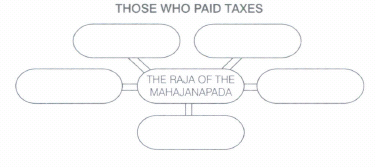
Fill in the chart given below with the terms: hunter-gatherers, farmers, traders, crafts persons, herders.
26.
Answer the questions based on the picture given below:
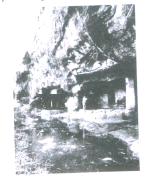

(i) The cave above in the picture are located in which state?
(ii) What was the purpose of these caves?
27.
Despite of facing difficulties, people travelled from one part of the sub-continent to another. Explain with reasons.
28.
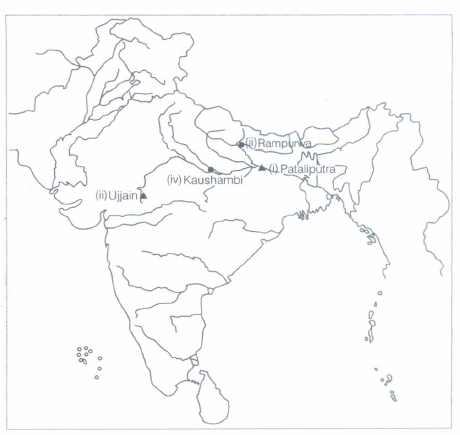
Mark the following places on the outline map of India:
(i) Pataliputra
(ii) Ujjain
(iii) Rampurwa
(iv) Kaushambi
1.
(c)
7000 years ago
2.
(c)
Prakrit
3.
(b)
An astronomer
4.
(b)
Charioteer
5.
(a)
India
6.
(a)
Harishena
7.
(d)
All of these
8.
(c)
Port-holes
9.
(b)
Buddhism
10.
(c)
Buddha
11.
(b)
Sheep and goat
12.
(d)
Panini
13.
(a)
microliths
14.
(c)
bones
15.
(a)
4700 BC
16.
Usually two to three generations live together in small settlements or villages. Most families are related to one another and groups of such families form a tribe. Members of a tribe follow occupations such as hunting, gathering, farming, herding and fishing.
17.
The people who would be present at the sacrifice are:
(i) The king, his wives, sons and relatives
(ii) The charioteer of the king
(iii) The priests
(iv) The ordinary people, the vish or vaishya
(v) The other rajas
The categories of people who are described in terms of their occupation are:
(i) The king. who protected the people and looked after their welfare.
(ii) The charioteer, who was his companion in his exploits.
(iii) The priest, who performed the religious ceremony.
18.
(a)The occupations mentioned in the story are:
(i) Hotel owner: lived in the city.
(ii) Trader: city
(iii) Gardener: b~h in the village and city
(iv) Potter: lived in the village
(v) Grasscutter: village
(vi) Horse merchant (trader): both in the village and city.
(b) The horse dealer was coming to the city to sell his horses because he hag 500 horses and wanted to sell them to make profit.
(c) Women could have taken up some occupations:
(i) Hotel owner It is time consuming, needing long hours of work. It cannot be taken up by women.
(ii) Traders Usually, they work in the cities or go from one city to other Sometimes, the traders have to stay overnight or for many days. Thus, women cannot do this job.
(iii) Gardener Women can do this job easily.
(iv) Grass cutter Women can do this job easily.
(v) Potter Women can do this job but it needs more skill.
19.
The Prakrit spoken in Magadha was known as Magadhi. Ordinary people could understand the teachings of Mahavira and his followers, because they used Prakrit. There were several forms of Prakrit, used in different parts of the country and named after the regions in which they were used.
20.
The historians and the archaeologists derive the informations from the inscriptions, manuscripts, coins etc as the sources. Once the sources are found, learning about the past becomes an adventure as the archaeologists reconstruct it bit by bit.So, we can say that the sources are like clues to find out about our past.
21.
(i) This passage is extracted from the famous epic Silappadikaram.
(ii) This epic was written in Tamil.
(iii) This epic was composed by a poet Ilango.
(iv) Kannagi was full of grief because the king sentenced her husband to death.
22.
Inamgaon is a site on the river God, a tributary of the river Bhima. It was occupied between 3600 and 2700 years ago.
(i) Here, adults were generally buried in the ground, laid out straight, with the head towards the north
(ii) Sometimes burials were within the houses.
(iii) Vessels that probably contained food and water were placed with the dead bodies.
(iv) One man was found buried in a large, fourlegged clay jar in the courtyard of a five-roomed house (one of the largest houses at the site) in the centre of the settlement.
(v) This house also had a granary. The body was placed in a cross-legged position.
23.
(i) Archaeologists and historians are scholars who study things that are made and used in the past through the process of excavation.
(ii) Manuscripts, inscriptions, tools, coins and monuments are the sources of information used by then to know about the past of the people.
(iii) Once these sources are found, learning about the past becomes an adventure and gradually, history is reconstructed. That is why, historians and archaeologists use various sources to study about our past.
24.
The farmers grow the cereals. The various steps involved are:
(i) Ploughing the fields and putting manure.
(ii) Sowing the seeds and looking after the tender plants and saving them from pests.
(iii)Watering the fields.
(iv) Harvesting the crop and storing them in the sheds. The chart given below show how the cereals reach the people from the farmers:
| Step 1 | Step 2 | Step 3 |
| The crops are purchased by the middlemen from the farmers. They bring them to the cities. |
They sell them to the wholesale traders or retailers. |
We buy it from the shops, either from the wholesale traders or from the retailers. |
25.
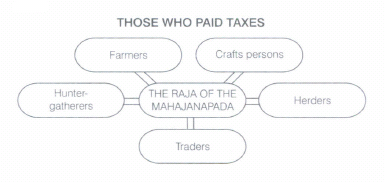
26.
(i)Karle, present-day Maharashtra
(ii)Monks and nuns lived and meditated in these caves or shelters.
27.
People travelled from one part of the sub-continent to another due to the following reasons:
(i) People travelled from one place to another in search of livelihood, to escape from natural disasters like floods or droughts.
(ii) Some people also travelled with the spirit of adventure, to find out the interesting facts and to discover new places.
(iii) Caravans or ships were the means of communication and transportation of food material for the merchants.
(iv) Religious teachers moved from one place to another to deliver their religious teachings to the people.
(v) Travelling emerged as a strong aspect of sharing ideas between the diversities.
28.

6th Standard CBSE Syllabus & Materials
6th Standard CBSE
CBSE 6th Social Science Locating Places on the Earth - New Sample Question Papers Study Material - QB365 Set A
NEW6th Standard CBSE
CBSE 6th Science A Journey Through States of Water - New Sample Question Papers Study Material - QB365 Set A
NEW6th Standard CBSE
CBSE 6th Science Temperature and its Measurement - New Sample Question Papers Study Material - QB365 Set A
NEW6th Standard CBSE
CBSE 6th Science Materials Around Us - New Sample Question Papers Study Material - QB365 Set A



CBSE 6th Standard CBSE Subjects
CBSE Standards




