
 100% FREE ACCESS
8th Standard CBSE Syllabus & Materials
8th Standard CBSE
CBSE 8th Social Science Theme D - Factors of Production - New Model Questions Papers Study Material - QB365 Set A
NEW8th Standard CBSE
CBSE 8th Social Science Theme C - Universal Franchise and India's Electoral System - New Model Questions Papers Study Material - QB365 Set A
NEW8th Standard CBSE
CBSE 8th Social Science Theme B - The Rise of the Marathas - New Model Questions Papers Study Material - QB365 Set A
NEW8th Standard CBSE
CBSE 8th Social Science Theme B - Reshaping India's Political Map - New Model Questions Papers Study Material - QB365 Set A
NEW8th Standard CBSE
CBSE 8th Social Science Theme A - Natural Resources and Their Use - New Model Questions Papers Study Material - QB365 Set A
NEW8th Standard CBSE
CBSE 8th Science Keeping Time with Skies - New Model Questions Papers Study Material - QB365 Set A

Published on: 10/10/2019
Direct and Inverse Proportions
Download CBSE Class 8th Standard CBSE Mathematics question papers, sample papers, important questions, and previous year solved papers in PDF format. Get free study materials, NCERT solutions, and exam preparation resources for Class 8th Standard CBSE Mathematics
Questions + Answers key
Take MCQ Mathematics Test
1.
Jagmeet has a road map with a scale of 1 cm = 20 km. He drives on a road for 72 km. What would be his distance covered in the map?
2.
A machine fills 540 bottles in six hours. How many bottles will it fill in five hours?
3.
A mixture of paint is prepared by mixing 1 part of green pigments with 6 parts of the base. In the following table, find the parts of base needed to be added.
| Parts of green pigment | 1 | 4 | 5 | 6 |
| Parts of base | 6 | x1 | x2 | x3 |
4.
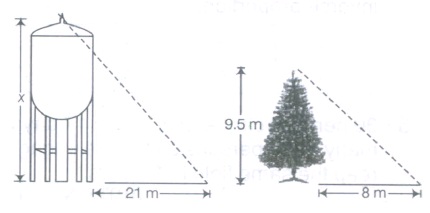
A water tank casts a shadow 21 m long. A tree of height 9.5 m casts a shadow 8 m long at the same time. The lengths of the shadows are directly proportional to their heights. Find the height of the tank.
5.
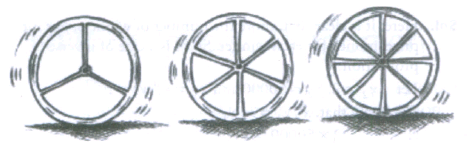
Rehman is making a wheel using spokes. He wants to fix equal spokes in such a way that the angles between any pair of consecutive spokes are equal. Help him by completing the following table:
| Number of spokes | 4 | 6 | 8 | 10 | 12 |
| Angle between a pair of consecutive spokes | 900 | 600 | .... | ..... | .... |
(i) Are the number of spokes and the angles formed between the pairs of consecutive spokes in inverse proportion?
(ii) Calculate the angle between a pair of consecutive spokes on a wheel with 15 spokes.
(iii) How many spokes would be needed, if the angle between of a pair of consecutive spokes is 40°?
6.
A girl 1.2 m tall casts a shadow 1.1 m at that height. When a building casts a shadow 6.6 m long. Determine the height of the building?
7.
Rashmi has a roadmap with a scale of 1 cm representing 18 km. She drives on a road for 72 km. What would be her distance covered in the map?
8.
Suppose 2 kg of sugar contains 9 X 10⁶ crystals. How many sugar crystals are there in 5 kg of sugar?
9.
Principal = Rs.1000,Rate = 8% per annum. Fill in the following table and find which type of interest (simple or compound) changes in direct proportion with time period.
| Time period | 1 year | 2 year | 3 year |
| Simple interest (in Rs) | |||
| Compound interest (in Rs) |
10.
Observe the following tables and find, if x and y are directly proportional
| x | 6 | 10 | 14 | 18 | 22 | 26 | 30 |
| y | 4 | 8 | 12 | 16 | 20 | 24 | 28 |
1.
Let the distance covered on the map be 'x' km.
\(\therefore\) We have:
| Actual distance covered on the road (in km) | Distance covered (represented) on the map (in cm) |
| 20 | 1 |
| 72 | x |
It is a case of direct variation.
\(\therefore \ \frac { 20 }{ 72 } =\frac { 1 }{ x } \Rightarrow 20\times x=1\times 72\)
\(\Rightarrow x=\frac { 72 }{ 20 } =\frac { 18 }{ 5 } =3.6\)
Thus, the required distance on the map is represented as 3.6 cm.
2.
| Numbers of bottles filled | Number of hours |
| 540 x |
6 5 |
Let the required number of bottles to be filled in 5 hours be x
Since, more number of bottles, more number of hours would be required.
\(\therefore\) The given quantities very directly
\(\therefore \ \frac { 540 }{ x } =\frac { 6 }{ 5 } \Rightarrow 6\times x=5\times 540\)
\(\Rightarrow \ x=\frac { 5\times 540 }{ 6 } =5\times 90=450\)
Thus, the required number of bottles = 450
3.
Here, as the base increased, the required number of green pigments will also increase.
\(\therefore\) The quantity vary directly:
i.e.,\(\frac { 1 }{ 6 } =\frac { 4 }{ { x }_{ 1 } } =\frac { 5 }{ { x }_{ 2 } } =\frac { 6 }{ { x }_{ 3 } } \)
\(\therefore\) \(\frac { 4 }{ { x }_{ 1 } } =\frac { 1 }{ 6 } \Rightarrow 1\times { x }_{ 1 }=4\times 6\Rightarrow { x }_{ 1 }=24\)
\(\frac { 1 }{ 6 } =\frac { 5 }{ { x }_{ 2 } } \Rightarrow 1\times { x }_{ 2 }=5\times 6\)
\(\Rightarrow { x }_{ 2 }=\frac { 5\times 6 }{ 1 } =30\)
\(\frac { 1 }{ 6 } =\frac { 6 }{ { x }_{ 3 } } \Rightarrow 1\times { x }_{ 3 }=6\times 6\)
\(\Rightarrow \ { x }_{ 3 }=\frac { 6\times 6 }{ 1 } =36\)
Thus, the required unknown quantities are: x1 = 24, x2 = 30, and x3 = 36.
4.
It is given that, a water tank casts a shadow 21 m long and a tree of height 9.5 m casts a shadow 8 m long at the same time. Here the lengths of the shadows are directly proportional to their heights.
Let height = h and the length of shadow = l
Here, h1 = 9.5 m, l1= 8 m, h2 = X, l2 = 21 m
For direct proportion,
\(\frac{h_1}{l_1}=\frac{h_2}{l_2} \Rightarrow \frac{9.5}{8}=\frac{x}{21}\)
∴ x = \(\frac{9.5\times 21}{8}=24.9\)m
∴ The height of the tank is 24.9 m.
5.
It is clear that more the number of spokes, less the measure of angle between a pair of consecutive spokes. So, it is the case of inverse proportion.
Here, x2 = 6,y2 = 60 and x3 = 8,y3 = ?
We know that, x2 y2 = x3y3
\(\therefore \ 6\times 60=8\times { y }_{ 3 }\Rightarrow { y }_{ 3 }=\frac { 6\times 60 }{ 8 } =\frac { 6\times 15 }{ 2 } \)
[numerator and denominator by 4]
y3 = 45°
x3 =8,y3 = 45 and x4 =10,y4 = ?
x3y3 = x4y4 = 8 x 45 =10 x y4
\(\ { y }_{ 4 }=\frac { 8\times 45 }{ 10 } \frac { 8\times 9 }{ 2 } \)
[dividing numerator and denominator by 5]
y4 = 36°
x4 = 10,y4 = 36 and x5 = 12,y5 = ?
x4y4 = x5y5 = 10\(\times\)36 = 12\(\times\)y5
\({ y }_{ 5 }=\frac { 10\times 36 }{ 12 } =\frac { 10\times 36 }{ 12 } \)
[dividing numerator and denominator by 6]
y5 = 30°
Now, the complete table is given below:
| Number of spokes | 4 | 6 | 8 | 10 | 12 |
| Angle between a pair of consecutive spokes | 900 | 600 | 450 | 360 | 300 |
(i) Given,
4 x 90° = 6 x 60° = 8 x 45° = 10 x 36° = 12 x 30° = 360°
i.e.x1y1= x2y2 = x3y3 = x4y4 = x5y5 = 360°
So, it is clear that it is the case of inverse proportion. Yes, the number of spokes and the angles formed between the pairs of consecutive spokes are in inverse proportion.
(ii) Let the measure of angle be x0.
Lesser the number of spokes, more will be the angle between a pair of consecutive spokes. So, it is the case of inverse proportion.
Here, x1= 4, y1 = 90° and x2 = 15, y2= x
We know that, x1y1=x2y2
4 x 90 = 15 x x
\(x=\frac { 4\times 90 }{ 15 } =4\times 6=24^{ 0 }\)
Hence, the angle between a pair of consecutive spokes on a wheel with 15 spokes is 24°.
(iii) Let number of spokes be n.
Lesser the number of spokes, more will be the angle between a pair of consecutive spokes. So, it is the case of inverse proportion.
Here, x1 = 4, y1 = 90° and x2 = n; y2 = 400
We know that, x1y1 = x2y2
\(\therefore 4\times 90=n\times 40\Rightarrow n=\frac { 4\times 90 }{ 40 } =9\)
Hence, 9 spokes would be needed, if the angle between a pair of consecutive spokes is 40°.
6.
7.2
7.
Let the distance covered in the map = x cm
Now, we can make a table as shown below:
| Actual distance (in km) | 18 | 72 |
| Distance on the map (in cm) | 1 | x |
Here, more the distance covered by Rashmi, more wouldbe the length of distance on the map. So, this is a case of direr proportion.
Here, x1 = 18,x2 = 72,y1=1 and y2 = x?
Now,by using relation \(\frac { { x }_{ 1 } }{ { y }_{ 1 } } =\frac { { x }_{ 2 } }{ { y }_{ 2 } } \)
\(\frac { 18 }{ 1 } =\frac { 72 }{ x } \Rightarrow 18\times x=1\times 72\Rightarrow x=\frac { 1\times 72 }{ 18 } \Rightarrow x=4cm\)
Hence, the distance covered by her on the map is 4 cm.
8.
Let the amount of sugar and number of crystals be x and y. As the amount of sugar increases, the number of crystals also increases in the same ratio. So, it is a case of direct proportion.
Here, x1 = 2 y1 = 9\(\times\)106 and x2= 5,y2 =?
Now by using the relation\(\frac { { x }_{ 1 } }{ { y }_{ 1 } } =\frac { { x }_{ 2 } }{ { y }_{ 2 } } \)
\(\frac { 2 }{ 9\times { 10 }^{ 6 } } =\frac { 5 }{ { y }_{ 2 } } \Rightarrow 2\times { y }_{ 2 }=5\times 9\times { 10 }^{ 6 }\)
\(\Rightarrow { y }_{ 2 }=\frac { 45\times { 10 }^{ 6 } }{ 2 } =22.5\times { 10 }^{ 6 }\Rightarrow { y }_{ 2 }=2.25\times { 10 }^{ 7 }\quad \)
Hence, there are 2.25 x 10⁷ crystals of sugar in 5 kg of So sugar.
9.
Given, P = Rs.1000, R = 8%
Simple interest for different time periods
(i) For T = 1yr,
\(Simple\ interest=\frac { PRT }{ 100 } =\frac { 1000\times 8\times 1 }{ 100 } =rs.80\)
(ii) For T = 2 yr,
\(Simple\ interest=\frac { PRT }{ 100 } =\frac { 1000\times 8\times 2 }{ 100 } =rs.160\)
(iii) For T = 3yr,
\(Simple\ interest=\frac { PRT }{ 100 } =\frac { 1000\times 8\times 3 }{ 100 } =rs.240\)
Compound interest for different time periods
(i) For T = 1yr
\(Compound\ interest=p\left( 1+\frac { R }{ 100 } \right) ^{ T }-p\)
\(=1000\left( 1+\frac { 8 }{ 100 } \right) ^{ 1 }-1000=1000\times \frac { 108 }{ 100 } -1000\)
= 1080 - 1000 = Rs.80
(ii) Compound interest = Rs.166.40
(iii)Compound interest = Rs. 259.712
Hence, the complete table is as follows:
| Time period | 1 yr | 2 yr | 3 yr |
| Simple interest (in Rs) | 80 | 160 | 240 |
| Compound interest (in Rs) | 80 | 166.40 | 259.712 |
Now, ratio of simple interest with time period are as follows:
\(For\ 1\ yr=,\frac { 80 }{ 1 } =80\)
\(For\ 2\ yr=,\frac { 160 }{ 2 } =80\)
\(For\ 3\ yr=,\frac { 240 }{ 3 } =80\)
Here, ratio of simple interest with time period is same for every year. Hence, simple interest changes in direct proportion with time period. Ratio of compound interest with time period are as follow:
\(For\ 1\ yr=,\frac { 80 }{ 1 } =80\)
\(For\ 2\ yr=,\frac { 166.40 }{ 2 } =83.20\)
\(For\ 3\ yr=,\frac { 259.712 }{ 3 } =86.5706\)
Here, ratio of compound interest with time period is not same for every year. Hence, compound interest does not change in direct proportion with time period.
10.
When x = 6, y = 4, then
\(\frac { x }{ y } =\frac { 6 }{ 4 } =\frac { 6\div 2 }{ 4\div 2 } \ \Rightarrow \frac { x }{ y } =\frac { 3 }{ 2 } \) [HCF of 6 and 4= 2]
When x = 10,y = 8, then
\(\frac { x }{ y } =\frac { 10 }{ 8 } =\frac { 10\div 2 }{ 8\div 2 } =\frac { 5 }{ 4 } \quad \) [HCF of 10 and 8 = 2]
When x = 14,y= 12, then
\(\frac { x }{ y } =\frac { 14 }{ 12 } =\frac { 14\div 2 }{ 12\div 2 } =\frac { 7 }{ 6 } \) [HCF of 14 and 12 = 2]
When x = 18,y = 16, then
\(\frac { x }{ y } =\frac { 18 }{ 16 } =\frac { 18\div 2 }{ 16\div 2 } =\frac { 9 }{ 8 } \) [HCF of 18 and 16= 2]
When x = 22, y = 20, then
\(\ \frac { x }{ y } =\frac { 22 }{ 20 } =\frac { 22\div 2 }{ 20\div 2 } =\frac { 11 }{ 10 } \) [HCF of 22 and 20 = 2]
When x = 26, y = 24, then
\(\frac { x }{ y } =\frac { 26 }{ 24 } =\frac { 26\div 2 }{ 24\div 2 } =\frac { 13 }{ 12 } \) [HCF of 26 and 24= 2]
When x = 30, y = 28, then
\(\frac { x }{ y } =\frac { 30 }{ 28 } =\frac { 30\div 2 }{ 28\div 2 } =\frac { 15 }{ 14 } \) [HCF of 30 and 28 = 2]
From above, it is clear that the values of \(\frac { x }{ y } \) is different for different valuesof x and y respectively .
So, these values of x and y are not directly proportional.

8th Standard CBSE Syllabus & Materials
8th Standard CBSE
CBSE 8th Science Particulate Nature of Matter - New Model Questions Papers Study Material - QB365 Set A
NEW8th Standard CBSE
CBSE 8th Science Pressure, Winds, Stroms and Cyclones - New Model Questions Papers Study Material - QB365 Set A
NEW8th Standard CBSE
CBSE 8th Mathematics Quadrilaterals - New Model Questions Papers Study Material - QB365 Set A
NEW8th Standard CBSE
CBSE 8th Mathematics A story of Numbers - New Model Questions Papers Study Material - QB365 Set A



CBSE 8th Standard CBSE Subjects
CBSE Standards




