
 100% FREE ACCESS
8th Standard CBSE Syllabus & Materials
8th Standard CBSE
CBSE 8th Social Science Theme D - Factors of Production - New Model Questions Papers Study Material - QB365 Set A
NEW8th Standard CBSE
CBSE 8th Social Science Theme C - Universal Franchise and India's Electoral System - New Model Questions Papers Study Material - QB365 Set A
NEW8th Standard CBSE
CBSE 8th Social Science Theme B - The Rise of the Marathas - New Model Questions Papers Study Material - QB365 Set A
NEW8th Standard CBSE
CBSE 8th Social Science Theme B - Reshaping India's Political Map - New Model Questions Papers Study Material - QB365 Set A
NEW8th Standard CBSE
CBSE 8th Social Science Theme A - Natural Resources and Their Use - New Model Questions Papers Study Material - QB365 Set A
NEW8th Standard CBSE
CBSE 8th Science Keeping Time with Skies - New Model Questions Papers Study Material - QB365 Set A

Published on: 26/09/2019
Mensuration
Download CBSE Class 8th Standard CBSE Mathematics question papers, sample papers, important questions, and previous year solved papers in PDF format. Get free study materials, NCERT solutions, and exam preparation resources for Class 8th Standard CBSE Mathematics
Questions + Answers key
Take MCQ Mathematics Test
1.
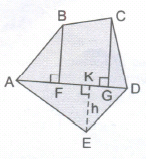
Find the area of the polygon ABCDE as shown in the figure.
2.
Find the area of a rhombus whose diagonals are of lengths 10 cm and 8.2 cm.
3.
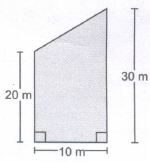
Find the area of the following figures.
4.
The difference between two parallel sides of a trapezium is 8 cm. The perpendicular distance between them is 19 cm. While the area of trapezium is 760cm2. What will be the length of the parallel sides?
5.
How many iron rods each of length 14 m and diameter 4 cm can be made out of 88 m3 of iron?
6.
160m3 of water is to be used to irrigate a rectangular field, whose area is 800 m2. What will be the height of the water level in the field?
7.
How many small cubes with edge of 30 cm each can be just accommodated in a cubical box of 3 m edge?
8.
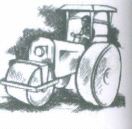
A road roller takes 750 complete revolutions to move once over to level a road. Find the area of the road, if the diameter of a road roller is 84 cm and length is 1m.
9.
Daniel is painting the walls and ceiling of a cuboidal hall with length, breadth and height of 15 m, 10m and 7 m, respectively. From each can paint of 100 m2 of area is painted. How many cans of paint will she need to paint the room?
10.
A suitcase with measures 80 cm\(\times\) 48 cm\(\times\)24 cm is to be covered with a tarpaulin cloth. How many metres of tarpaulins of width 96 cm is required to cover 100such suitcases?
11.
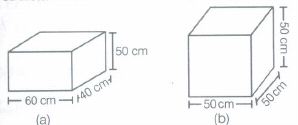
There are two cuboidal boxes as shown in the following figures. Which box requires the lesser amount of material to make?
12.
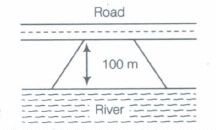
Mohan wants to buy a trapezium shaped field. Its side along the river is parallel and twice the side along the road. If the area of this field is 10500 m2 and the perpendicular distance between the two parallel sides is 100 m, find the length of the side along the river.
13.
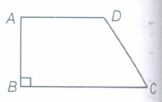
Length of the fence of a trapezium shaped field ABCD is 120 m. If BC = 48 m, CD = 17 m and AD = 40 m, find the area of this field. Side AB is perpendicular to the parallel sides AD and BC
14.
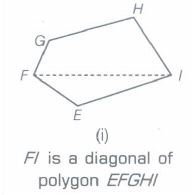
Divide the following polygons into parts (triangles and trapezium) to find out its area.
15.
If h = 10 cm, c = 6 cm, b = 12 cm and d = 4 cm, find the values of each of its parts separately and add to find the area WXYZ..Verify, it by putting the values of h, a and b in the expression \(\frac { h(a+b) }{ 2 } \)
1.
Area of ABCDE=ar(\(\triangle\) AFB)+ar(trap.FBCG)+ar(\(\triangle\)CGD)+ar(\(\triangle\)DEK)+ar(\(\triangle\)AKE)
2.
Area of the rhombus = \(\frac{1}{2}\) d1 d 2 where d 1, d 2 are lengths of diagonals.
\(=\frac{1}{2} \mathrm{x}\) 10 x 8.2 cm2 = 41 cm2.
3.
250 m2
4.
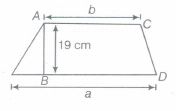
Let the two parallel sides be a and b.
According to the question,
a-b = 8 ....(i)
Area of trapezium
= \(\frac { 1 }{ 2 } \times \)h(a+b)
⇒ \(\frac { 1 }{ 2 } \) (a+b)\(\times\)19 =760
⇒ a+b =40\(\times\)2
⇒ a+b = 80 ...(ii)
From Eqs. (i) and (ii), we get
2a =88 ⇒ \(a=\frac { 88 }{ 2 } =44\)
From Eq. (i), we get
a-b=8
⇒ b = a-8 = 44-8 = 36 cm
∴ 8 = 44 cm and b = 36 cm
5.
Here,r = m and h = 14 m
∴ Volume of iron rods = \(\pi\)r2h
= \(\frac { 22 }{ 7 } \times \frac { 2 }{ 100 } \times \frac { 2 }{ 100 } \times 14\)
= \(22\times \frac { 1 }{ 50 } \times \frac { 1 }{ 50 } \times 2\)
= \(\frac { 44 }{ 2500 } =\frac { 11 }{ 625 } { m }^{ 3 }\)
=0.88 m3
Number of iron rods =\(88\times \frac { 625 }{ 11 } \)=5000
6.
Volume of water = 160 m3
Area of rectangular field = 800 m2
Let h be the height of water level in the field.
Now, volume of water = Volume of cuboid formed on the field by water
⇒ 160= Area of base x Height
⇒ 160 = 800\(\times\)h
∴ h = \(\frac { 160 }{ 800 } \)=0.2 m
Hence, the required height is 0.2 m.
7.
Edge of a small cube = 30 cm
Surface area of each small cube = 6\(\times\)(Edge)2
= 6\(\times\)30\(\times\)30 = 5400 cm2
Edge of the cubical box = 3 m = 300 cm
Surface area of cubical box = 6\(\times\)(Edge)2
= 6\(\times\)(300)2 = 6\(\times\)300\(\times\)300 = 540000 cm2
∴ Number of small cubes accomodated in the cubical box of edge 3 m or 300 cm
= \(\frac { Surface\quad area\quad of\quad the\quad cubical\quad box }{ Surface\quad area\quad of\quad each\quad small\quad cubes } \)
= \(\frac { 54000 }{ 5400 } =100\)
Hence, 100 small cubes can be accomodated ina cubical box of 3 m edge.
8.
Given, road roller is in cylindrical shape.
Length of road roller = 1m =100 cm [∵1 m= 100 cm]
and diameter of road roller = 84 cm
∴ Radius of road roller =\(\frac { 84 }{ 2 } \) = 42 cm
The curved surface area of cylindrical road roller = 2\(\pi\)rh
= \(2\times \frac { 22 }{ 7 } \times 42\times 10\) =44\(\times\)6\(\times\)100 = 26400 cm2
∵ Area covered by road roller in 1 revolution = Curved surface area of road roller = 26400 cm2 = \(\frac { 26400 }{ 100\times 100 } { m }^{ 2 }\)
∴ Area covered by road roller in 750 revolutions
= 750\(\times\)2.64 = 1980 m2
Hence, the required area of road is 1980 m2
9.
Given, length of wall (I) = 15 m
Breadth of wall (b) = 10m and height of wall (h) = 7 m
∴ Area to be painted = Area of 4 walls + Area of ceiling
= 2h(l+b) l\(\times\)b
= 2\(\times\)7(15 + 10) + 15\(\times\)10
= 2 \(\times\)7 x 25 + 150 m2
Given, one can of paint covers 100 m2 area
∴ Number of cans needed = \(\frac { Area\ to\ be\ painted }{ Area\ painted\ by\ one\ can } \)
=\(\frac { 500{ m }^{ 2 } }{ 100{ m }^{ 2 } } \) = 5
Hence, she will need 5 cans of paint to painted the room.
10.
Given, length of suitcase (I) = 80 cm
Breadth of suitcase (b) = 48 cm and height of suitcase (h) = 24 cm
∴ Total surface area of one suitcase = 2(1b + bh + hl)
= 2(80\(\times\)48 + 48\(\times\)24 + 24\(\times\)80)
= 2 (3840 + 1152 + 1920) = 2\(\times\)6912 = 13824 cm2
Also, width of tarpaulin = 96 cm
Since, area of tarpaulin required to cover of suitcase will be equal to the total surface area of suitcase.
So, area of tarpaulin required to cover one suitcase = 13824 cm2
⇒ Length\(\times\)Width = 13824 [∵ tarpaulin is in the shape of a rectangle]
⇒ Length\(\times\)96 = 13824 ⇒ Length =\(\frac { 13824 }{ 96 } \) = 144 cm
Thus, length of tarpaulin required of cover 100 suitcase
= 100\(\times\)144 = 14400 cm=\(\frac { 1440 }{ 100 } m\) = 144 m
[∵ 1m = 100 cm⇒1 cm = \(\frac { 1 }{ 100 } \) m]
Hence, 144 m of tarpaulin with width 96 cm is required to cover 100 suitcases.
11.
Here, the amount of material to make a cuboidal box will be equal to its total surface area
For first cuboidal box, Length (l) = 60 cm
breadth (b) = 40 cm and height (h) = 50 cm
∴ Total surface area of cuboid = 2(1b + bh + hI)
= 2(60\(\times\)40 + 40\(\times\)50 + 50\(\times\)60)
= 2(2400 + 2000 + 3000) = 2 \(\times\) 7400 = 14800 cm2
For second cuboidal box, I = b = h = 50 cm
∴ Total surface area of cuboid = 2(1b + bh + hI)
= 2(50 \(\times\) 50 + 50 \(\times\) 50 + 50 \(\times\) 50)
= 2(2500 + 2500 + 2500) = 2 \(\times\) 7500 = 15000 cm2
Since, total surface area of cuboid (a) is less, so the box (a) requires the lesser amount of material to make.
12.
According to the question, the side along the river is parallel to and twice the side along the road.
Let the length of side along the road be x m
Then, the length of side along the river = 2x m
Given, perpendicular distance between the two parallel sides =100 m
and area of the trapezium shaped field = 10500 m2
⇒\(\frac { 1 }{ 2 } \times \) (Sum of parallel sides) Heigth = 10500
⇒\(\frac { 1 }{ 2 } \times \) (2x+2) 100= 10500 ⇒ 3\(\times\) 50 =10500
⇒ 3x = \(\frac { 10500 }{ 50 } =\frac { 1050 }{ 5 } \)
∴ x =\(\frac { 1050 }{ 3\times 5 } \) = 70 and 2x = 2 0 =140
Hence, the length of the side along the river is 140 m.
13.
Given, fence of the trapezium shaped field ABCD = 120 m, BC = 48 m, CD = 17 m and AD = 40 m.
Here, length of the fence of a trapezium shaped field means perimeter of the trapezium.
∴ Perimeter of trapezium shaped field ABCD = AB+BC+CD+DA
⇒ AB+BC+CD+DA =120
⇒ AB + 48 + 17 + 40 = 120
⇒ AB+105=120
⇒ AB =120-105 = 15 m
∴ Area of the field ABCD =\(\frac { 1 }{ 2 } \times \) (BC+AD)\(\times\) AD
=\(\frac { 1 }{ 2 } \times \) (48+40)\(\times\) 15
=\(\frac { 1 }{ 2 } \times \) 88\(\times\)15 = 660m2
Hence, area of the trapezium shaped fill is 660 m2
14.
Given, a polygon EFGHI and FI is a diagonal of it. To find the area, we have to divide this polygon into triangle and trapezium. So, firstly draw perpendicular from opposite vertical on FI i.e. from points G, Hand E to Fl. Thus, we get perpendiculars GM, HN and EP respectively on FI and polygon is divided into 5 parts, out of which four are triangles and one is trapezium.
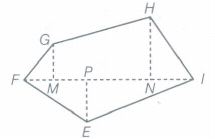
Area of polygon EFGHI =Area of ΔGMF + Area of trapezium GMNH + Area of ΔHNI + Area of ΔEPI + Area of ΔEPF
= \(\left( \frac { 1 }{ 2 } \times FM\times GM \right) +\left[ \frac { 1 }{ 2 } (GM+HN)\times MN \right] \) +\(\frac { 1 }{ 2 } \times NI\times HN+\left( \frac { 1 }{ 2 } \times PI\times EP \right) +\left( \frac { 1 }{ 2 } \times PF\times EP \right) \)
\([ \because area\ of\ triangle=\frac { 1 }{ 2 } \times base\times height\ and\)
\(\\ area\ of\ trapezium\ =\frac { 1 }{ 2 } \times (sum\ of\ parellel\ sides)\times height \)
15.
Given,h = 10 cm, c = 6 cm, b = 12 cm and d = 4 cm
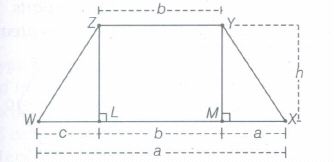
Area of ΔWLZ =\(\frac { 1 }{ 2 } \) \(\times\)c\(\times\) b = 6 \(\times\)10 = 30cm2
Area of rectangle LMYZ = b \(\times\)h = 12\(\times\) 10 = 120 cm2
and area of ΔXMY = \(\frac { 1 }{ 2 } \)\(\times\)d \(\times\)h = \(\frac { 1 }{ 2 } \)\(\times\) 4 \(\times\)10 = 20cm2
Now, area of trapezium WXYZ = Area of ΔWLZ + Area of rectangle LMYZ + Area of ΔXMY
=(30+120+20)cm2 =170cm2
By using the formula,
Area of trapezium WXYZ = \(\frac { h(a+b) }{ 2 } =\frac { 10(22+12) }{ 2 } \)
[∵ a = c + b + d = 6 + 12 + 4 = 22 cm] = 5 \(\times\)34 =170 cm2
which is same as above.
Hence, area of trapezium is verified.

8th Standard CBSE Syllabus & Materials
8th Standard CBSE
CBSE 8th Science Particulate Nature of Matter - New Model Questions Papers Study Material - QB365 Set A
NEW8th Standard CBSE
CBSE 8th Science Pressure, Winds, Stroms and Cyclones - New Model Questions Papers Study Material - QB365 Set A
NEW8th Standard CBSE
CBSE 8th Mathematics Quadrilaterals - New Model Questions Papers Study Material - QB365 Set A
NEW8th Standard CBSE
CBSE 8th Mathematics A story of Numbers - New Model Questions Papers Study Material - QB365 Set A



CBSE 8th Standard CBSE Subjects
CBSE Standards




