
 100% FREE ACCESS
8th Standard CBSE Syllabus & Materials
8th Standard CBSE
CBSE 8th Social Science Theme D - Factors of Production - New Model Questions Papers Study Material - QB365 Set A
NEW8th Standard CBSE
CBSE 8th Social Science Theme C - Universal Franchise and India's Electoral System - New Model Questions Papers Study Material - QB365 Set A
NEW8th Standard CBSE
CBSE 8th Social Science Theme B - The Rise of the Marathas - New Model Questions Papers Study Material - QB365 Set A
NEW8th Standard CBSE
CBSE 8th Social Science Theme B - Reshaping India's Political Map - New Model Questions Papers Study Material - QB365 Set A
NEW8th Standard CBSE
CBSE 8th Social Science Theme A - Natural Resources and Their Use - New Model Questions Papers Study Material - QB365 Set A
NEW8th Standard CBSE
CBSE 8th Science Keeping Time with Skies - New Model Questions Papers Study Material - QB365 Set A

Published on: 10/10/2019
Practical Geometry
Download CBSE Class 8th Standard CBSE Mathematics question papers, sample papers, important questions, and previous year solved papers in PDF format. Get free study materials, NCERT solutions, and exam preparation resources for Class 8th Standard CBSE Mathematics
Questions + Answers key
Take MCQ Mathematics Test
1.
A park is in the shape of a quadrilateral as shown below:
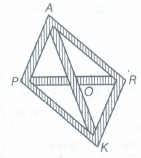
Let the vertices of park be P, A, R, K. A running track is constructed at the corner of each sides of the park as shown above.
A runner runs on the track and see that the distance covered by him from P to A and A to R is same as the distance covered by him from R to K and K to P. He also, finds that the distance of A from P is less than distance of K from P.
(a) What is the shape of the quadrilateral park?
(b) What should be the angle between the two tracks AO and OR?
(c) What type of value you depicted from the park?
2.
Construct a rectangle whose one side is 3 cm and a diagonal equal to 5 cm.
3.
Construct the following quadrilaterals. Quadrilateral GOLD OL = 7.5 cm, GL= 6 cm, GD = 6 cm, LD = 5 cm, OD = 10 cm
4.
Construct the following quadrilaterals. Quadrilateral LIFT LI = 4 cm, IF = 3 cm, TL = 2.5 cm, LF = 4.5 cm, IT = 4 cm
5.
Construct the following quadrilaterals. Rhombus BEST BE = 4.5 cm, ET = 6 cm
6.
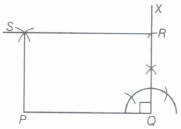
How will you construct a rectangle PQRS, if you know only the lengths PQ and QR?
7.
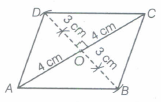
Draw a rhombus ABCD having their diagonals of lengths BD = 6 cm and AC = 8 cm.
8.
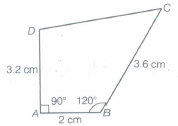
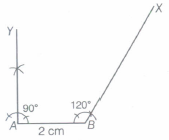
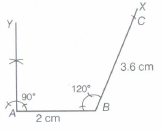
Costruct a quadrilateral ABCD such that AB=2 cm, BC=3.6 cm, AD=3.2 cm, \(\angle \)A=90° and \(\angle \)B=120°.
9.
Construct a quadrilateral ABCD, given that AB=7.5 cm, BC = 5 cm, CD=6 cm, BD=6 cm and AC = 10 cm.
10.
Construct a quadrilateral ABCD, where AB = 5 cm, CD = 4 cm, DB = 7cm, BC = 6 cm and DA = 5.5 cm.
1.
(a) The quadrilateral park have kite shape, since PA = AR and PK = RK
(b) In a kite, the diagonals are perpendicular to each other, so \(\angle
\)AOR = 90°.
(c) The park is having a well structured as kite shape with a running track for the runner.
2.
Diagonals of a rectangle are equal.
\(\therefore\) AC = BD = 5 cm
Steps of construction
Step I Draw AB = 3 cm.
Step II Draw a ray BX such that \(\angle\) ABX = 90°.
Step III Draw an arc such that AC = 5 cm.
Step IV With B as centre, draw an arc of radius 5 cm and with C as centre. Draw another arc of radius 3 cm, which intersects first arc at a point, suppose D.
Step V Join CD and AD.
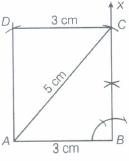
Hence ABCD is the required rectangle
3.
Firstly, draw a rough sketch of quadrilateral LIFT, which helps us in deciding steps of construction.
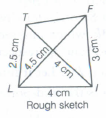
Steps of construction
Step I Draw LI = 4 cm
Step II With L as centre and radius 2.5 cm, draw an arc.
Step III With I as centre and radius 4 cm, draw another arc, which intersects the arc drawn in Step II at T.
Step IV With I as centre and radius 3 cm, draw an arc.
Step V With L as centre and radius 4.5 cm, draw another arc which intersects the arc drawn in Step IV at F.
Step Join IF, FT, TL, LF and IT.
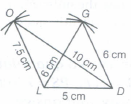
GOLD is the required quadrilateral.
4.
Firstly, draw a rough sketch of quadrilateral LIFT, which helps us in deciding steps of construction.
Steps of construction
Step I Draw LI = 4 cm
Step II With L as centre and radius 2.5 cm, draw an arc.
Step III With I as centre and radius 4 cm, draw another arc, which intersects the arc drawn in Step II at T.
Step IV With I as centre and radius 3 cm, draw an arc.
Step V With L as centre and radius 4.5 cm, draw another arc which intersects the arc drawn in Step IV at F.
Step Join IF, FT, TL, LF and IT.
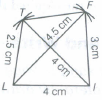
Thus, LIFT is the required quadrilateral.
5.
We know that, in a rhombus, all sides are of equal length.
Here, BE=4.5 cm
Firstly, draw a rough sketch of rhombus BEST, which helps us in deciding steps of construction.
So, BE = ES = ST = BT = 4.5 cm
Steps of construction
Step IDraw BE = 4.5 cm.
Step II With B as centre and radius 4.5 cm, draw an arc.
Step III With E as centre at E and radius 6 cm, draw another arc which intersects the arc in Step II at T
Step IV With E as centre and radius 4.5 cm, draw an arc on the side opposite to B with reference to ET
Step V With T as centre and radius 4.5 cm, draw another arc which intersects the arc drawn in step IV at S.
Step VI Join ES, ST, TB and TE.
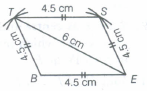
Thus, BEST is the required rhombus.
6.
We know that, the length PQ and QR of a rectangle PQRS. Also, we know that in a rectangle opposite sides have equal length and each of the angle is 90°.
Thus, we have PQ=RS and QR=PS and \(\angle \)PQR = 90°.
Steps of construction
Step I Draw PQ.
Step II Makes \(\angle \)PQX=90°.
Step III Cut QR from QX
Step IV From P cut-off an arc equal to QR.
Step V From R, cut-off an arc equal to PQ.
Step VI Mark S as the intersection point of both the arcs. Join PS and RS to get the required rectangle PQRS.
7.
Initially, it appears that only two measurements are available. Actually, the figure is a special quadrilateral, so we have many more details with us.
We know that, in a rhombus diagonals bisect each other at right angle.
Steps of construction
Step I First, draw AC=8 cm.
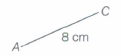
Step II Now, construct its perpendicular bisector.
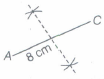
Step III Let them meet at O. Cut-off 3 cm lengths on either side of the drawn bisector. You now get B and D.
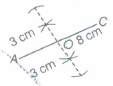
On joining AB, AB, BC and CD, we get the required rhombus.
8.
First, we draw a rough sketch of the required quadrilateral, which is given below:
Steps of construction
Step I Draw AB=2 cm and make \(\angle \) ABX=120° and \(\angle \)BAY=90° on it
Step II Cut off BC=3.6 cm on BX.
Step III Taking A as centre, draw an arc of length 3.2 cm, which cuts AY on D.
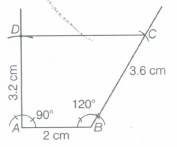
Thus, we get the quadrilateral ABCD.
9.
First, we draw a rough sketch of the quadrilateral ABCD, which is given below:
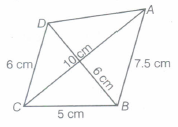
Steps of construction
Step I Draw a \(\Delta \)ACB using SSS construction condition
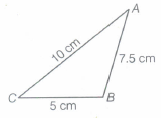
Step II Taking C as centre, draw the arc of 6 cm. Taking B as centre and draw the arc of length 6 cm. Now, by the intersection point of both the arcs we get a point D.
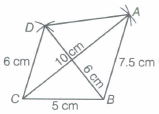
Thus, we get a quadrilateral ABCD.
10.
Let us draw a rough sketch to visualise the quadrilateral. See the following figure.
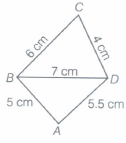
Steps of construction
Step I From the rough sketch, it is easy to see that a \(\Delta
\)BCD can be constructed using SSS construction condition.
Draw the \(\Delta
\)BCD.
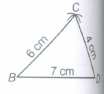
Step II Now, we will locate a point A, which would be on the side opposite to C with reference to B.
A is 5.5 cm away from D. So, with D as centre, draw an arc of radius 5.5 cm.
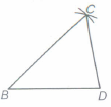
Step III A is 5 cm away from B. So, with B as centre, draw an arc of radius 5 cm.
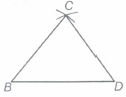
Step IV A should be the intersection point of both the arcs drawn. Mark A and join BA and DA.
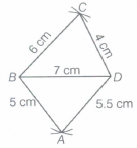
Hence, ABCD is the required quadrilateral.

8th Standard CBSE Syllabus & Materials
8th Standard CBSE
CBSE 8th Science Particulate Nature of Matter - New Model Questions Papers Study Material - QB365 Set A
NEW8th Standard CBSE
CBSE 8th Science Pressure, Winds, Stroms and Cyclones - New Model Questions Papers Study Material - QB365 Set A
NEW8th Standard CBSE
CBSE 8th Mathematics Quadrilaterals - New Model Questions Papers Study Material - QB365 Set A
NEW8th Standard CBSE
CBSE 8th Mathematics A story of Numbers - New Model Questions Papers Study Material - QB365 Set A



CBSE 8th Standard CBSE Subjects
CBSE Standards




