
 100% FREE ACCESS
8th Standard CBSE Syllabus & Materials
8th Standard CBSE
CBSE 8th Social Science Theme D - Factors of Production - New Model Questions Papers Study Material - QB365 Set A
NEW8th Standard CBSE
CBSE 8th Social Science Theme C - Universal Franchise and India's Electoral System - New Model Questions Papers Study Material - QB365 Set A
NEW8th Standard CBSE
CBSE 8th Social Science Theme B - The Rise of the Marathas - New Model Questions Papers Study Material - QB365 Set A
NEW8th Standard CBSE
CBSE 8th Social Science Theme B - Reshaping India's Political Map - New Model Questions Papers Study Material - QB365 Set A
NEW8th Standard CBSE
CBSE 8th Social Science Theme A - Natural Resources and Their Use - New Model Questions Papers Study Material - QB365 Set A
NEW8th Standard CBSE
CBSE 8th Science Keeping Time with Skies - New Model Questions Papers Study Material - QB365 Set A

Published on: 03/10/2019
Square and Square Roots
Download CBSE Class 8th Standard CBSE Mathematics question papers, sample papers, important questions, and previous year solved papers in PDF format. Get free study materials, NCERT solutions, and exam preparation resources for Class 8th Standard CBSE Mathematics
Questions + Answers key
Take MCQ Mathematics Test
1.
Complete the following crossword puzzle using the given direction.
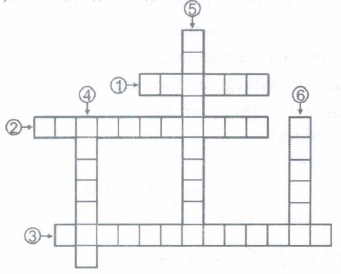
Direction:
Across:
(1) The product of number by itself two times, is called its _______
(2) If three numbers a, band c are such that a2 + b2= c2 then they are called _____ Triplets.
(3) A number is a when it is a product of the same two numbers.
Down: (4) The numbers 2n, n2-1 and n2 + 1 where n is a natural number show Pythagorean______.
(5) Finding is the inverse operation of squaring a number.
(6) A number which divides a _______ given number exactly is called a or divisor of that number.
2.
In a right angled \(\Delta\) ABC, if \(\angle\)B=90°, AB=12 cm and BC=5 cm, then find AC.
3.
The area of a square plot is 101\(\frac { 1 }{ 100 } \)m2. Find the length of one side of the plot.
4.
The perimeters of two squares are 40 m and 96 m, respectively. Find the perimeter of another square, equal in area to the sum of the first two squares.
5.
Find the square root of 324 by the method of repeated subtraction.
6.
Find the least number that must be added to 1500. so as to get a perfect square. Also, find the square root of the perfect square.
7.
The area of a rectangular field whose length is twice its breadth, is 2450 m2. Find the perimeter of the field.
8.
Find the least number, which is a perfect square and has 7936 as one of its factors.
9.
If (46)2 is subtracted from the square of a number, then answer so obtained is 485. What is the number?
10.
If the expression X x 809436 x 809436 be a perfect square, then find the value of x.
1.
1.SQUARE
2.PYTHAGOREAN
3.PERFECT SQUARE
4.TRIPLET
5.SQUARE ROOT
6.FACTOR
2.
According to Pythagoras theorem,
(Hypotenuse)2 = (Base)2 + (Perpendicular)2
Clearly, the side opposite to 90° is hypotenuse
AC = Hypotenuse
AB = Base
BC = Perpendicular
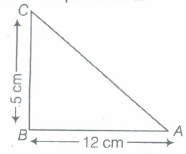
(AC)2 = (AB)2 + (BC)2
\(\Rightarrow\) (AC)2 =(12)2 +(5)2
\(\Rightarrow\) (AC)2=144+25
\(\Rightarrow\) (AC)2 =169
\(\Rightarrow\) AC =\(\sqrt { 169 } \) = 13 cm
3.
Let length of the square plot be a, then the area of square = a2
According to the question,
\(Area=101\frac { 1 }{ 400 } { m }^{ 2 }\)
\(\Rightarrow \ { a }^{ 2 }=101\frac { 1 }{ 400 } \)
\(\Rightarrow \ { a }^{ 2 }=\frac { 40401 }{ 400 } \)
\(\therefore \ a=\frac { 201 }{ 20 } \)
\(=10\frac { 1 }{ 20 } m\)
Hence, length of one side of the plot is 10\(\frac { 1 }{ 20 } \) m.
4.
Let side of two squares be a1 and a2·
Then, perimeter of first square = 4a1
According to the question,
Perimeter = 40
\(\therefore\) 4a1 = 40 \(\Rightarrow\) a1 = 10
Similarly, second square's perimeter = 4a2
But according to the question,
Perimeter = 96
\(\therefore\) 4a2 = 96 \(\Rightarrow\) a2 = 24
Let a be the side of another square.
Now, sum of the areas of first and second square area of
= Area of (first square) + (Area of second square)
=\({ a }_{ 1 }^{ 2 }+{ a }_{ 2 }^{ 2 }\)
Area =(10)2 + (24)2 =100 + 576
\(\therefore\) Area = 676
\(\Rightarrow\)a2 = 676 \(\Rightarrow\) a = \(\sqrt { 676 } \)
Then, a=26 m
Another square's perimeter = 4a = 4 x 26 = 104 m
So, perimeter of another square is 104 m.
5.
Here, 324 -1 = 323,323 - 3 = 320
320 - 5 = 315,315 -7 = 308
308 - 9 = 299, 299 - 11 = 288
288 -13 = 275,275 -15 = 260
260 - 17 = 243, 243 - 19 = 224
224 - 21 = 203,203 - 23 =180
180 - 25 =155, 155 - 27 =128
128 - 29 = 99, 99 - 31 = 68
68 - 33 = 35, 35 - 35 = 0
So, to get 0, we use 18 steps.
Hence, square root of 324 is 18.
6.
We have, 1500
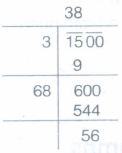
We see that, 382 < 1500 < 392
So, number to be added = 392 - 1500
= 1521 - 1500 = 21
Therefore, the perfect square is 1500 + 21 = 1521 and \(\sqrt { 1521 } \)= 39
So, the required number is 21 and the square root is 39.
7.
Let the breadth of the field be \(\times\) m. Then, length of the field will be 2 \(\times\) m.
Area of the rectangular field = Length \(\times\) Breadth
\(\therefore \ =(2x)\times (x)=({ 2x }^{ 2 }){ m }^{ 2 }\)
Given that, area = 2450 m2
Therefore, 2x2=2450
\(\Rightarrow \ { x }^{ 2 }=\frac { 2450 }{ 2 } \)
\(\Rightarrow \ x=\sqrt { 1225 } \Rightarrow \ x=35\ m\)
\(\therefore \) Breadth = 35 m and length = 35 \(\times\)2 = 70 m
Perimeter of the field = 2(l + b) = 2(70 + 35) m
= 2 \(\times\)105 m = 210 m
8.
246016
9.
51
10.
1

8th Standard CBSE Syllabus & Materials
8th Standard CBSE
CBSE 8th Science Particulate Nature of Matter - New Model Questions Papers Study Material - QB365 Set A
NEW8th Standard CBSE
CBSE 8th Science Pressure, Winds, Stroms and Cyclones - New Model Questions Papers Study Material - QB365 Set A
NEW8th Standard CBSE
CBSE 8th Mathematics Quadrilaterals - New Model Questions Papers Study Material - QB365 Set A
NEW8th Standard CBSE
CBSE 8th Mathematics A story of Numbers - New Model Questions Papers Study Material - QB365 Set A



CBSE 8th Standard CBSE Subjects
CBSE Standards




