
 100% FREE ACCESS
8th Standard CBSE Syllabus & Materials
8th Standard CBSE
CBSE 8th Social Science Theme D - Factors of Production - New Model Questions Papers Study Material - QB365 Set A
NEW8th Standard CBSE
CBSE 8th Social Science Theme C - Universal Franchise and India's Electoral System - New Model Questions Papers Study Material - QB365 Set A
NEW8th Standard CBSE
CBSE 8th Social Science Theme B - The Rise of the Marathas - New Model Questions Papers Study Material - QB365 Set A
NEW8th Standard CBSE
CBSE 8th Social Science Theme B - Reshaping India's Political Map - New Model Questions Papers Study Material - QB365 Set A
NEW8th Standard CBSE
CBSE 8th Social Science Theme A - Natural Resources and Their Use - New Model Questions Papers Study Material - QB365 Set A
NEW8th Standard CBSE
CBSE 8th Science Keeping Time with Skies - New Model Questions Papers Study Material - QB365 Set A

Published on: 14/09/2019
Square and Square Roots
Download CBSE Class 8th Standard CBSE Mathematics question papers, sample papers, important questions, and previous year solved papers in PDF format. Get free study materials, NCERT solutions, and exam preparation resources for Class 8th Standard CBSE Mathematics
Questions + Answers key
Take MCQ Mathematics Test
1.
Write the Pythagorean triplet whose one member is 13.
2.
How many numbers lie between squares of:
27 and 28
3.
Express the following as the sum of two consecutive integers. 192
4.
Express the following as the sum of two consecutive integers. 112
5.
Find the square of 6.1.
6.
How many perfect squares lie between 1 and 50?
7.
EvauIate. \(\sqrt { \frac { 0.0289 }{ 0.0121 } } +\sqrt { \frac { 64 }{ 16 } } \)
8.
What is the least number to be added to 8200 to make it a perfect square (using division method)?
9.
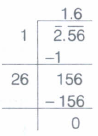
Find the square root of the following decimal numbers. 2.56
10.
Find the number of digits in the square root of each of the following numbers (without any calculation). 144
11.
Find the square root of each of the following numbers by division method.1024
12.
What will be the number of zeros in the square of the following numbers? 60
13.
What will be the one's digit in the square of the following numbers? 21222
14.
Write five numbers which you cannot decide just by looking at their unit's digit (or one's place) whether they are square numbers or not.
15.
Can we say whether the following numbers are perfect squares? How do we know? 7928
Write five numbers which you can decide by looking at their units digit that they are not square numbers.
1.
When 'n' is a member of a Pythagorean
triplet, then the triplet is
n2 - 1, 2n, n2 + 1
or (132- 1), (2 x 13), (132 + 1)
or (169 - 1), (26), (169 + 1)
or 168, 26 and 170
2.
We know that, between n2 and (n + 1)2, there are 2n non-square numbers.
\(\therefore\) Between 27 and 28, there are 2 x 27, i.e, 54 numbers.
3.
Here, n = 19
∴ \(\frac { { n }^{ 2 }-1 }{ 2 } =\frac { { 19 }^{ 2 }-1 }{ 2 } =\frac { 361-1 }{ 2 } \)
= \(\frac { 360 }{ 2 } \) = 180
and \(\frac { { n }^{ 2 }+1 }{ 2 } =\frac { { 19 }^{ 2 }+1 }{ 2 } =\frac { 361+1 }{ 2 } \)
= \(\frac { 362 }{ 2 } \) = 181
∴ 192 = 180 + 181 = 361
4.
Here , n = 11
∴ \(\frac { { n }^{ 2 }-1 }{ 2 } =\frac { { 11 }^{ 2 }-1 }{ 2 } =\frac { 121-1 }{ 2 } \)
=\(\frac { 120 }{ 2 } \)= 60
and \(\frac { { n }^{ 2 }+1 }{ 2 } =\frac { { 11 }^{ 2 }+1 }{ 2 } =\frac { 121+1 }{ 2 } \)
=\(\frac { 121+1 }{ 2 } \)=61
∴ 112 = 60 + 61 = 121.
5.
\(\because \quad 6.1=\frac { 61 }{ 10 } \)
\(\therefore \quad { (6.1) }^{ 2 }={ \left( \frac { 61 }{ 10 } \right) }^{ 2 }=\frac { 61\times 61 }{ 10\times 10 } =\frac { 3721 }{ 100 } =37.21\)
6.
4, 9,16,25,36 and 49 are six perfect squares, which lie between 1 and 50.
7.
\(\frac { 39 }{ 11 } \)
8.
81
9.
Given decimal number is 2.56.
Firstly, place the bar over the number and then use the division method
\(\therefore \ \sqrt { 2.56 } =1.6\)
Hence, the square root of 2.56 is 1.6.
10.
Given number is 144.
Here, number of digits, n =3 [odd]
\(\therefore\) Number of digits in the square root of 144
\(=\frac { n+1 }{ 2 } =\frac { 3+1 }{ 2 } =\frac { 4 }{ 2 } =2\)
Hence, number of digits in the square root of 144 is 2 digits.
11.
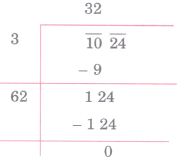
Therefore,\(\sqrt { 1024 } \)= 32
12.
We know that, the number of zeroes in the end of a number is half of the number of zeroes in the end of its square. The number of zeros in the square of 60 is 2.
13.
Given number is 21222.
Unit's digit of 21222 = 2
So, square of unit's digit = (2)2 = 4
Hence, unit's digit of the square of unit's digit of the given number is 4.
14.
A list of five numbers for which we cannot decide whether they are square numbers just by looking at their unit's digits are 1331, 2744, 3375,17576 and 24389.
15.
We know that, a number ends with 2, 3, 7 or 8 is neverapeIfea square.
The number 7928 ends with 8, which is not one of the end digits of 0, 1, 4, 5, 6 or 9, so it is not a perfect square.

8th Standard CBSE Syllabus & Materials
8th Standard CBSE
CBSE 8th Science Particulate Nature of Matter - New Model Questions Papers Study Material - QB365 Set A
NEW8th Standard CBSE
CBSE 8th Science Pressure, Winds, Stroms and Cyclones - New Model Questions Papers Study Material - QB365 Set A
NEW8th Standard CBSE
CBSE 8th Mathematics Quadrilaterals - New Model Questions Papers Study Material - QB365 Set A
NEW8th Standard CBSE
CBSE 8th Mathematics A story of Numbers - New Model Questions Papers Study Material - QB365 Set A



CBSE 8th Standard CBSE Subjects
CBSE Standards




