
 100% FREE ACCESS
8th Standard CBSE Syllabus & Materials
8th Standard CBSE
CBSE 8th Social Science Theme D - Factors of Production - New Model Questions Papers Study Material - QB365 Set A
NEW8th Standard CBSE
CBSE 8th Social Science Theme C - Universal Franchise and India's Electoral System - New Model Questions Papers Study Material - QB365 Set A
NEW8th Standard CBSE
CBSE 8th Social Science Theme B - The Rise of the Marathas - New Model Questions Papers Study Material - QB365 Set A
NEW8th Standard CBSE
CBSE 8th Social Science Theme B - Reshaping India's Political Map - New Model Questions Papers Study Material - QB365 Set A
NEW8th Standard CBSE
CBSE 8th Social Science Theme A - Natural Resources and Their Use - New Model Questions Papers Study Material - QB365 Set A
NEW8th Standard CBSE
CBSE 8th Science Keeping Time with Skies - New Model Questions Papers Study Material - QB365 Set A

Published on: 31/10/2019
Download CBSE Class 8th Standard CBSE Mathematics question papers, sample papers, important questions, and previous year solved papers in PDF format. Get free study materials, NCERT solutions, and exam preparation resources for Class 8th Standard CBSE Mathematics
Questions + Answers key
Take MCQ Mathematics Test
1.
If 51x3 is a multiple of 9, where x is a digit, then what is the value of x?
2.
Solve: \({15\over 4}-7p=9\)
3.
Find the cube root of 13824 by prime factorisation method.
4.
Draw a line passing through (2, 1) and (1, 2). Find the coordinates of the points at which this line meets the x-axis and y-axis.
5.
Simplify: \(\frac { { 2 }^{ -5 }\times { 3 }^{ -5 }\times 125 }{ { 5 }^{ -4 }\times { 6 }^{ -5 } } \)
6.
Find three rational numbers between -3 and - 4
7.
Solve the following:
\((\frac{2}{3})^{-2}\times(\frac{2}{3})^{5}\)
8.
Find the square roots of the following numbers by the prime factorisation method.9216
9.
Find the values of the letters in each of the following and give reasons for the steps involved.\(\begin{matrix} \quad \quad A\quad B \\ \quad \times \quad 6 \\ \_ \_ \_ \_ \_ \_ \_ \_ \_ \\ B\quad B\quad B \\ \_ \_ \_ \_ \_ \_ \_ \_ \_ \_ \end{matrix}\)
10.
On a winter day, the temperature at a place in Jammu and Kashmir was -16° C. Convert it in degree Fahrenheit (°F)by using the formula\({c\over5}={F-32\over9}\)
11.
Simplify
\({3\over7}\times({-2\over21})\times({-5\over6})\)
12.
Express the following as the sum of two consecutive integers. 212
13.
Solve, \({-3\over13}+{15\over17}\times{-3\over13}+{17\over15}\)
14.
If a property holds for rational number, will it also hold for integers? For whole numbers? Which will? Which will not?
15.
Construct a frequency distribution table for the data on weights (in kg) of 20 students of a class using intervals 30-35, 35-40 and so on. 40,38,33,48,60,53,31,46,34,36,49,41, 55, 49, 65, 42, 44, 47, 38, 39.
1.
We have the sum of the digits of 51x3
= 5+1+x+3=9+x
Since, 51x3 is divisible by 9.
∴ (9 + x) must be divisible by 9.
∴ (9 + x) must be equal to 0 or 9 or 18 or 27
or ... But x is a digit, then
9+x=9 ⇒ x=0
9 + x = 18 ⇒ x = 9
x = 27 ⇒ x = 18, which is not possible.
∴ The required value of x = 0 or 9.
2.
\(p={-3\over 4}\)
3.
13824 = 2 x 2 x 2 x 2 x 2 x 2 x 2 x 2 x 2 x 3 x 3 x 3 = 23 x 23 x 23 x 33.
Therefore, \(\sqrt[3]{13824}=\) 2 x 2 x 2 x 3 = 24
4.
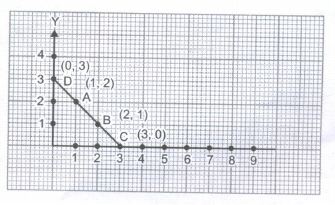
On plotting the given points A(1, 2) and B(2, 1) on the same graph and joining them, we get a straight line AB. When we extend the line AB on both sides, we find that it intersects the x-axis at C(3, 0) and the y-axis at D(0, 3).
5.
Since 125 = 5 \(\times\)5\(\times\)5=53
6-5=(2\(\times\)3)-5 = 2-5 \(\times\) 3-5
\(\therefore \frac { { 2 }^{ -5 }\times { 3 }^{ -5 }\times 125 }{ { 5 }^{ -4 }\times { 6 }^{ -5 } } =\frac { { 2 }^{ -5 }\times { 3 }^{ -5 }\times { 5 }^{ 3 } }{ { 5 }^{ -4 }\times { 2 }^{ -5 }\times { 3 }^{ -5 } } \)
\(=\frac { { 2 }^{ -5 } }{ { 2 }^{ -5 } } \times \frac { { 3 }^{ -5 } }{ { 3 }^{ -5 } } \times { 5 }^{ 3+4 }=1\times { 5 }^{ 7 }\)
=5 \(\times\)5\(\times\)5\(\times\)5\(\times\)5\(\times\)5\(\times\)5 = 78125.
6.
We have
A rational number between -3 and -4
= \(\frac { (-3)+(-4) }{ 2 } =\frac { -7 }{ 2 } \)
A rational number between (-3) and \(\frac { -7 }{ 2 } \)
\(\left[ \left( -3 \right) +\left( \frac { -7 }{ 2 } \right) \right] \div 2=\left[ \frac { -6+(-7) }{ 2 } \right] \times \frac { 1 }{ 2 } \)
= \(\frac { -13 }{ 2 } \times \frac { 1 }{ 2 } =\frac { -13 }{ 4 } \)
A rational number between \(\left( \frac { -7 }{ 2 } \right) \) and (-4)
= \(\left[ \frac { -7 }{ 2 } +(-4) \right] \div 2=\left[ \frac { -7+(-8) }{ 2 } \right] \div 2\)
= \(\frac { -15 }{ 2 } \times \frac { 1 }{ 2 } =\frac { -15 }{ 4 } \)
Thus, the three rational numbers
\(\left( \frac { -7 }{ 2 } \right) ,\left( \frac { -13 }{ 4 } \right) \) and \(\left( \frac { -15 }{ 4 } \right) \) are between (-3) and (-4).
7.
\((\frac{2}{3})^{-2}\times(\frac{2}{3})^{5}\)=\((\frac{2}{3})^{-2+5}\)=\((\frac{2}{3})^{3}=\frac{(2)^{3}}{(3)^{3}}\)
=\(\frac{2\times2\times2}{3\times3\times3}=\frac{8}{27}\)
8.
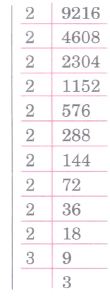
The prime factorisation of 9216 is
9216 = 2\(\times\)2\(\times\)2\(\times\)2\(\times\)2\(\times\)2\(\times\)2\(\times\)2\(\times\)2\(\times\)2\(\times\)3\(\times\)3
By pairing the prime factors, we get
9216 = \(\underline { 2\times 2 } \)\(\times\)\(\underline { 2\times 2 } \)\(\times\)\(\underline { 2\times 2 } \)\(\times\)\(\underline { 2\times 2 } \)\(\times\)\(\underline { 2\times 2 } \)\(\times\)\(\underline { 3\times 3 } \)
So, \(\sqrt { 9126 } \)= 2\(\times\)2\(\times\)2\(\times\)2\(\times\)2\(\times\)3 = 96
9.
\(\begin{matrix} \quad \quad A\quad B \\ \quad \times \quad 6 \\ \_ \_ \_ \_ \_ \_ \_ \_ \_ \\ B\quad B\quad B \\ \_ \_ \_ \_ \_ \_ \_ \_ \_ \_ \end{matrix}\)
Here, we have two letters A and B whose values are to be found, since one's digit of B X 6 is 8, so B must be 2 or 4 or 6 or 8.
Then, possible values of BBB are 222, 444, 666 or 888.
If we divide these numbers by 6, then quotient should be A2 or A4 or A6 or A8.
Now, 222 \(\div\) 6 = 37, remainder = 0
But the quotient is not of the form A2, so B = 2 is not possible.
444 \(\div\) 6 = 74, remainder = 0
Also, quotient is of the form A4, which clearly works well.
Then, the puzzle is solved as shown below:
\(\begin{matrix} \quad \quad 7\quad 4 \\ \quad \times \quad 6 \\ \_ \_ \_ \_ \_ \_ \_ \_ \_ \\ 4\quad 4\quad 4 \\ \_ \_ \_ \_ \_ \_ \_ \_ \_ \_ \end{matrix}\)
Hence, A = 7 and B = 4
10.
3.2F°
11.
We have
\({3\over7}+({-2\over21})\times({-5\over6})={3\over7}+[({-2\over21})\times({-5\over6})]\)
\( \\ ={3\over7}+({-5\over-63})={3\over7}+{5\over63}={27+5\over63}={32\over63}\)
12.
Given number is 212.
Using the formula, the square of any number can be expressed as two integers as
\({ n }^{ 2 }=\frac { { n }^{ 2 }-1 }{ 2 } +\frac { { n }^{ 2 }+1 }{ 2 } \)
\(\therefore \ { 21 }^{ 2 }=\frac { 2{ 1 }^{ 2 }-1 }{ 2 } +\frac { { 21 }^{ 2 }+1 }{ 2 } =\frac { 441-1 }{ 2 } +\frac { 441+1 }{ 2 } \)
\(=\frac { 440 }{ 2 } +\frac { 442 }{ 2 } =220+221\)
which is expressed as the sum of two consecutive numbers.
13.
We have \({-3\over13}+{15\over17}\times{-3\over13}+{17\over15}\)
\(={-3\over13}[1+{15\over17}]+{17\over15}={-3\over13}[{17+15\over17}]+{17\over15}\\
={-3\over13}\times[{32\over 17}]+{17\over15}={-96\over221}+{17\over15} \\ ={-96\times15+221\times17\over221\times15}\\ {-1440+3757\over3315}
={2317\over3315}\)
14.
All properties of operations on rational numbers also hold in case of integers except the following property:
a \(\div\) b is a rational number if b \(\neq\) 0 but a \(\div\)b is not necessarily an integer in case ab \(\in\) J,
All properties of operations on rational numbers also hold in case of whole numbers except the following properties:
(i) If a and b are rational numbers, then (a - b) may or may not be a whole number,
(ii) If a and b are rational numbers, then a\(\div\)b (where b \(\neq\) 0) is not necessarily a whole number,
15.
Here, lowest observation =31
and highest observation = 65
So, we have to take class intervals 30-35, 35-40, 40-45, ... in first column and corresponding frequency i.e. number of students whose weight lie in this class interval, in the second column. Then, frequency distribution table for the above data is given below:
| Class Interval [Weights (in kg)] |
Tally marks | Frequency (Number of students) |
| 30-35 | III | 3 |
| 35-40 | IIII | 4 |
| 40-45 | IIII | 4 |
| 45-50 | .jpg) |
5 |
| 50-55 | I | 1 |
| 55-60 | I | 1 |
| 60-65 | I | 1 |
| 65-70 | I | 1 |
| Total | 20 |

8th Standard CBSE Syllabus & Materials
8th Standard CBSE
CBSE 8th Science Particulate Nature of Matter - New Model Questions Papers Study Material - QB365 Set A
NEW8th Standard CBSE
CBSE 8th Science Pressure, Winds, Stroms and Cyclones - New Model Questions Papers Study Material - QB365 Set A
NEW8th Standard CBSE
CBSE 8th Mathematics Quadrilaterals - New Model Questions Papers Study Material - QB365 Set A
NEW8th Standard CBSE
CBSE 8th Mathematics A story of Numbers - New Model Questions Papers Study Material - QB365 Set A



CBSE 8th Standard CBSE Subjects
CBSE Standards




