
 100% FREE ACCESS
8th Standard CBSE Syllabus & Materials
8th Standard CBSE
CBSE 8th Social Science Theme D - Factors of Production - New Model Questions Papers Study Material - QB365 Set A
NEW8th Standard CBSE
CBSE 8th Social Science Theme C - Universal Franchise and India's Electoral System - New Model Questions Papers Study Material - QB365 Set A
NEW8th Standard CBSE
CBSE 8th Social Science Theme B - The Rise of the Marathas - New Model Questions Papers Study Material - QB365 Set A
NEW8th Standard CBSE
CBSE 8th Social Science Theme B - Reshaping India's Political Map - New Model Questions Papers Study Material - QB365 Set A
NEW8th Standard CBSE
CBSE 8th Social Science Theme A - Natural Resources and Their Use - New Model Questions Papers Study Material - QB365 Set A
NEW8th Standard CBSE
CBSE 8th Science Keeping Time with Skies - New Model Questions Papers Study Material - QB365 Set A

Published on: 10/10/2019
Understanding Quadrilaterals
Download CBSE Class 8th Standard CBSE Mathematics question papers, sample papers, important questions, and previous year solved papers in PDF format. Get free study materials, NCERT solutions, and exam preparation resources for Class 8th Standard CBSE Mathematics
Questions + Answers key
Take MCQ Mathematics Test
1.
Find the number of diagonals in a decagon.
2.
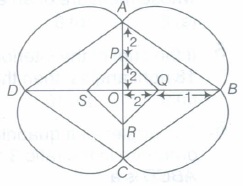
A rangoli has been drawn on the floor of a school's main gate. Participatent of Class VllI th girls for making rangoli, all bring different types of color from market to colour the rangoli (as shown below), where, ABCD and PORS both are in the shape of a rhombus. Find the radius of semi circle drawn on each side of rhombus ABCD. What type of value depict here?
3.
The diagonals of a rhombus are 8 cm and 15 cm. Find its side.
4.
The angle between the two altitudes of a parallelogram through the vertex of an obtuse angle of the parallelogram is 45°. Find the measure of the obtuse angle.
5.
RISE is a rectangle and its diagonals meet at O. If RO = (3x + 15) and 10 = (5x + 7), find the value of x.
6.
PQRS is a rhombus such that perpendicular bisector of PQ passes through the point S. Find the angles of rhombus.
7.
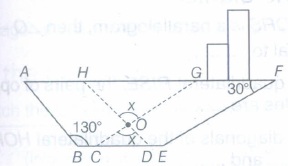
In the following figure of a ship, ABDH and CEFG are two parallelograms. Find the value of x.
8.
A rectangular MORE is shown below:
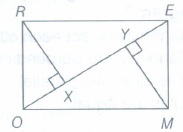
Answer the following questions by giving appropriate reason.
(i) Is RE = OM?
(ii) Is ㄥMYO = ㄥRXE?
(iii) Is ㄥMOY = ㄥREX?
(iv) Is ΔMYO ≅ RXE?
(v) Is MY = RX?
9.
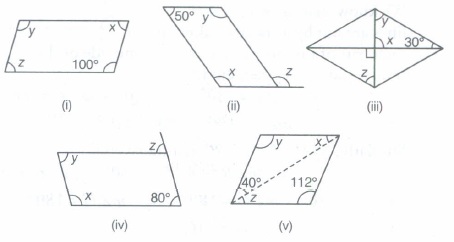
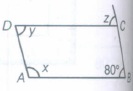
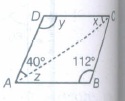
Consider the following parallelograms. Find the values of the unknowns x, y and z.
10.
Given here are some figures.
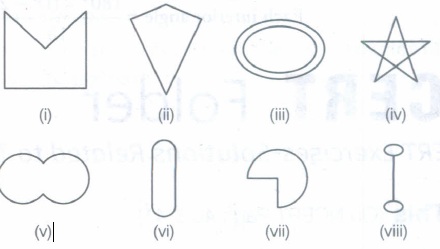
Classify each of them on the basis of the following.
(a) Simple curve
(b) Simple closed curve
(c) Polygon
(d) Convex polygon
(e) Concave polygon
1.
35
2.
In rhombus ABCD,
AO = OP + PA = 2 + 2 ⇒ AO = 4
and OB = OQ + QB = 2 + 1 ⇒ OB = 3
In ΔOAB,
(AB)2 =(OA)2 + (OB)2
[by Pythagoras theorem]
⇒ (AB)2 =(4)2 + (3)2 = 25
⇒ AB=5
Since, AB is diameter of semi-circle.
∴ Radius = \(\frac { 5 }{ 2 } \)=2.5
Hence, radius of the semi-circle is 2.5. The value depict here is participation unity and creativity.
3.
Let ABGD is a rhombus
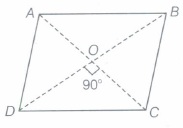
Then, BD = 8 cm, AC =15 cm
and AB = BG = CD = DA
We know that, in a rhombus, diagonals bisect each other at right angles.
So, DO = OB and AO = OC
∴ DO =4 cm and OC = 7.5 cm
Now, we see that a /lDOC is formed such that
ㄥDOC = 90°
∴ (DC)2 = (DO)2 + (OC)2
[∵ in a right angled triangle, the square of the side opposite to the right angle is equal to the sum of the squares of other two sides]
(DC)2 =(4)2 + (7.5)2 = 16+ 56.25
= 72.25 cm2
or DC = \(\sqrt { 72.25 } \) = 8.5 cm
Thus, side of the rhombus is 8.5 cm.
4.
Let ABCD is a parallelogram and the obtuse angles of the parallelogram are ㄥA and ㄥC.
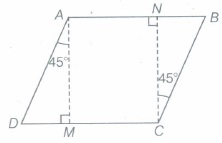
Let AM is the altitude drawn from the vertex A on DG and CN is the altitude drawn from the vertex C on AB.
∴ ㄥDAM = 45° and ㄥNCB = 45° [given]
In ΔAMD, we know that, sum of the interior angles of a triangle is 180°.
ㄥD + 45° + 90° = 180°
ㄥD =180° - 45° - 90°
=180° -135° = 45°
Similarly, in ΔCNB
ㄥB = 45°
Now, ㄥA + ㄥD =180°
[sum of adjacent angles In a paralleloprarn.is 180°]
∴ ㄥA + 45° = 180° [∵ㄥD = 45°]
⇒ ㄥA =180° - 45° =135°
Also, ㄥA = ㄥC
[∵ opposite angles of a parallelogram are equal]
ㄥC =135°
5.
Since,in a parallelogram diagonals bisect each other and we know that, rectangle is a parallelogram.
So, RO= OS and IO= OE
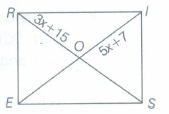
or RS = 2RO and IE = 2OI
∴ RS=2 x (3x + 15) and IE=2 x (5x + 7)
or RS = 6x + 30 and IE = 10x + 14
Now.we again know that, in a rectangle diagonals are equal.
So, RS = IE ⇒ 6x + 30 = 10x + 14
⇒ 30-14=10x - 6x ⇒ 16 = 4x ⇒ 16 x \(\frac { 1 }{ 4 } \)=x
⇒ 4=x ⇒ x=4
6.
Let perpendicular bisector of PQ is TS.
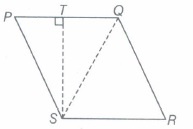
Such that ㄥPTS = ㄥSTQ = 90°
Also, PT = TQ and TS = ST
So, we see that
ΔPTS ≅ ΔQTS [by SAS]
So, we can say that,
P S= SQ
But PQRS is a rhombus.
So, PQ = PS = SQ
So, ΔPQS is an equilateral triangle.
ㄥSPQ = 60° or ㄥR = 60°
[opposite angles of rhombus are equal]
Also, ㄥQ = 180° - 60° = 120°
[∵ adjacent angles of a rhombus are supplementary]
and ㄥQ = ㄥS = 120°
Thus, ㄥP = 60° , ㄥR = 60°
ㄥQ = 120°, ㄥS = 120°
7.
We have, two parallelograms ABDH and EFGC.
ㄥABD = ㄥAHD = 130°
[opposite angles of a parallelogram]
ㄥGHD = 180° - ㄥAHD = 180° - 130°
⇒ 500= ㄥGHO
Also, ㄥEFG + ㄥFGC = 180°
[adjacent angles of a parallelogram]
⇒ 30° + ㄥFGC = 180°
⇒ ㄥFGC =180° - 30° =150°
∴ ㄥHGC =180° - ㄥFGC =180° -150°
=300 = ㄥHGO
Now, in ΔHGO, by using angle sum property,
ㄥOHG + ㄥHGO + ㄥHOG =180°
⇒ 50°+ 30°+ x0 =180°
⇒ x0 =180° - 80° = 100°
8.
(i) Yes, RE = OM
Given, the above rectangle, opposite sides are equal. .
(ii) Yes, ㄥMYO = ㄥRXE
Here, MY and RX are perpendicular to OE.
Since, ㄥRXO = 90° ⇒ ㄥRXE = 900
and ㄥMYE = 90° ⇒ ㄥMYO = 90°
(iii) Yes, ㄥMOY = ㄥREX
Since, these are alternate interior angles.
∵ RE || OM and EO is a transversal.
∴ ㄥMOE = ㄥOER
⇒ ㄥMOY = ㄥREX
(iv) Yes, ΔMYO ≅ RXE
In ΔMYO and ΔRXE, we see that
MO=RE [proved]
ㄥMOY = ㄥREX [proved]
ㄥMYO = ㄥRXE [proved]
∴ ΔMYO ≅ ΔRXE [by AAS]
(v) Yes, MY = RX
Since, these are corresponding part of congruent triangles.
9.
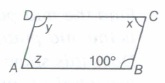
(i) Given, ABCD is a parallelogram in which ㄥB = 100°.
We know that, the sum of any two adjacent angles of a parallelogram is 180°.
ㄥA + ㄥB = 180°
[∴ ㄥA and ㄥB are adjacent angles]
⇒ z+1000=180° ⇒ z=1800-100° =80°
Also, opposite angles of a parallelogram are of equal measure.
∴ ㄥD=ㄥB ⇒ y=1000
and ㄥC=ㄥA ⇒ x=z=80°
Hence, the measure of x, y and z are 80°,100° and 80°, respectively.
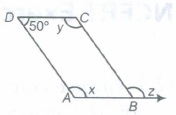
(ii) Let a parallelogram be ABCD in which ㄥD = 50° .
We know that, the sum of any two adjacent angles of a parallelogram is 180°.
∴ ㄥA + ㄥD=50° ⇒ x + 500= 180°
⇒ x = 180°-50° = 130°
Also, opposite angles of a parallelogram are of equal measure.
∴ ㄥC=ㄥA ⇒ y=x=1300 and ㄥB=ㄥD=50°
Now, ㄥB + exterior ㄥB = 180°
⇒ 50° + z = 180° [by linear pair angle]
⇒ z = 1800- 50° = 130°
Hence, the measure of angles x, y and z are 130°, 130° and 130° , respectively.
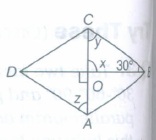
(iii) Let a parallelogram be ABCD, in which ㄥCBO = 30°. Here, AC and BD intersect each other at O and ㄥAOD=90°.
∴ ㄥCOB = ㄥAOD=90°
[vertically opposite angles]
We know that, the sum of three angles of a triangle is 180°.
In ΔOBC,
ㄥCOB + ㄥOCB + ㄥCBO = 180°
⇒ 90° +y +30° = 180° ⇒ Y + 120° = 1800
y=1800 - 1200= 600
As AD II BC and AC is a transversal.
y = z = 60° [alternate interior angles]
Hence, the measure of angles x, y and z are 90°, 60 and 60° , respectively.
(iv) Let parallelogram be ABCD, in which ㄥB = 80°
We know that, the sum of any two adjacent angles of a parallelogram is 180°.
∴ ㄥB + ㄥC = 180° ⇒ 800+ ㄥC= 180°
⇒ ㄥC = 180° - 80°= 100°
Also, ㄥC + exterior ㄥC = 180° [by linear pair
:. exterior LC or z = 180° - 80°= 100°
Also, opposite angles of a parallelogram are of equal measure.
So, ㄥA = ㄥC ⇒ x = 100°
and ㄥD = ㄥB ⇒ y = 80°
Hence, the measure of angles x, y and z are 100°,80° and 100°, respectively.
(v) Let parallelogram be ABCD, in which
ㄥB = 112° and ㄥDAC = 40°.
We know that, the sum of any two adjacent angles of a parallelogram is 180°.
∴ ㄥA + ㄥB = 180°
⇒ (40° + z) + 112° = 180°
⇒ 400 + z + 112° = 180° ⇒ z+152°=1800
⇒ z = 1800-152°=280
Also, opposite angles of a parallelogram are of equal measure.
So, ㄥD = ㄥB ⇒ y=112°
Now, in ㄥACD, using angle sum property of a triangle,
ㄥCAD + ㄥD + ㄥDCA = 1800
⇒ 400+y+x=1800
⇒ 40° +112° + x = 180°
⇒ 152° + x =1800 - x=1800-152°=280
Hence, the values of x, y and z are 280, 112° and 28°, respectively.
10.
(a) Simple curve A plane figure formed by joining a number of points without lifting a pencil from the paper and without returing any portion of the drawing other than single points is called a simple curve or curve. In the given figures, simple curves are figures (i), (ii), (v), (vi) and (vii).
(b) Simple closed curve A closed curve, which does not intersect itself, is called a simple closed curve. In the given figures, simple closed curves are figures (i), (ii), (v), (vi) and (vii).
(c) Polygon A polygon is a closed curve formed by the line segments such that
(i) no two line segments intersect except at their end points.
(ii) no two line segments with a common end points are coincide. In other words, a simple dosed curve made upto only line segments is called a polygon. In the given figures, polygons are figures (i) and (ii).
(d) Convex polygon A convex polygon is a polygon in which each interior angle has a measure less than 180°. In other words, a polygon is convex, if noportion of their diagonals in their exterior. In the given figures, convex polygon is figure (ii).
(e) Concave polygon A concave polygon is a polygon, which atleast one interior angle has measure more than 180°, i.e. atleast one segment connecting two vertices is outside the polygon. In the given figure, concave polygons are figures (i) and (iv).

8th Standard CBSE Syllabus & Materials
8th Standard CBSE
CBSE 8th Science Particulate Nature of Matter - New Model Questions Papers Study Material - QB365 Set A
NEW8th Standard CBSE
CBSE 8th Science Pressure, Winds, Stroms and Cyclones - New Model Questions Papers Study Material - QB365 Set A
NEW8th Standard CBSE
CBSE 8th Mathematics Quadrilaterals - New Model Questions Papers Study Material - QB365 Set A
NEW8th Standard CBSE
CBSE 8th Mathematics A story of Numbers - New Model Questions Papers Study Material - QB365 Set A



CBSE 8th Standard CBSE Subjects
CBSE Standards




