
 100% FREE ACCESS
8th Standard CBSE Syllabus & Materials
8th Standard CBSE
CBSE 8th Social Science Theme D - Factors of Production - New Model Questions Papers Study Material - QB365 Set A
NEW8th Standard CBSE
CBSE 8th Social Science Theme C - Universal Franchise and India's Electoral System - New Model Questions Papers Study Material - QB365 Set A
NEW8th Standard CBSE
CBSE 8th Social Science Theme B - The Rise of the Marathas - New Model Questions Papers Study Material - QB365 Set A
NEW8th Standard CBSE
CBSE 8th Social Science Theme B - Reshaping India's Political Map - New Model Questions Papers Study Material - QB365 Set A
NEW8th Standard CBSE
CBSE 8th Social Science Theme A - Natural Resources and Their Use - New Model Questions Papers Study Material - QB365 Set A
NEW8th Standard CBSE
CBSE 8th Science Keeping Time with Skies - New Model Questions Papers Study Material - QB365 Set A

Published on: 24/09/2019
Understanding Quadrilaterals
Download CBSE Class 8th Standard CBSE Mathematics question papers, sample papers, important questions, and previous year solved papers in PDF format. Get free study materials, NCERT solutions, and exam preparation resources for Class 8th Standard CBSE Mathematics
Questions + Answers key
Take MCQ Mathematics Test
1.
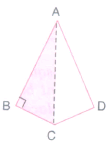
Show that \(\Delta\) ABC and \(\Delta\) ADC are congruent. What do we infer from this?
2.
Take a thick white sheet.
Fold the paper once.
Draw two line segments of different lengths as shown in the figure.
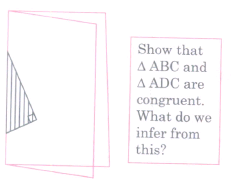
Cut along the line segments and open up.
You have the shape of a kite.
Has the kite any line symmetry?
Fold both the diagonals of the kite. Use the set-square to check if they cut at right angles. Are the diagonals equal in length?
Verify by (paper-folding or measurement) if the diagonals bisect each other.
By folding an angle of the kite on its opposites, check for angles of equal measure. Observe the diagonal folds; do they indicate any diagonal being an angle bisector? Share your findings with others and list them.
3.
In a quadrilateral ABCD, DO and CO are the bisectors of \(\angle\)D and \(\angle\)C respectively. Prove that \(\angle\)COD = \(\frac { 1 }{ 2 } \)[\(\angle\)A + \(\angle\)B].
4.
The measures of two adjacent angles of a parallelogram are in the ratio 4:5. Find the measure of each of the angles of the parallelogram.
5.
In a quadrilateral ABCD, the angles A, B, C and D are in the ratio 1: 2 : 3: 4. Find the measure of each angle of the quadrilateral.
6.
In the adjoining figure, find x + y + z + w.
7.
Find the measure of each interior angle of a regular heptagon.
8.
In a rhombus ABCD, if AB = 10 cm and BD = 16 cm, then find the length of diagonal AC .
9.
If an angle of a parallelogram is two-third of its adjacent angle, then find the smallest angle of the paralleloqrarn.
10.
Find the measure of each interior angle of a regular
(a) pentagon
(b) octagon.
11.
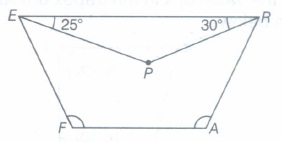
In a trapezium FARE, EP and RP are bisectors of ㄥE and ㄥR, respectively. Find ㄥFAR and ㄥEFA.
12.
The sides of a pentagon are produced in order and the exterior angles, so obtained are of measure x0 ,(3x)0 ,(4x + 10)0, (2x +5)0 and (5x)0 ,respectively. Find the value of x and measure of each exterior angle of a pentagon.
13.
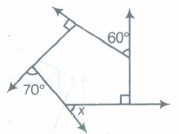
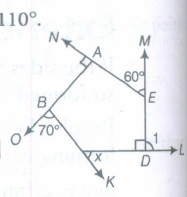
Find x, in the following figures.
14.
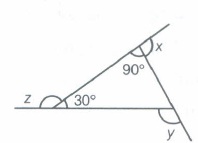
Find x + y + z
15.
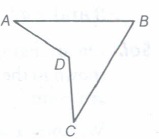
These quadrilaterals were convex. What would happen, if the quadrilateral is not convex? Consider quadrilateral ABCD. Split it into two triangles and find the sum of the interior angles in adjoining figure.
1.
In \(\Delta\) ABC and \(\Delta\) ADC
AB = AD
| One pair of consecutive sides BC = DC
| Other pairs of consecutive sides AC = AC | Common
\(\therefore\) \(\Delta\) ABC \(\cong \) \(\Delta\) ADC
| SSS Congruence Axiom
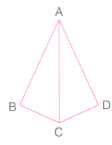
\(\therefore \angle BAC=\angle DAC\) | CPCT
\(\angle BCA=\angle DCA\) | CPCT
i.e., diagonal AC bisects \(\angle BAD\) and \(\angle BCD\) each.
2.
The kite has only one line of symmetry shown by dotted line segment (a diagonal) AC. and \(\angle B=\angle D\)
The diagonal AC is an angle bisector as it bisects \(\angle A\) and \(\angle C\) both.
Yes; the diagonals cut at right angles.
No; the diagonals are not equal in length.
Yes; one of the diagonals bisect the other.
3.
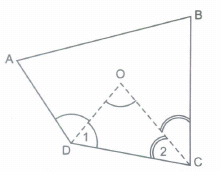
In \(\Delta\)COD, we have \(\angle\)COD + \(\angle\)1 + \(\angle\)2 = 180o
\(\Rightarrow\) \(\angle\)COD = 180o - [\(\angle\)1 + \(\angle\)2]
\(\Rightarrow\)\(\angle\)COD = 180o - \(\left[ \frac { 1 }{ 2 } \angle D+\frac { 1 }{ 2 } \angle C \right] \)
\(\Rightarrow\) \(\angle\)COD = 180o - \(\frac { 1 }{ 2 } \left[ \angle D+\angle C \right] \)
But \(\angle\)A + \(\angle\)B + \(\angle\)C + \(\angle\)D = 360o
\(\Rightarrow\) \(\angle\)C + \(\angle\)D = 360o - (\(\angle\)A + \(\angle\)B )
\(\therefore\)\(\angle\)COD = 180o - \(\frac { 1 }{ 2 } \)[360o - (\(\angle\)A + \(\angle\)B)
= 180o - \(\frac { 1 }{ 2 } \)[360o] + \(\frac { 1 }{ 2 } \)[\(\angle\)A + \(\angle\)B]
= 180o - 180o + \(\frac { 1 }{ 2 } \)(\(\angle\)A + \(\angle\)B) = \(\frac { 1 }{ 2 } \)(\(\angle\)A + \(\angle\)B)
Thus, \(\angle\)COD = \(\frac { 1 }{ 2 } \)[\(\angle\)A + \(\angle\)B]
4.
Let ABCD be a parallelogram such that \(\angle\)A and \(\angle\)B are 4x and 5x respectively.
Since, the adjacent angles are supplementary,
\(\therefore\)\(\angle\)A + \(\angle\)B = 180°
4x + 5x = 180°
\(\Rightarrow\) 9x = 180o \(\Rightarrow\) x = \(\frac { { 180 }^{ o } }{ 9 } \)=20o
\(\therefore\)\(\angle\)A = 4x = 4 x 20o = 80o and \(\angle\)B = 5x = 5 x 20o
We know that opposite angles of a parallelogram are equal.
\(\angle\)C = \(\angle\)A = 80° And \(\angle\)D = \(\angle\)B = 100°
Thus, \(\angle\)A = 80°, \(\angle\)B = 100°, \(\angle\)C = 80° and \(\angle\)D = 100°
5.
\(\because \)\(\angle\)A : \(\angle\)B : \(\angle\)C : \(\angle\)D = 1 : 2 : 3 : 4
\(\therefore\)Let us suppose that
\(\angle\)A = 1xo, \(\angle\)B = 2xo
\(\angle\)C = 3xo, \(\angle\)D = 4xo
Since, \(\angle\)A + \(\angle\)B + \(\angle\)C + \(\angle\)D = 360°
:. x + 2x + 3x + 4x = 360°
\(\Rightarrow\)10x = 360°\(\Rightarrow\)x = \(\frac { { 360 }^{ o } }{ 10 } \) = 36o
\(\therefore\)Angles are: \(\angle\)A = xo = 36°
\(\angle\)B = 2xo = 2 x 36° = 72°
\(\angle\)C = 3xo = 3 x 36° = 108°
\(\angle\)D= 4xo = 4 x 36° = 144°
Thus, the measure of the angles of the quad. are
36°, 72°, 108° and 144°
6.
Since, the sum of the measures of interior angles of a quadrilateral is 360°.
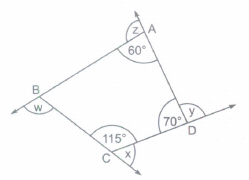
Also, 115° + 70° + 60° = 245°
\(\therefore\)245° + LABC = 360°
\(\Rightarrow\)\(\angle \)ABC = 360° - 245° = 115°
Now, x = ext. \(\angle\)BCD = 180° - \(\angle\)BCD
= 180° - 115° = 65°
Similarly, y = 180° - 70° = 110°
z = 180° - 60° = 120°
w = 180° - 115° = 65°
\(\therefore\)x +y + z + w = 65° + 110°+ 120° + 65° = 360°
7.
128.50
8.
12 cm
9.
72°
10.
(a) 108°
(b) 135°
11.
We have, FARE is a trapezium, where ER II FA and EP and RP are bisectors of LE and LR respectively.
Thus, ㄥPEF = ㄥPER and ㄥPRE = ㄥPRA
∴ ㄥPEF = 25° and ㄥPRA = 30°
So, ㄥE = 25° + 25° = 50°
and ㄥR = 30° + 30° = 60°
Now, we know that in a trapezium,
ㄥE + ㄥF =180° and ㄥR + ㄥA =180°
∴ ㄥF =180° - 50° =130°
and ㄥA =180° - 60° =120°
or ㄥEFA =130° and ㄥFAR =120°
12.
We know that, the sum of exterior angles of a regular polygon is 360°.
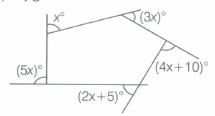
So, x0+ (3x)0 + (4x + 10)0 + (2x + 5)0+ (5x)0 = 3600
⇒ 15x+150 =3600 ⇒ 15x=3600-150
⇒ 15x=3450 ⇒ \(\frac { { 345 }^{ 0 } }{ 15 } \)=230
∴ 3x0 = 3 x 23 = 69° ,
4x + 10 = 4 x 23 + 10= 92 + 10 = 102° ,
2x + 5 = 2 x 23 + 5 = 46 + 5 = 5t~,
5x = 5 x 23 = 115°
x =23°
So, exterior angles are 23° ,69° ,102° ,51° and 115°.
13.
Let given polygon be
ABCDE It is clear that, AB is a straight line.
90° + ㄥ1 = 180°
[by linear pair angle]
⇒ ㄥ1 = 1800 - 900 = 900
Now, x +90° +60° +90° + 70° = 360°
The sum of the exterior angles of any polygon is 360°.
⇒ x + 3100 = 360°
⇒ x = 3600-3100= 50°
Hence, the measure of angle x is 50°.
14.
We know that, the sum of three angles of a triangle is 180°.
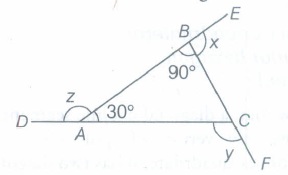
Let the given triangle be ABC.
∴ ㄥA + ㄥB+ ㄥC =180°
⇒ 300 + 900+ ㄥC=180° ⇒ ㄥC+1200=180°
⇒ ㄥC = 180° - 120° = 60°
Now, ㄥEBC + ㄥABC = 180° [by linear pair]
∴ x +90° = 180° ⇒ x = 180° - 90° = 90°
Similarly, ㄥFCA + ㄥACB = 180° [by linear pair]
⇒ y+600=180° ⇒ y=1800-600=120°
and ㄥDAB + ㄥBAC = 180° [by linear pair]
⇒ z + 30° = 180° ⇒ z = 180° - 30° = 150°
∴ x + y + z = 90° + 120° + 150° = 360°
Hence, the value of x + y + z is 360°
15.
If a quadrilateral is not convex, then it will be concave. In the quadrilateral ABCD, join BD. Then, quadrilateral split into two triangles.
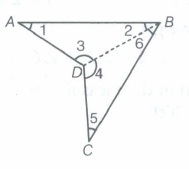
In ΔADB, we have
mㄥ1 + mㄥ2 + mㄥ3 = 180°
[using angle sum property of a traingle] ... (i)
In ΔBDC, we have
mㄥ4 + mㄥ5 + mㄥ6 = 180°
[using angle sum property of a triangle] ... (ii)
On adding Eqs. (i) and (ii), we get
mㄥ1 + mㄥ2 + mㄥ3 + mㄥ4 + mㄥ5 +mㄥ6 = 180°+180°
⇒ mㄥ1 + mㄥ2 + mㄥ6+ mㄥ5 + (mㄥ3 + mㄥ4) = 360°
∴ mㄥA + mㄥB + mㄥC + mㄥD = 360°
Hence, the sum of the interior angles of a quadrilateral is 360°.

8th Standard CBSE Syllabus & Materials
8th Standard CBSE
CBSE 8th Science Particulate Nature of Matter - New Model Questions Papers Study Material - QB365 Set A
NEW8th Standard CBSE
CBSE 8th Science Pressure, Winds, Stroms and Cyclones - New Model Questions Papers Study Material - QB365 Set A
NEW8th Standard CBSE
CBSE 8th Mathematics Quadrilaterals - New Model Questions Papers Study Material - QB365 Set A
NEW8th Standard CBSE
CBSE 8th Mathematics A story of Numbers - New Model Questions Papers Study Material - QB365 Set A



CBSE 8th Standard CBSE Subjects
CBSE Standards




