
 100% FREE ACCESS
8th Standard CBSE Syllabus & Materials
8th Standard CBSE
CBSE 8th Social Science Theme D - Factors of Production - New Model Questions Papers Study Material - QB365 Set A
NEW8th Standard CBSE
CBSE 8th Social Science Theme C - Universal Franchise and India's Electoral System - New Model Questions Papers Study Material - QB365 Set A
NEW8th Standard CBSE
CBSE 8th Social Science Theme B - The Rise of the Marathas - New Model Questions Papers Study Material - QB365 Set A
NEW8th Standard CBSE
CBSE 8th Social Science Theme B - Reshaping India's Political Map - New Model Questions Papers Study Material - QB365 Set A
NEW8th Standard CBSE
CBSE 8th Social Science Theme A - Natural Resources and Their Use - New Model Questions Papers Study Material - QB365 Set A
NEW8th Standard CBSE
CBSE 8th Science Keeping Time with Skies - New Model Questions Papers Study Material - QB365 Set A

Published on: 07/09/2019
Mensuration
Download CBSE Class 8th Standard CBSE Mathematics question papers, sample papers, important questions, and previous year solved papers in PDF format. Get free study materials, NCERT solutions, and exam preparation resources for Class 8th Standard CBSE Mathematics
Questions + Answers key
Take MCQ Mathematics Test
1.
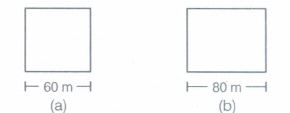
A square and a rectangular field with measurements as given in the figure have the same perimeter. Which field has a larger area?
2.
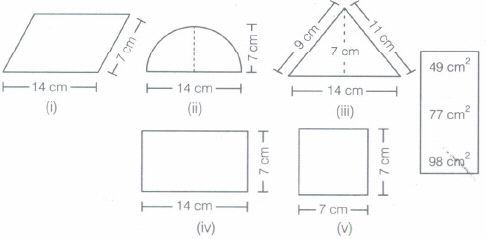
Match the following figures with their respective areas in the box
3.
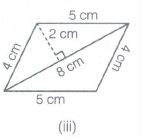
Find the area of these quadrilateral
4.
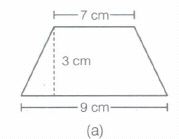
Find the area of the following trapezium
5.
The diagonals of two squares are in the ratio 3 : 2. Find the ratio of their areas.
6.
The ratio of the length and breadth of a rectangle is 5 : 3. If length is 8 m more than breadth, then find the area of the rectangle.
7.
The length of a rectangular field is 100 m and its breadth is 40 m. What will be the area of the field?
8.
Find the area of a rhombus whose one side measures 5 cm and one diagonal as 8 cm.
9.
160m3 of water is to be used to irrigate a rectangular field, whose area is 800 m2. What will be the height of the water level in the field?
10.
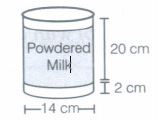
A company packages its milk powder in cylindrical container whose base has a diameter of 14 cm and height 20 cm. Company places a label around the surface of the container(as shown in the figure). If the label is placed 2 cm from top and bottom, what is the area of the label?
11.
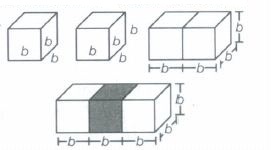
Two cubes each with side b are joined to form a cuboid (see the figure) .What is the surface area of this cuboid? Is it 12b2? Is the surface area of cuboid formed by joining three such cubes, 18b2? Why?
12.
Find the area of a rhombus whose side is 5 cm and whose altitude is 4.8 cm. If one of its diagonal is 8 cm long, find the length of the other diagonal.
13.
Surface area of four walls of a room whose length, breadth and height are respectively the
2 [Ih + bh + hi]
2 [Ib + hl]
2 [Ib + bh]
2 [bh + hl]
14.
Radius of a circle is 7cm. Its perimeter
44 cm
36 cm
58 cm
154 cm
15.
The ratio of radii of two cylinders is 1: 2 and heights are in the ratio 2 : 3. The ratio of their volumes is
1:6
2:9
1:3
1:9
16.
Three cubes of metal whose edges are 6 cm, 8 cm and 10 cm respectively, are melted to form a single cube. The edge of the new cube is
6 cm
12 cm
8 cm
18 cm
17.
A cube of side 5 cm is painted on all its faces. If it is sliced into 1 cubic centimetre cubes, how many 1 cubic centimetre cubes will have exactly one of their faces painted?
27
42
54
142
18.

Find Shape, Area?
19.
1 cm3= 1 cm x 1 cm x 1 cm = ... mm3
20.
The surface area of a cuboid formed by joining two cubes of sides c face to face is_______
21.
A cube of side 5 cm is cut into 1 cm cubes. The percentage increase in volume after each such cutting is ____
22.
Two cubes have volumes in the ratio 1: 64. The ratio of the area of a face of first cube to that of the other is______
23.
Two cylinders of same volume have their radii in the ratio 1 : 6, then ratio of their heights is 216 :1.
24.
Volumes of a solid is the measurement of the space occupied by it.
25.
Two cuboids with equal volumes will always have equal surface areas.
26.
The area of trapezium becomes 4 times if its height gets doubled.
27.
The areas of any two faces of a cuboid are equal
1.
Condition is given, here a square and a rectangular field have the same perimeter.
Given, side of a square field = 60 m
∴ Perimeter of square field = 4 Side = 4\(\times\) 60m = 240 m
and area of square field = (side)2= (60)2 = 60m\(\times\) 60m
= 3600 m2
Also, given lengrh of rectangular field = 80 m
Let breadth of rectangular field be x m.
According to the question,
Perimeter of square = Perimeter of rectangle
Perimeter of rectangular field = 240 m
Also, perimeter of a rectangular field = 2 (Length + Breadth)
∴ 2(80 + x) = 240 ⇒ (80+x) = \(\frac { 240 }{ 2 } \)
⇒ 80 + x = 120
⇒ x = 120- 80 ⇒ x = 40
Now, area of rectangular field = Length \(\times\) Breadth
= 80 m x 40m = 3200 m2
Here, it is clear that, 3600 > 3200
∴ Area of square field> Area of rectangular field
Hence, square field has a larger area.
2.
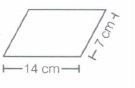
(i) Given figure is a parallelogram in which base (b) is 14 cm and height (h) is 7 cm.
∴ Area of parallelogram = b\(\times\) h
= 14\(\times\) 7 = 98cm2
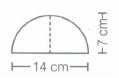
(ii) Given figure is a semi-circle, whose radius (r) is 7 cm.
∴ Area of semi CircIe = \(\frac { 1 }{ 2 } { \pi r }^{ 2 }\)
= \(\frac { 1 }{ 2 } \times \frac { 22 }{ 7 } \times (7)^{ 2 }\) \(\left[ \because \pi =\frac { 22 }{ 7 } \right] \)
= 11 \(\times\)7 = 77 cm2
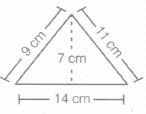
(iii) Given figure is a triangle in which base is 14 cm and height is 7 cm
∴ Area of rectangle = \(\frac { 1 }{ 2 } \) \(\times\)Base\(\times\) Height
= \(\frac { 1 }{ 2 } \) \(\times\) 14\(\times\) 7 = 49 cm2
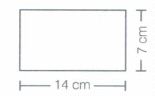
(iv)Given figure is a rectangle whose length is 14 cm and breadth is 7 cm.
∴ Area of rectangle =Length \(\times\)Breadth
= 14\(\times\) 7 = 98 cm2
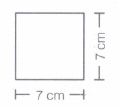
(v) Given figure is a square whose side is 7 cm
∴ Area of square = (Side)2
= (7)2
=49 cm2
Hence, the required matching is given below
| Figures | Areas |
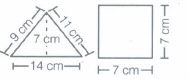 |
49 cm2 |
|
77 cm2 |
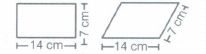 |
98 cm2 |
3.
Let given figure be a quadrilateral a ABCD, which is a parallelogram and its diagonal divides it into two congruent triangles. So, base of these two congruent triangles is 8 ern and height is 2 crn (from the figure).
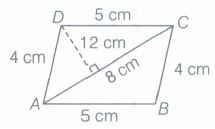
∴ Area of parallelogram = 2 \(\times\)(Area of ΔADC) = 2\(\times\) \(\left( \frac { 1 }{ 2 } \times 8\times 2 \right) \)
[∵ area of triangle =\(\frac { 1 }{ 2 } \) \(\times\)base \(\times\)height]
= 2 \(\times\)8 = 16 cm2
4.
We know that
Area of trapezium= \(\frac { 1 }{ 2 } \times \) (Sum of parallel sides) \(\times\) Height
Here, height of trapezium = 3 cm and parallel sides are 9 cm and 7 cm
∴ Required area of trapezium = \(\left[ \frac { 1 }{ 2 } \times (9+7)\times 3 \right] \)
= \(\frac { 1 }{ 2 } \times \)16 \(\times\)3 = 8 \(\times\)3 = 24 cm2
5.
9 :4
6.
240 m2
7.
400 m2
8.
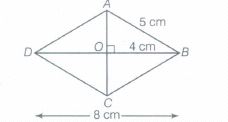
Let ABCD be the rhombus as shown below:
DO= OB = 4 cm, since diagonals of a rhombus are perpendicular bisectors of each other. By using Pythagoras theorem in ΔAOB
AO2+OB2 AB2
AO = \(\sqrt { { AB }^{ 2 }-OB^{ 2 } } =\sqrt { 5^{ 2 }-4^{ 2 } } \) =3 cm
∴ AC = 2 \(\times\) 3 = 6 cm [∵ AC =2 A0]
Thus,area of the rhombus
=\(\frac { 1 }{ 2 } \times \) d1\(\times\)d2 = 8\(\times\)6 =2\(\times\)4 cm2
9.
Volume of water = 160 m3
Area of rectangular field = 800 m2
Let h be the height of water level in the field.
Now, volume of water = Volume of cuboid formed on the field by water
⇒ 160= Area of base x Height
⇒ 160 = 800\(\times\)h
∴ h = \(\frac { 160 }{ 800 } \)=0.2 m
Hence, the required height is 0.2 m.
10.
Given,diameter of base of cylindrical container = 14 cm
∴ Radius of base of cylindrical container, r =\(\frac { 14 }{ 7 } \) =7cm and height of cylindrical container = 20 cm
Now, label is placed 2 ern from top and bottom.
∴ Height of label, h = (20 - 2 - 2) = 16 cm
Now, area of label = Cured surface area of cylindrical portion of which label is placed
= \(2\pi rh=2\times \frac { 22 }{ 7 } \times 7\times 16=704\quad cm^{ 2 }\) [∵ radius = 7 cm]
Hence, area of the label is 704 cm2
11.
By joining two cubes end-to-end each with side b. We get, a cuboid whose length = b + b = 2b, breadth = b and height = b
∴ Total surface area of this cuboid =2(LB+BH+HL)
= 2(2b\(\times\)b+b\(\times\)b+b\(\times\)2b) = 2(2b2+b2+2b2) = 2\(\times\)5b2 =10b2
So, surface area of cuboid formed by joining two cubes is not equal to 12b2 , it is 10b2
Now, by joining three cubes end-to-end each with side b.
We get, a cuboid whose length = b + b + b = 3b, breadth = b and height = b
∴ Total surface area of this cuboid = 2(LB + BH + HL)
= 2(3b\(\times\)b+b\(\times\)b+b\(\times\)3b)
=2\(\times\)(3b2+b2+3b2) = 2\(\times\)7b2 =14b2
So, the surface area of cuboid formed by joining three such cuboid is, it is not equal to 18b2, it is 14b2
12.
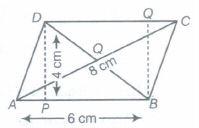
Let ABCD be a rhombus.
Given, side (AB) = 6 cm,altitude (PD) = 4 cm and diagonal (AC) = 8 cm
Let other diagonal BD be x cm.Now, area of a rhombus = base \(\times\)altitude = 6cm\(\times\)4cm =24 cm2
Also,area of a rhombus =\(\frac { 1 }{ 2 } \times \) d1 \(\times\)d2
⇒ 24= \(\frac { 1 }{ 2 } \times \)x1 \(\times\)x2
⇒ 24 = 4\(\times\)d2
⇒ x =\(\frac { 24 }{ 4 } \) =6 cm
Hence, length of the other diagonal of rhombus is 6 cm.
13.
(d)
2 [bh + hl]
14.
(b)
36 cm
15.
(a)
1:6
16.
(b)
12 cm
17.
(c)
54
18.
()
Triangle;\(\frac{1}{2}\times b\times h\)
19.
()
100
20.
Side of both the cubes = c
On joining two cubes of side c each, we get length of the formed cuboid as c + c = 2c, breadth = c and height = c
∴ Surface area of the cuboid, so formed = 2(lb+bh+hl)
= 2( 2c\(\times\)c + c\(\times\)c + c\(\times\)2c) = 2(2c2 + c2 + 2c2) = 10c2
21.
None: on cutting a cube into number of cubes, we have no change in volume of the cube. So, there will be no percentage increase in the volume.
22.
Let the side of the first cube be a and other be b.
∴ \(\frac { { a }^{ 3 } }{ b^{ 3 } } =\frac { 1 }{ 64 } \Rightarrow \frac { { a }^{ 3 } }{ b^{ 3 } } =\left( \frac { 1 }{ 4 } \right) ^{ 3 }\)
⇒ \(\frac { a }{ b } =\frac { 1 }{ 4 } \Rightarrow a=\frac { b }{ 4 } \)
∴ Area of face of first cube = a2 = \(\left( \frac { b }{ 4 } \right) ^{ 2 }=\frac { { b }^{ 2 } }{ 16 } \)
and area of face of other cube = b2
∴ Required ratio =\(\frac { { b }^{ 2 } }{ 16 } \)= b2 =1:16
23.
(b)
24.
(a)
25.
(b)
26.
(b)
27.
(b)

8th Standard CBSE Syllabus & Materials
8th Standard CBSE
CBSE 8th Science Particulate Nature of Matter - New Model Questions Papers Study Material - QB365 Set A
NEW8th Standard CBSE
CBSE 8th Science Pressure, Winds, Stroms and Cyclones - New Model Questions Papers Study Material - QB365 Set A
NEW8th Standard CBSE
CBSE 8th Mathematics Quadrilaterals - New Model Questions Papers Study Material - QB365 Set A
NEW8th Standard CBSE
CBSE 8th Mathematics A story of Numbers - New Model Questions Papers Study Material - QB365 Set A



CBSE 8th Standard CBSE Subjects
CBSE Standards




