
 100% FREE ACCESS
8th Standard CBSE Syllabus & Materials
8th Standard CBSE
CBSE 8th Social Science Theme D - Factors of Production - New Model Questions Papers Study Material - QB365 Set A
NEW8th Standard CBSE
CBSE 8th Social Science Theme C - Universal Franchise and India's Electoral System - New Model Questions Papers Study Material - QB365 Set A
NEW8th Standard CBSE
CBSE 8th Social Science Theme B - The Rise of the Marathas - New Model Questions Papers Study Material - QB365 Set A
NEW8th Standard CBSE
CBSE 8th Social Science Theme B - Reshaping India's Political Map - New Model Questions Papers Study Material - QB365 Set A
NEW8th Standard CBSE
CBSE 8th Social Science Theme A - Natural Resources and Their Use - New Model Questions Papers Study Material - QB365 Set A
NEW8th Standard CBSE
CBSE 8th Science Keeping Time with Skies - New Model Questions Papers Study Material - QB365 Set A

Published on: 29/10/2025
Download CBSE Class 8th Standard CBSE Science question papers, sample papers, important questions, and previous year solved papers in PDF format. Get free study materials, NCERT solutions, and exam preparation resources for Class 8th Standard CBSE Science
Questions + Answers key
Take MCQ Science Test
1.
Supriya's teacher told in class that food provides us with energy. However, she remembered the previous class in which a part of cell was said as powerhouse because it provides energy. She got very confused and decided to ask her teacher about it. The teacher smiled and explained her clearly
(a) Name the cell organelle is called as powerhouse of the cell.
(b) The powerhouse is related to energy. How is energy obtained?
(c) Mention the values displayed by Supriya
2.
Outline the structural hierarchy that is found in all organisms.
3.
Nucleus is removed from a cell. What is most likely to happen?
4.
In a multicellular organism, all cells have the ability to perform all life functions. State whether it is true or not. Give reason for your answer.
5.
Write short notes on the following.
(a) Cytoplasm
(b) Nucleus of a cell.
6.
In 1831, an important discovery was discovered in a cell. What was it?
7.
Name two organisms that are made up of a single cell.
8.
Name the three parts of a cell very important for its functioning.
9.
Explain why chloroplasts are found only in plant cell?
10.
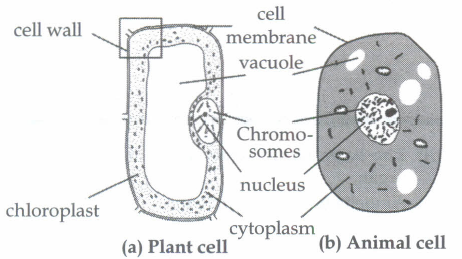
Make sketches of animal and plant cells. State three differences between them.
11.
The size of the cells of an organism has no relation with the size of its body. Do you agree? Give reason for your answer.
12.
We read about various organelles present in a cell. Explain what is an organelle. Name the organelles that are found in most cells. What is the function of nucleus?
13.
Which of the following is not a plastid?
Chloroplast
Chromoplast
Leucoplast
Ribosome
14.
A suitable term for the various components of cells is
tissue
cell organelles
chromosomes
genes
15.
Out of the following, which animal is unicellular?
Amoeba
Paramecium
Bacteria
All of these
16.
Which one of the following terms is not a part of the nucleus?
Ribosome
Chromosome
Nucleolus
Gene
17.
The structural and functional unit of life called cell was discovered by
Robert Boyle
Charles Darwin
Robert Koch
Robert Hooke
18.
Cell was discovered in..................
19.
.............is called kitchen of the cell.
20.
The shape and size of a cell are related to its...................
21.
Cells in which nuclear membrane is absent from the nucleus are called................cells.
22.
...............is a unicellular aquatic animal.
23.
Amoeba has irregular shape.
24.
Unicellular organisms have one-celled body.
25.
The living substance in a cell is called organelle.
26.
Plastids are present in animal cells
27.
Nerve cell is branched and long
1.
(a) Mitochondria is called powerhouse of the cell.
(b) The energy from the food is released into the mitochondria, from where it is used by cell for various activities.
(c) Supriya is intelligent, attentive and has scientific attitude and knowledge
2.
The structural hierarchy found in organisms starts from the cell that is the basic structural unit in all living organisms. Similar cells combine to form tissues, tissues combine to form organs, organs work together to form organ systems and all the different organ system, combine to form the organism.
3.
It is said that the nucleus controls all the metabolic activities as well as formation of various cell organelles. Thus, if the nucleus is removed, it will adversely affect the organism. In organism such as Amoeba, removal of nucleus may even lead to death.
4.
In a multicellular organism, all cells do not have the capability to perform all life functions. Thus, the given statement is false.
Although each cell can carry out the important functions of life, it is not capable of existing on its own, e.g. A muscle cell cannot obtain its own food or oxygen. Other specialised cells in the body collect food or oxygen.
All the cells do not perform all the jobs, different tasks or functions are divided among different groups of cells.
5.
(a) Cytoplasm It is a jelly-like substance, present between the cell membrane and the nucleus. It encloses tiny structures called cell organelles that perform different functions. It also contains water, sugar, proteins, minerals, etc.
(b) Nucleus of a cell It is a spherical component of cell commonly located in the centre of cell. It is covered by porous nuclear membrane and contains genetic material like RNA and DNA. It also contains thread-like structures called chromosomes which carry genes. Nucleus controls various activities of the cell and play role in inheritance.
6.
Robert Brown in 1831 discovered the nucleus in the cell.
7.
Amoeba and Paramecium are unicellular organisms that made up of single cell.
8.
Three important parts of a cell are cell membrane,cytoplasm and nucleus
9.
Chloroplasts are found only in plant cells because plants synthesise their own food in the leaves. Chloroplast contains green pigment called chlorophyll which is essential for making food by the process called photosynthesis and also imparts green colour to the leaves.
10.
Three main differences between plant and animal cells are as follows:
| Plant Cell | Animal Cell |
|---|---|
| It contains cell wall | It does not have cell wall |
| Chloroplasts are present | Chloroplasts are absent |
| Vacuoles are large and mostly single |
Vacuoles are smaller and are numerous. |
11.
The size of the cells of an organism is not related to the size of organism. This can be understood with the example of an elephant and a rat.
The cells in elephant are not big in size as compared to the cells of small animal like rat. Hence, cells are not related to the size of an organism
However, the size of a cell is related to the function that a cell performs. The nerve cells in both rat and elephant are long and branched and perform the function of transferring and receiving messages and also help in coordination of different functions of body parts
12.
Organelles are distinct, highly organised structures that perform specialised functions within the cell.
The organelles that are found in most cells are mitochondria, ribosomes and vacuole.
Functions of nucleus
(i) It is concerned with the transmission of hereditary traits from the parent to offspring (i.e.inheritance).
(ii) It controls all the metabolic activities of the cell (i.e. control centre of cell activities).
13.
(d)
Ribosome
14.
(c)
chromosomes
15.
(d)
All of these
16.
(a)
Ribosome
17.
(d)
Robert Hooke
18.
()
1665
19.
()
Chloroplast
20.
()
function
21.
()
prokaryotic
22.
()
Amoeba
23.
(b)
24.
(a)
25.
(b)
26.
(b)
27.
(a)

8th Standard CBSE Syllabus & Materials
8th Standard CBSE
CBSE 8th Science Particulate Nature of Matter - New Model Questions Papers Study Material - QB365 Set A
NEW8th Standard CBSE
CBSE 8th Science Pressure, Winds, Stroms and Cyclones - New Model Questions Papers Study Material - QB365 Set A
NEW8th Standard CBSE
CBSE 8th Mathematics Quadrilaterals - New Model Questions Papers Study Material - QB365 Set A
NEW8th Standard CBSE
CBSE 8th Mathematics A story of Numbers - New Model Questions Papers Study Material - QB365 Set A



NCERT Books

Syllabus

Exam Pattern

Sample Question Papers

Previous year Question Papers

Important Notes

MCQ Practice test

NCERT Exemplers

Case study Questions

Image Based Questions

Passage based Questions

HOT Questions

Value Based Questions

Model Questions Papers
NCERT ( Book Back ) Questions

Assertion and Reason
Important Questions And Answers

CBSE 8th Standard CBSE Subjects
CBSE Standards


