
 100% FREE ACCESS
8th Standard CBSE Syllabus & Materials
8th Standard CBSE
CBSE 8th Social Science Theme D - Factors of Production - New Model Questions Papers Study Material - QB365 Set A
NEW8th Standard CBSE
CBSE 8th Social Science Theme C - Universal Franchise and India's Electoral System - New Model Questions Papers Study Material - QB365 Set A
NEW8th Standard CBSE
CBSE 8th Social Science Theme B - The Rise of the Marathas - New Model Questions Papers Study Material - QB365 Set A
NEW8th Standard CBSE
CBSE 8th Social Science Theme B - Reshaping India's Political Map - New Model Questions Papers Study Material - QB365 Set A
NEW8th Standard CBSE
CBSE 8th Social Science Theme A - Natural Resources and Their Use - New Model Questions Papers Study Material - QB365 Set A
NEW8th Standard CBSE
CBSE 8th Science Keeping Time with Skies - New Model Questions Papers Study Material - QB365 Set A

Published on: 29/10/2025
Download CBSE Class 8th Standard CBSE Science question papers, sample papers, important questions, and previous year solved papers in PDF format. Get free study materials, NCERT solutions, and exam preparation resources for Class 8th Standard CBSE Science
Questions + Answers key
Take MCQ Science Test
1.
State whether the structure of the nucleus is the same in cells of plants, animals and bacteria
2.
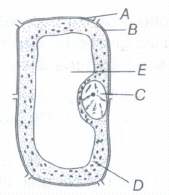
Label the parts A to E in the given figure
3.
Nucleus is removed from a cell. What is most likely to happen?
4.
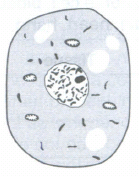
Observe the following figure given below
Answer the following questions.
(a) Does it represent a plant cell or an animal cell?
(b) Does it represent a prokaryotic cell or a eukaryotic cell?
5.
Write some point of differences between plasma membrane and cell wall.
6.
Write short notes on the following.
(a) Cytoplasm
(b) Nucleus of a cell.
7.
Pseudopodia in Amoeba are every important for its functioning. What functions do they perform?
8.
What are the functions of cell wall in plant cells?
9.
Explain why chloroplasts are found only in plant cell?
10.
State the difference between eukaryotes and prokaryotes.
11.
Rohit while gardening observed many beautiful flowering plants. He got attracted by the brightly coloured flowers and their beautiful appearance. He was curious to know about the variation of colours in flowers and asked her biology teacher about it. Teacher told her about the plastids found in plant cells.
(a) A particular plastid is responsible for the variation in colours of flowers. Which is it?
(b) Name the plastids known as kitchen of the cell.
(c) Are all plastids coloured?
(d) Will we be able to observe plastid in an animal cell?
(e) Identify values shown by Rohit.
12.
A cell has A as its control centre. A contains B that plays an important role in inheritance with the help of C. The cell also contains a jelly-like substance D. D contains various cell organelles like E that is essential for obtaining energy from food. The cell is surrounded by an F that is a living component. What could A, B, D, E and F be? Also write a short note on C.
13.
Which of the following is not a cell?
Red Blood Cell (RBC)
Bacterium
Spermatozoa
Virus
14.
Green colour of leaves is due to the presence of the pigment
Chlorophyll
mitochondria
ribosomes
chloroplast
15.
Which of the following cells does not have a nucleus?
White blood cell
Red blood cell
Nerve cell
Muscle cell
16.
Choose the correct statements.
Genes are located in the chromosomes
Cell is located in the nucleus
Chromosomes are located in the nucleolus
Cell membrane surrounds the nucleus
17.
Which of the following is not a plastid?
Chloroplast
Chromoplast
Leucoplast
Ribosome
18.
A suitable term for the various components of cells is
tissue
cell organelles
chromosomes
genes
19.
Out of the following, which animal is unicellular?
Amoeba
Paramecium
Bacteria
All of these
20.
Which one of the following terms is not a part of the nucleus?
Ribosome
Chromosome
Nucleolus
Gene
21.
Choose the correct statement with respect to unicellular organisms.
In unicellular organisms, tissues work in coordination to perform different functions
Unicellular organisms do not require food
Unicellular organisms respire and reproduce
All unicellular organisms move by cilia
22.
The structural and functional unit of life called cell was discovered by
Robert Boyle
Charles Darwin
Robert Koch
Robert Hooke
23.
Cell was discovered in..................
24.
.............is called kitchen of the cell.
25.
The shape and size of a cell are related to its...................
26.
Cells in which nuclear membrane is absent from the nucleus are called................cells.
27.
...............is a unicellular aquatic animal.
1.
The nuclear structure of plant and animal cells is same but the nucleus of bacterial cell is different. It is not well organised. It and does not have nuclear membrane and nucleolus. The genetic material is present in special region. Therefore, bacteria is called prokaryotes while plants and animals are eukaryotes.
2.
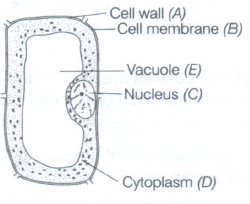
Given figure in question, represents a plant cell. The various parts of plant cells are labelled as follows:
3.
It is said that the nucleus controls all the metabolic activities as well as formation of various cell organelles. Thus, if the nucleus is removed, it will adversely affect the organism. In organism such as Amoeba, removal of nucleus may even lead to death.
4.
(a) The above diagram represents an animal cell because cell is bounded by cell membrane and cell wall is absent.
(b) The above diagram represents a eukaryotic cell as it has a well-organised nucleus and other cell organelles in it.
5.
Difference between plasma membrane and cell wall are:
| Plasma membrane | Cell wall |
|---|---|
| It is made up of lipids and proteins. | It is made up of cellulose. |
| It is living. | It is dead. |
| It is present in bacteria as well as plant and animal cell. |
It is found exclusively in plant cell. |
| It regulates entry and exit of molecules into and out of cells. |
It provides strength to the plants. |
6.
(a) Cytoplasm It is a jelly-like substance, present between the cell membrane and the nucleus. It encloses tiny structures called cell organelles that perform different functions. It also contains water, sugar, proteins, minerals, etc.
(b) Nucleus of a cell It is a spherical component of cell commonly located in the centre of cell. It is covered by porous nuclear membrane and contains genetic material like RNA and DNA. It also contains thread-like structures called chromosomes which carry genes. Nucleus controls various activities of the cell and play role in inheritance.
7.
Pseudopodia (pseudo-false; podia-feet) are finger-like projections of varying length protruding out of the body of Amoeba. These can appear or disappear as Amoeba moves or feeds. It helps in movement and in capturing food.
8.
Cell wall is an additional layer surrounding the plasma membrane that protects cells against variations in temperature, moisture and high wind speed. It also provides shape and rigidity to cells.
9.
Chloroplasts are found only in plant cells because plants synthesise their own food in the leaves. Chloroplast contains green pigment called chlorophyll which is essential for making food by the process called photosynthesis and also imparts green colour to the leaves.
10.
Eukaryotes are organisms which contain well organised nucleus with nuclear membrane, e.g. humans.
Prokaryotes are those organisms which contain the primitive nucleus (unorganised) without nuclear membrane, e.g. bacteria, blue-green algae.
11.
(a) Chromoplasts are the coloured plastids (except green) that give fruit and flower their colour.
(b) Chloroplasts are known as 'kitchen of the cell
(c) No, all plastids are not coloured. Leucoplasts are the colourless plastids.
(d) No, we will not see plastids in an animal cell as it is devoid of plastids.
(e) Rohit is inquisitive, attentive and has love and care towards nature
12.
Ans. A - Nucleus B - Chromosomes
C - Genes D - Cytoplasm
E - Mitochondria F - Cell membrane
Gene is a unit of inheritance in living organisms. It controls the transfer of hereditary characteristic from parents to offspring. This means that your parents pass some of their characteristics on to you. If your father has brown eyes, you may also have brown eyes.
13.
(c)
Spermatozoa
14.
(a)
Chlorophyll
15.
(b)
Red blood cell
16.
(a)
Genes are located in the chromosomes
17.
(d)
Ribosome
18.
(c)
chromosomes
19.
(d)
All of these
20.
(a)
Ribosome
21.
(c)
Unicellular organisms respire and reproduce
22.
(d)
Robert Hooke
23.
()
1665
24.
()
Chloroplast
25.
()
function
26.
()
prokaryotic
27.
()
Amoeba

8th Standard CBSE Syllabus & Materials
8th Standard CBSE
CBSE 8th Science Particulate Nature of Matter - New Model Questions Papers Study Material - QB365 Set A
NEW8th Standard CBSE
CBSE 8th Science Pressure, Winds, Stroms and Cyclones - New Model Questions Papers Study Material - QB365 Set A
NEW8th Standard CBSE
CBSE 8th Mathematics Quadrilaterals - New Model Questions Papers Study Material - QB365 Set A
NEW8th Standard CBSE
CBSE 8th Mathematics A story of Numbers - New Model Questions Papers Study Material - QB365 Set A



NCERT Books

Syllabus

Exam Pattern

Sample Question Papers

Previous year Question Papers

Important Notes

MCQ Practice test

NCERT Exemplers

Case study Questions

Image Based Questions

Passage based Questions

HOT Questions

Value Based Questions

Model Questions Papers
NCERT ( Book Back ) Questions

Assertion and Reason
Important Questions And Answers

CBSE 8th Standard CBSE Subjects
CBSE Standards


