
 100% FREE ACCESS
8th Standard CBSE Syllabus & Materials
8th Standard CBSE
CBSE 8th Social Science Theme D - Factors of Production - New Model Questions Papers Study Material - QB365 Set A
NEW8th Standard CBSE
CBSE 8th Social Science Theme C - Universal Franchise and India's Electoral System - New Model Questions Papers Study Material - QB365 Set A
NEW8th Standard CBSE
CBSE 8th Social Science Theme B - The Rise of the Marathas - New Model Questions Papers Study Material - QB365 Set A
NEW8th Standard CBSE
CBSE 8th Social Science Theme B - Reshaping India's Political Map - New Model Questions Papers Study Material - QB365 Set A
NEW8th Standard CBSE
CBSE 8th Social Science Theme A - Natural Resources and Their Use - New Model Questions Papers Study Material - QB365 Set A
NEW8th Standard CBSE
CBSE 8th Science Keeping Time with Skies - New Model Questions Papers Study Material - QB365 Set A

Published on: 29/10/2025
Download CBSE Class 8th Standard CBSE Science question papers, sample papers, important questions, and previous year solved papers in PDF format. Get free study materials, NCERT solutions, and exam preparation resources for Class 8th Standard CBSE Science
Questions + Answers key
Take MCQ Science Test
1.
Which one of the following solutions will not conduct electricity
Lemon juice
Vinegar
Tap water
Vegetable oil
2.
The solution that can conduct electricity is of
pure water
water and acid solution
water and salt solution
Both (b) and (c)
3.
An electrolyte is
a metal
a solution
a liquid that conducts current
All of the above
4.
An electric current can produce
heating effect
chemical effect
magnetic effect
chemical, heating and magnetic effects
5.
A tester is used to check the conduction of electricity through two liquids, labelled A and B. It is found that the bulb of the tester glows brightly for liquid A, while it glows very dimly for liquid B. You would conclude that
liquid A is a better conductor than liquid B
liquid B is a better conductor than liquid A
both liquids are equally conducting
conducting properties of liquid cannot be compared in this manner
6.
Paheli wants to deposit silver on an iron spoon. She took silver nitrate (AgNO3) solution in a beaker and set up a simple circuit for electroplating. Which terminal of the battery should the spoon be connected to? What material should the other electrode be made of?
7.
Fill the following table and classify the liquids with the help of a tester.
| S.No. | Material | Compass needle shows deflection (YES/NO) | conductor/Insulator |
| 1 | Lemon juice | ||
| 2 | Vinegar | ||
| 3 | Tap water | ||
| 4 | Vegetable oil | ||
| 5 | Milk | ||
| 6 | Honey |
8.
The bulb glows when the electric current passes through it. Explain why.
9.
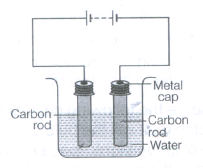
Boojho made the circuit as shown in figure. He wanted to observe what happens when an electric current is passed through water. But he forgot to add a few drops of lemon juice to water. Will it make any difference to his observations? Explain
10.
Does pure water conduct electricity? If not, what can we do to make it conducting?
11.
What happens when common salt is added to distilled water?
12.
Mention the name of three liquids which can conduct electricity
13.
When a compass needle is brought near a current carrying wire, then what happens?
14.
Name the effect of current responsible for the glow of the bulb in an electric circuit.
15.
Will the solution of sugar in distilled water conduct electricity?
16.
Observing that the bulb does not glow in the circuit shown in Fig. (a) Boojho changed the circuit as shown in Fig. (b). He observed deflection in the magnetic compass.
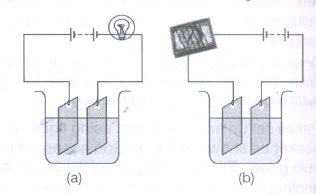
(a) What does the deflection in magnetic compass indicate?
(b) Why did the bulb not glow in Fig. (a)?
(c) What would be the effect of increase in the number of turns in the coil wound around the magnetic compass in Fig. (b)?
17.
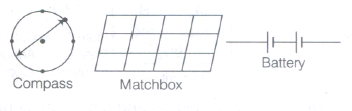
You are provided with a magnetic compass, an empty matchbox, a battery of two cells and connecting wires. Using these objects, how will you make a tester for testing an electric circuit? Draw the necessary circuit diagram and explain.
18.
The conducting solutions used in...........process are polluting wastes.
19.
Electroplating is used to give more...............to the cheap objects.
20.
Small amount of a mineral salt present naturally in water makes it a.......of electricity
21.
Most of the conducting liquids are the solutions of.................,.............,and..........
22.
One of the most common applications of chemical effect of electric current is..........
23.
Lemon juice shows deflection means that it is a good conductor.
24.
Poor conductors also allow electricity to pass under certain conditions.
25.
The bulb gets heated to a high temperature and it starts glowing when electric current passes through it.
26.
Tester is used to test the conductivity of liquid.
27.
During electroplating, the object to be electroplated is made anode
1.
(d)
Vegetable oil
2.
(b)
water and acid solution
3.
(b)
a solution
4.
(d)
chemical, heating and magnetic effects
5.
(a)
liquid A is a better conductor than liquid B
6.
Spoon should be connected to the negative terminal of the battery. The other electrode should be of silver so that silver ions get deposited on an iron spoon.
7.
| S.No. | Material | Compass needle shows deflection (YES/NO) | Conductor/Insulator |
| 1 | Lemon juice | Yes | Conductor |
| 2 | Vinegar | Yes | Conductor |
| 3 | Tap water | Yes | Conductor |
| 4 | Vegetable oil | No | Insulator |
| 5 | Milk | No | Insulator |
| 6 | Honey | No | Insulator |
8.
Due to the heating effect of current, the filament of the bulb gets heated to a high temperature and it starts glowing. However, if the current through a circuit is too weak, the filament does not get heated sufficiently and it does not glow.
9.
Adding few drops of lemon juice in water will increase the conductivity of the solution. The current will flow in both the cases but adding of lemon juice makes easy the current to flow.
10.
No, pure water does not conduct electricity because it has no dissolved salt in it. Hence, pure water can be made conducting by dissolving salt in it.
11.
Distilled water is not a good conductor of electricity but adding common salt make it conducting.
12.
Three liquids which can conduct electricity are.
(i) Tap water
(ii) Lemon juice (citric acid)
(iii) Vinegar (acetic acid).
13.
When a compass needle is brought near a current carrying wire, then needle deflects.
14.
Heating effect of electric current is responsible for the bulb to glow in an electric circuit.
15.
The sugar solution in distilled water will make it a good conductor of electricity and current can easily pass through it.
16.
(a) The deflection in the magnetic compass shows that the current is flowing in the circuit.
(b) The bulb did not glow, it may be because of the current passing through the circuit could be weak. Also, it may happen because of other reasons like due to bulb fused or the connections may be loose.
(c) Increase in the number of turns in the coil wound around the magnetic compass would increase the magnetic field around the magnetic compass which will result in the flowing of large amount of current through the circuit.
17.
Take the tray from the inside of a discarded matchbox. Wrap an electric wire a few times around the tray. Place a small compass needle inside it. Now connect one free end of the wire to the one terminal of a battery. Leave the other end free.
Take another piece of wire and connect it to the other terminal of the battery. Join the free ends of two wires momentarily. The compass needle should show deflection. Your tester with two free ends of the wire is ready.
18.
()
electroplating
19.
()
attraction/shining
20.
()
good conductor
21.
()
acids, bases and salts
22.
()
electroplating
23.
(a)
24.
(a)
25.
(a)
26.
(a)
27.
(b)

8th Standard CBSE Syllabus & Materials
8th Standard CBSE
CBSE 8th Science Particulate Nature of Matter - New Model Questions Papers Study Material - QB365 Set A
NEW8th Standard CBSE
CBSE 8th Science Pressure, Winds, Stroms and Cyclones - New Model Questions Papers Study Material - QB365 Set A
NEW8th Standard CBSE
CBSE 8th Mathematics Quadrilaterals - New Model Questions Papers Study Material - QB365 Set A
NEW8th Standard CBSE
CBSE 8th Mathematics A story of Numbers - New Model Questions Papers Study Material - QB365 Set A



NCERT Books

Syllabus

Exam Pattern

Sample Question Papers

Previous year Question Papers

Important Notes

MCQ Practice test

NCERT Exemplers

Case study Questions

Image Based Questions

Passage based Questions

HOT Questions

Value Based Questions

Model Questions Papers
NCERT ( Book Back ) Questions

Assertion and Reason
Important Questions And Answers

CBSE 8th Standard CBSE Subjects
CBSE Standards


