
 100% FREE ACCESS
8th Standard CBSE Syllabus & Materials
8th Standard CBSE
CBSE 8th Social Science Theme D - Factors of Production - New Model Questions Papers Study Material - QB365 Set A
NEW8th Standard CBSE
CBSE 8th Social Science Theme C - Universal Franchise and India's Electoral System - New Model Questions Papers Study Material - QB365 Set A
NEW8th Standard CBSE
CBSE 8th Social Science Theme B - The Rise of the Marathas - New Model Questions Papers Study Material - QB365 Set A
NEW8th Standard CBSE
CBSE 8th Social Science Theme B - Reshaping India's Political Map - New Model Questions Papers Study Material - QB365 Set A
NEW8th Standard CBSE
CBSE 8th Social Science Theme A - Natural Resources and Their Use - New Model Questions Papers Study Material - QB365 Set A
NEW8th Standard CBSE
CBSE 8th Science Keeping Time with Skies - New Model Questions Papers Study Material - QB365 Set A

Published on: 29/10/2025
Download CBSE Class 8th Standard CBSE Science question papers, sample papers, important questions, and previous year solved papers in PDF format. Get free study materials, NCERT solutions, and exam preparation resources for Class 8th Standard CBSE Science
Questions + Answers key
Take MCQ Science Test
1.
Explain the process of formation of petroleum.
2.
Differentiate between regular and diffused reflection. Does diffused reflection mean the failure of the laws of reflection?
3.
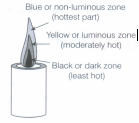
Make a labelled diagram of a candle flame.
4.
What are the advantages of using CNG and LPG as fuels?
5.
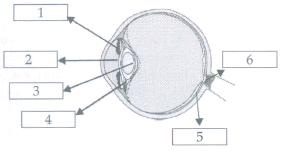
Write down the names of parts of the eye in the blank spaces shown in fig. below.
6.
What are the three essential requirements to produce fire? How fire extinguisher is useful for controlling the fire?
7.
The material X is a fossil fuel. It is formed from the buried large land plants (vegetation) by a very slow process Y. When X is heated in the absence of air, i. e. in the process called Z, it gives three products A, B and C. A is used as a reducing agent in the extraction of metals, B is used as an industrial fuel, whereas the product C has been traditionally used for metalling the roads. It is now replaced by a petroleum product, bitumen. Now give the answer of the following questions.
(a) What is the material X?
(b) What is the physical state and colour of X?
(c) Name the processes Y and Z.
(d) What are the products A, B and C?
8.
Which of the following statements is correct regarding rods and cones in the human eye?
Cones are sensitive to dim light
Cones are sensitive to bright light
Rods are sensitive to bright light
Rods can sense colour
9.
The change in converging power of an eye lensis caused by the action of
retina
optic nerve
ciliary muscles
iris
10.
We can see a non-luminous object when light
emitted by the object falls on the eye
is reflected from the object towards our eye
completely passes through the object
gets completely absorbed by the object
11.
Part of the eye which controls the entering of light is called
iris
cornea
lens
retina
12.
A person cannot see the distant objects clearly, (though) he can see the nearby object clearly. He is suffering from the defect of vision called
myopia
hypermetropia
cataract
night blindness
13.
The product(s) of combustion is/are
only oxygen
oxygen and water
carbon dioxide and water
only carbon dioxide
14.
Combustion is generally
a physical process
a chemical process
Both(a) and (b)
None of these
15.
The calorific value of a fuel is expressed in a unit called
kilojoule per litre
kilogram per millilitre
kilojoule per gram
kilojoule per kilogram
16.
Which of the following is not a combustible substance?
Camphor
Glass
Straw
Alcohol
17.
Which one of the following has the highest calorific value?
Kerosene
Biogas
LPG
Petrol
18.
Which of the following is exhaustible natural resource?
Water
Air
Sunlight
Coal
19.
When coal burns in air
carbon monoxide is formed
sulphur dioxide is formed
oxygen is formed
carbon dioxide is formed
20.
Purest form of carbon is
coal
charcoal
coke
All of these
21.
Which of the following is not a constituent of petroleum?
Paraffin wax
Lubricating oil
Petrol
Coke
22.
Which of the following is a pair of exhaustible natural resources?
Coal and soil
Air and sunlight
Water and petroleum
Wildlife and minerals
23.
What is lateral inversion?
24.
What are fossil fuels?
25.
What is calorific value?
26.
What is global warming?
27.
Define ignition temperature.
28.
Write two laws of reflection.
1.
Petroleum is believed to be formed from organisms living in the sea. As these organisms died, their bodies settled at the bottom of the sea and got covered with layers of sand and clay. Over millions of years, the dead organisms were transformed into petroleum oil and natural gas and other fossil fuels under the conditions of the absence of air, high temperature and high pressure. Like coal, petroleum and natural gas are also fossil fuels.
Since oil and gas are lighter than water and do not mix with it, they move upward. They are stopped by the overlying rocks which they cannot break through.
2.
Differences between regular and diffused reflection are
| Regular reflection | Diffused reflection |
|---|---|
| i) It is caused by the reflection from smooth and shiny surfaces | It is caused by reflection from unpolished and rough surfaces |
| ii) Reflected rays are parallel to each other | Reflected rays are not parallel to each other |
No, the diffused reflection does not mean the failure of the laws of reflection.
3.
4.
The advantages of using CNG and LPG as fuels are as follows :
(i) CNG and LPG are clean fuels.
(ii) They do not produce pollution.
(iii) They are easily available.
(iv) They can be used directly for burning.
(v) They are easy to transport.
(vi) Their cost is low.
5.
(1) Cornea
(2) Iris
(3) Eye lens
(4) Ciliary muscles
(5) Sclera
(6) Blind Spot.
6.
Three essential requirements to produce fire are as follows:
(i) Fuel
(ii) Air and
(iii) Heat to acquire the ignition temperature. The job of fire extinguisher is to cut off the supply of air or to bring down the temperature of fuel or both. The most common fire extinguisher is water. But water works only when things like wood and paper are on fire. For fires involving electrical equipment and inflammable materials like petrol, carbon dioxide (C02) is the best extinguisher. CO2 being heavier than oxygen, covers the fire like a blanket. Since, the contact between the fuel and oxygen is cut-off, so the fire can be controlled. The added advantage of CO2 is that in most cases, it does not harm the electrical equipment.
7.
(a) Coal.
(b) It is solid and black coloured.
(c) Y is carbonisation and Z is destructive distillation.
(d) A is coke, B is coal gas while C is coal tar.
8.
(b)
Cones are sensitive to bright light
9.
(c)
ciliary muscles
10.
(b)
is reflected from the object towards our eye
11.
(b)
cornea
12.
(a)
myopia
13.
(c)
carbon dioxide and water
14.
(b)
a chemical process
15.
(d)
kilojoule per kilogram
16.
(d)
Alcohol
17.
(c)
LPG
18.
(d)
Coal
19.
(d)
carbon dioxide is formed
20.
(c)
coke
21.
(d)
Coke
22.
(d)
Wildlife and minerals
23.
()
In an image formed by a mirror the left side appears on the right side and the right side appears on the left side, this is known as lateral inversion.
24.
()
Some exhaustible natural resources are formed from the dead remains of living organisms. Hence, these are all known as fossil fuels.
25.
()
The amount of heat energy produced on complete combustion of 1kg of a fuel is called its calorific value.
26.
()
The rise in temperature of the atmosphere of the earth due to increased concentration of carbon dioxide in the air is called global warming.
27.
()
The lowest temperature at which a substance catches fire is called its ignition temperature.
28.
The two laws of reflection:
(i)The incident ray, reflected ray and normal lie in the same plane.
(ii)Angle of incidence is always equal to angle of reflection.

8th Standard CBSE Syllabus & Materials
8th Standard CBSE
CBSE 8th Science Particulate Nature of Matter - New Model Questions Papers Study Material - QB365 Set A
NEW8th Standard CBSE
CBSE 8th Science Pressure, Winds, Stroms and Cyclones - New Model Questions Papers Study Material - QB365 Set A
NEW8th Standard CBSE
CBSE 8th Mathematics Quadrilaterals - New Model Questions Papers Study Material - QB365 Set A
NEW8th Standard CBSE
CBSE 8th Mathematics A story of Numbers - New Model Questions Papers Study Material - QB365 Set A



NCERT Books

Syllabus

Exam Pattern

Sample Question Papers

Previous year Question Papers

Important Notes

MCQ Practice test

NCERT Exemplers

Case study Questions

Image Based Questions

Passage based Questions

HOT Questions

Value Based Questions

Model Questions Papers
NCERT ( Book Back ) Questions

Assertion and Reason
Important Questions And Answers

CBSE 8th Standard CBSE Subjects
CBSE Standards


