
 100% FREE ACCESS
8th Standard CBSE Syllabus & Materials
8th Standard CBSE
CBSE 8th Social Science Theme D - Factors of Production - New Model Questions Papers Study Material - QB365 Set A
NEW8th Standard CBSE
CBSE 8th Social Science Theme C - Universal Franchise and India's Electoral System - New Model Questions Papers Study Material - QB365 Set A
NEW8th Standard CBSE
CBSE 8th Social Science Theme B - The Rise of the Marathas - New Model Questions Papers Study Material - QB365 Set A
NEW8th Standard CBSE
CBSE 8th Social Science Theme B - Reshaping India's Political Map - New Model Questions Papers Study Material - QB365 Set A
NEW8th Standard CBSE
CBSE 8th Social Science Theme A - Natural Resources and Their Use - New Model Questions Papers Study Material - QB365 Set A
NEW8th Standard CBSE
CBSE 8th Science Keeping Time with Skies - New Model Questions Papers Study Material - QB365 Set A

Published on: 29/10/2025
Download CBSE Class 8th Standard CBSE Science question papers, sample papers, important questions, and previous year solved papers in PDF format. Get free study materials, NCERT solutions, and exam preparation resources for Class 8th Standard CBSE Science
Questions + Answers key
Take MCQ Science Test
1.
Mohan uses a diesel car which causes lot of pollution. But his friend Sohan has purchased an electric car which does not use fossil fuel and does not cause air pollution. Sohan told his friend that major pollution of air is caused by industries and combustion of fossil fuels by vehicles. Sulphur dioxide and nitrogen dioxide are released into air by burning coal and petroleum. Air is precious for our life, but air pollution causes many diseases like asthma, bronchitis and heart related disease. Read the given passage and answer the following questions.
(a) What are the formula of sulphur dioxide and nitrogen dioxide?
(b) What is the effect of increase in carbon dioxide in the atmosphere?
(c) What values are possessed by Sohan?
2.
Write the difference between coke and coal
3.
Sunlight and air are inexhaustible natural resources. Comment.
4.
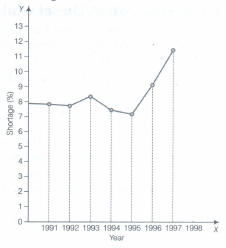
The following table shows the total power shortage in India from 1991-1997. Show the data in the form of a graph plot shortage percentage for the years on the Y-axis and the year on the X-axis.
| S.No. | Year | Shortage (%) |
| 1 | 1991 | 7.9 |
| 2 | 1992 | 7.8 |
| 3 | 1993 | 8.3 |
| 4 | 1994 | 7.4 |
| 5 | 1995 | 7.1 |
| 6 | 1996 | 9.2 |
| 7 | 1997 | 11.5 |
5.
What are the advantages of using CNG and LPG as fuels?
6.
__________is a petroleum gas in liquid form.
7.
Petroleum is also called_________.
8.
Least polluting fuel for vehicle is ___________________
9.
Process of separation of different constituents from petroleum is called ____________________
10.
Fossil fuels are __________,____________ and ______________
11.
Oxygen in air is an exhaustible natural resource
12.
Kerosene is not a fossil fuel.
13.
Coal tar is a mixture of various substances.
14.
Coke is almost pure form of carbon
15.
CNG is more polluting fuel than petrol.
16.
Fossil fuels can be made in the laboratory.
17.
What is the full form of CNG and LPG?
18.
Give some examples of materials which are manufactured by using petrochemicals.
19.
What do you mean by carbonisation?
20.
Petrochemicals are obtained from where? Give examples
21.
Petroleum is called black gold. Why?
22.
Which product of coal is used as a reducing agent in the extraction of metals?
23.
Why petrol is exhaustible natural resource whereas sunlight is not? Explain.
24.
Name the products obtained and their uses when coal is processed in industry.
25.
A black, tough and porous substance is :
Coal tar
Coal Gas
Coke
Diesel
26.
Which is not an exhaustible natural resource?
Sunlight
Petroleum
Natural gas
Wildlife
27.
PCRA stands for:
Public Conservation Research Association
Petroleum Conservation Research Association
Public Council of Research Association
Partial Counting of Remaining Amendment.
28.
Coal is formed from the remains of
vegetation only
animals only
both vegetation and animals
neither vegetation nor animals
29.
Fossil fuels are obtained from
remains of non-living materials
dead remains of birds only
dead remains of insects only
dead remains of living organisms
30.
Exhaustible natural resources are
unlimited in quantity
not dependent on nature
limited in quantity
not exhausted by human activities
31.
Coal is processed in industries to get some useful products. Which of the following is not obtained from coal?
Coke
Coal tar
Coal gas
CNG
32.
Which of the following is a pair of exhaustible natural resources?
Coal and soil
Air and sunlight
Water and petroleum
Wildlife and minerals
33.
Air is a natural resource and cannot be exhausted by human activities. It is known as inexhaustible natural resource. Which of the following is another inexhaustible natural resource?
Coal
Petroleum
Sunlight
Minerals
34.
Various materials which are obtained from nature are called natural resources. Which of the following is not a natural resource?
Minerals
Water
Soil
Plastic
35.
LPG
36.
Petroleum
37.
Natural gas
38.
Used for road surfacing
39.
Where is oil found in India?
40.
Write one use of coal.
41.
Name some useful products obtained from coal when it is processed in industry.
42.
What are fossil fuels?
1.
(a) Formula of sulphur dioxide is S02. Formula of nitrogen dioxide is N02
(b) Increase in concentration of carbon dioxide in the atmosphere will increase the temperature of earth's atmosphere.
(c) Sohan is aware about the safety of environment from air pollution
2.
Difference between coke and coal are as follows:
| Coke | Coal |
| It is almost pure form of carbon | It mainly contains mainly carbon. |
| It is an amorphous form of carbon | It is a non-crystalline form of carbon |
| It is obtained by heating coal in the absence of air. | It is obtained by the decay of vegetation which existed millions of year ago. |
3.
These resources are present in an unlimited quantity in nature and are not likely to be exhausted by human activities.
4.
Scale along X -axis, 1 unit = 1 year and along Y-axis, 1 unit = 1%
5.
The advantages of using CNG and LPG as fuels are as follows :
(i) CNG and LPG are clean fuels.
(ii) They do not produce pollution.
(iii) They are easily available.
(iv) They can be used directly for burning.
(v) They are easy to transport.
(vi) Their cost is low.
6.
()
LPG
7.
()
black gold
8.
()
Compressed Natural Gas (CNG)
9.
()
refining
10.
()
coal, petroleum, natural gas
11.
(b)
12.
(b)
13.
(a)
14.
(a)
15.
(b)
16.
(b)
17.
CNG: Compressed Natural Gas.
LPG: Liquefied Petroleum Gas.
18.
Examples of materials which are manufactured by using petrochemicals are detergents, fibres, plastics, drugs, dyes, perfumes, fertilisers, synthetic rubber, etc.
19.
The slow process of conversion of dead vegetation into coal is called carbonisation.
20.
Those chemicals which are obtained from petroleum and natural gas are called petrochemicals. Some examples of petrochemicals are methyl alcohol, ethyl alcohol, acetone, benzene, hydrogen, etc.
21.
Petroleum is called black gold due to its great commercial importance.
22.
Coke
23.
The natural resources which are present in a limited quantity in nature and can be exhausted (used up) by human activities are called exhaustible natural resources, e.g. coal, petroleum, natural gas, minerals, forests, wildlife, etc.
It requires millions of years for the conversion of the dead organisms into petroleum, from which petrol is separated. So, once the present stock of it gets exhausted, no new supplies of it will be available to us in the near future, whereas sunlight is present in an unlimited quantity in nature, so it is inexhaustible natural resource. It is not likely to be exhausted by human activities.
24.
When coal is strongly heated in the absence of air in closed retorts, various useful products are obtained. These are coke, coaltar and coal gas.
Uses of coke Coke is used in the manufacture of steel and in the extraction of many metals. It acts as a fuel and it is a better fuel than coal.
Uses of coal tar The various compounds obtained from coal tar are used as starting materials for manufacturing a large number of substances used in everyday life and in industry like synthetic dyes, drugs, explosives, perfumes, plastics, paints, photographic materials, roofing materials, etc. Naphthalene balls used to repel moths and other insects are also obtained from coaltar.
Uses of coal gas It is used as a fuel in many industries situated near the coal processing plants.
25.
(c)
Coke
26.
(a)
Sunlight
27.
(b)
Petroleum Conservation Research Association
28.
(a)
vegetation only
29.
(d)
dead remains of living organisms
30.
(c)
limited in quantity
31.
(d)
CNG
32.
(d)
Wildlife and minerals
33.
(c)
Sunlight
34.
(d)
Plastic
35.
()
Fuel for home
36.
()
Black gold
37.
()
CNG
38.
()
Bitumen
39.
()
Oil is found in India in Assam, Gujarat, and Mumbai High and in the river basin of Godavari and Krishna.
40.
()
Coal is used in thermal power plants to produce electricity.
41.
()
Coal is processed in industry to get some useful products such as coke, coal-tar and coal gas.
42.
()
Some exhaustible natural resources are formed from the dead remains of living organisms. Hence, these are all known as fossil fuels.

8th Standard CBSE Syllabus & Materials
8th Standard CBSE
CBSE 8th Science Particulate Nature of Matter - New Model Questions Papers Study Material - QB365 Set A
NEW8th Standard CBSE
CBSE 8th Science Pressure, Winds, Stroms and Cyclones - New Model Questions Papers Study Material - QB365 Set A
NEW8th Standard CBSE
CBSE 8th Mathematics Quadrilaterals - New Model Questions Papers Study Material - QB365 Set A
NEW8th Standard CBSE
CBSE 8th Mathematics A story of Numbers - New Model Questions Papers Study Material - QB365 Set A



NCERT Books

Syllabus

Exam Pattern

Sample Question Papers

Previous year Question Papers

Important Notes

MCQ Practice test

NCERT Exemplers

Case study Questions

Image Based Questions

Passage based Questions

HOT Questions

Value Based Questions

Model Questions Papers
NCERT ( Book Back ) Questions

Assertion and Reason
Important Questions And Answers

CBSE 8th Standard CBSE Subjects
CBSE Standards


