
 100% FREE ACCESS
8th Standard CBSE Syllabus & Materials
8th Standard CBSE
CBSE 8th Social Science Theme D - Factors of Production - New Model Questions Papers Study Material - QB365 Set A
NEW8th Standard CBSE
CBSE 8th Social Science Theme C - Universal Franchise and India's Electoral System - New Model Questions Papers Study Material - QB365 Set A
NEW8th Standard CBSE
CBSE 8th Social Science Theme B - The Rise of the Marathas - New Model Questions Papers Study Material - QB365 Set A
NEW8th Standard CBSE
CBSE 8th Social Science Theme B - Reshaping India's Political Map - New Model Questions Papers Study Material - QB365 Set A
NEW8th Standard CBSE
CBSE 8th Social Science Theme A - Natural Resources and Their Use - New Model Questions Papers Study Material - QB365 Set A
NEW8th Standard CBSE
CBSE 8th Science Keeping Time with Skies - New Model Questions Papers Study Material - QB365 Set A

Published on: 29/10/2025
Download CBSE Class 8th Standard CBSE Science question papers, sample papers, important questions, and previous year solved papers in PDF format. Get free study materials, NCERT solutions, and exam preparation resources for Class 8th Standard CBSE Science
Questions + Answers key
Take MCQ Science Test
1.
What is ultrasound?
2.
How do whales and dolphins hear the sound?
3.
Adolescence is the period from 13-19 years of age. Is there any other term for this period?
4.
The change from tadpole to frog is given a particular term. What is it?
5.
What do you mean by good fuel?
6.
What do you mean by deforestation?
7.
How heat is produced in our body?
8.
Name the process of separating the various useful constituents of petroleum
9.
Unpleasant sounds are called ______
10.
The meal that includes all ____________ is a balanced diet.
11.
_______ reproduces by budding.
12.
The other name of human voice box is............
13.
_____________is expressed in terms of its calorific value.
14.
Petroleum is very important so, it is called______________________
15.
When heated in air, coal burns and produces_________ mainly gas.
16.
For human ears, the audible range is 20 Hz to 20,000 Hz.
17.
An embryo is made up of a single cell.
18.
The menstrual flow lasts for 28-30 days.
19.
Middle zone is the hottest zone of a flame.
20.
CNG is less polluting fuel than petrol and diesel
21.
External fertilisation
22.
Unit of frequency
23.
Length of vocal cords in man
24.
LPG
25.
Paraffin wax
26.
Explain the structure of human ear and its functions.
27.
Define: (i) an oscillation (ii) Hertz
28.
Name the hormone which would be released during the following situations.
(a) A frightened person
(b) Growth of a child to adult
(c) Development of caterpillar to moth
(d) Development of tadpole to frog
29.
Observe the figure given and answer the questions that follow.
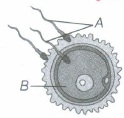
(a) Label A and B.
(b) Identify the process.
(c) What happens during the process and what is formed?
30.
Explain the reason for not hearing of the screams of a bat by us.
31.
Complete the crossword with the help of the clues:
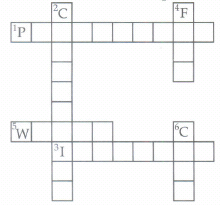
1. Non-metal which catches fire if exposed to air.
2. A chemical process in which a substance reacts with oxygen to give off heat.
3. The lowest temperature at which a substance catches fire is called its temperature.
4. Petrol is used as a _________ in automobiles.
5. The most common fire extinguisher.
6. It is as hard as stone and black in colour.
32.
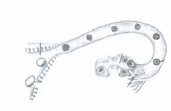
After observing figure above, answer the following.
(a) Read the following statements and label them in the figure.
(i) The part which produces female gametes.
(ii) The part where development of the baby takes place.
(iii) The part through which the developing embryo passes to reach the uterus.
(b) Explain the future development of the embryo that would take place after it gets embedded in the uterus.
33.
Define fertilization
34.
What is combustion?
1.
Ultrasound refers to sound that has a frequency above the audible range (20,000 Hz) of the human ear.
2.
Through water as a liquid medium, both whales and dolphins hear the sound.
3.
Yes, the other term for adolescence is teenage.
4.
Metamorphosis is the term used for the change from tadpole to frog.
5.
A fuel which produces large amount of heat energy without causing pollution is called a good fuel.
6.
The cutting of trees is called deforestation/
7.
In our body, food is broken down by reaction with oxygen. During such reactions, heat is produced. This heat keeps our body warm.
8.
Refining.
9.
()
Noise
10.
()
nutrients
11.
()
Hydra
12.
()
larynx
13.
()
Fuel efficiency
14.
()
black gold
15.
()
carbon dioxide
16.
(a)
17.
(b)
18.
(b)
19.
(b)
20.
(a)
21.
()
Frog
22.
()
Hertz
23.
()
20 mm long
24.
()
Cooking gas
25.
()
Vaseline and candles
26.
Structure and function of human ear: The hearing organs in humans are ears. It is divided into three parts - outer, inner and middle ear. Middle ear has a stretched structure called eardrum. When ears receive sound, it enters down the ear canal and reaches eardrum. Sound vibrations vibrate the eardrum and it sends vibrations to inner ear from which vibrations are sent to the brain for interpretation of sound.
27.
(i) Oscillation: The to and fro motion of an object is called vibration. This motion is also called oscillatory motion.
(ii) Hertz : The number of oscillations per second is called the frequency in Hertz (Hz). A frequency of 1 Hz is one oscillation per second.
28.
(a) Adrenaline is secreted from adrenal gland during the stress conditions like fright or fear, anger, worry or embarrassment.
(b) Growth hormone is secreted from pituitary gland to regulate the normal growth of a person, i.e. growth of a child to adult.
(c) Insect hormones control the development of caterpillar to moth.
(d) Thyroxine is produced by thyroid gland to control the development of tadpole to frog.
29.
(a) A-sperm, B-ovum (egg).
(b) The process is fertilisation.
(c) During the process, the sperm nucleus fuses with the egg nucleus to form the zygote.
30.
As we know that the audible frequency range for human being is 20 Hz to 20 kHz. So, it is an obvious thing that the frequency of bat is beyond this range due to which, we are usually unable to hear the screams of a bat.
31.
1. Phosphorus,
2. Combustion,
3. Ignition,
4. Fuel,
5. Water,
6. Coal.
32.
(a) The parts in the figure are labelled below:
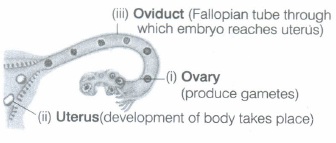
(b) The embryo continues to develop after it gets embedded in the uterus. It divides and differentiates into three germ layers which give rise to different body parts such as hands, legs, head, eyes, ears, etc. This stage where all the body parts are distinct and easily identified in developing embryo is called foetus. After completion of development of foetus, mother gives birth to baby.
33.
()
The fusion of ovum and sperm is called fertilization
34.
()
A chemical process in which a substance burns in the presence of oxygen to release heat is called combustion.

8th Standard CBSE Syllabus & Materials
8th Standard CBSE
CBSE 8th Science Particulate Nature of Matter - New Model Questions Papers Study Material - QB365 Set A
NEW8th Standard CBSE
CBSE 8th Science Pressure, Winds, Stroms and Cyclones - New Model Questions Papers Study Material - QB365 Set A
NEW8th Standard CBSE
CBSE 8th Mathematics Quadrilaterals - New Model Questions Papers Study Material - QB365 Set A
NEW8th Standard CBSE
CBSE 8th Mathematics A story of Numbers - New Model Questions Papers Study Material - QB365 Set A



NCERT Books

Syllabus

Exam Pattern

Sample Question Papers

Previous year Question Papers

Important Notes

MCQ Practice test

NCERT Exemplers

Case study Questions

Image Based Questions

Passage based Questions

HOT Questions

Value Based Questions

Model Questions Papers
NCERT ( Book Back ) Questions

Assertion and Reason
Important Questions And Answers

CBSE 8th Standard CBSE Subjects
CBSE Standards


