
 100% FREE ACCESS
8th Standard CBSE Syllabus & Materials
8th Standard CBSE
CBSE 8th Social Science Theme D - Factors of Production - New Model Questions Papers Study Material - QB365 Set A
NEW8th Standard CBSE
CBSE 8th Social Science Theme C - Universal Franchise and India's Electoral System - New Model Questions Papers Study Material - QB365 Set A
NEW8th Standard CBSE
CBSE 8th Social Science Theme B - The Rise of the Marathas - New Model Questions Papers Study Material - QB365 Set A
NEW8th Standard CBSE
CBSE 8th Social Science Theme B - Reshaping India's Political Map - New Model Questions Papers Study Material - QB365 Set A
NEW8th Standard CBSE
CBSE 8th Social Science Theme A - Natural Resources and Their Use - New Model Questions Papers Study Material - QB365 Set A
NEW8th Standard CBSE
CBSE 8th Science Keeping Time with Skies - New Model Questions Papers Study Material - QB365 Set A

Published on: 29/10/2025
Download CBSE Class 8th Standard CBSE Science question papers, sample papers, important questions, and previous year solved papers in PDF format. Get free study materials, NCERT solutions, and exam preparation resources for Class 8th Standard CBSE Science
Questions + Answers key
Take MCQ Science Test
1.
Plastic wire is
an insulator
a conductor
Both (a) and (b)
None of these
2.
An electric current can produce
heating effect
chemical effect
magnetic effect
chemical, heating and magnetic effects
3.
Angle of incidence is equal to the angle of reflection
Always
Sometimes
Under special conditions
Never
4.
Wild buffalo is an endangered species because
its population is diminishing
it has become extinct
it is found exclusively in a particular area
its poaching is strictly prohibited
5.
PET is a
polyester
nylon
polyamide
thermosetting polymer
6.
A disease in human beings caused by virus is
typhoid
influenza
dysentery
cholera
7.
Watering the crops is called
sowing
manuring
tilling
irrigation
8.
Yeast is used in the production of
sugar
alcohol
hydrochloric acid
oxygen
9.
Radha is a student of class X of a Govt. School and she is a member of 'Eco club' of her school. What suggestions would you like to give to Radha to improve the environment in her school?
10.
Take two cloth pieces of the same size, one from natural fibre and another from synthetic fibre. Soak them in different mugs containing same amount of water. After five minutes spread them in the Sun. Observe and answer the following:
(i) How much water is soaked by both fibres?
(ii) Which fibre soaks more water?
(iii) Which fibre dries quickly?
11.
Two mirrors meet at right angles. A ray of light is incident on one at an angle of 30° as shown in figure. Draw the reflected ray from the second mirror.
.jpg)
12.
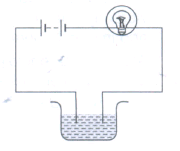
The bulb does not glow in the setup shown in figure below. List the possible reasons.Explain your answer.
13.
When the free ends of a tester are dipped into a solution, the magnetic needle shows deflection. Can you explain the reason?
14.
Mention against each of the following whether regular or diffused reflection will take place when a beam of light strikes. Justify your answer in each case.
(a) Polished wooden table
(b) Chalk powder
(c) Cardboard surface
(d) Marble floor with water spread over it
(e) Mirror
(f) Piece of paper.
15.
Difference between flora and fauna.
16.
Explain the difference between thermoplastic and thermosetting plastics.
17.
Can microorganisms be seen with the naked eye? If not, how can they be seen?
18.
Write difference between regular and irregular reflection.
19.
If we cut 17 full grown trees, how much paper can we obtain?
20.
Name two types of plastics
21.
Explain the meaning of crop.
22.
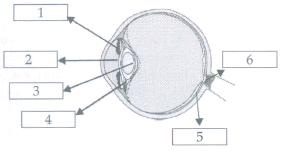
Write down the names of parts of the eye in the blank spaces shown in fig. below.
23.
Explain and draw nitrogen cycle.
24.
What is irrigation? Describe two methods of irrigation which conserve water.
25.
During biology class, teacher was telling about microbes and how they are useful to humans. Hearing this, Jasmine got confused as she knew the TB caused to her uncle is due to a microbe. She asked his teacher about it. The teacher appreciated her for question and explained the whole class.
(a) What are microbes?
(b) How are microbes helpful to humans?
(c) Name one microbe
(i) used in household products.
(ii) used in antibiotics.
(d) Mention two diseases other than TB caused by microbes.
(e) Identify the values shown by Jasmine.
26.
Cellulose is made of a large number of _______.
27.
Night birds have __________ cones than rods in their eyes.
28.
Red Data Book contains a record of______________species.
29.
Plastics are............ conductors of heat
30.
Name the articles made from PET.
31.
Name two harvest festivals celebrated in India.
1.
(a)
an insulator
2.
(d)
chemical, heating and magnetic effects
3.
(a)
Always
4.
(a)
its population is diminishing
5.
(a)
polyester
6.
(b)
influenza
7.
(d)
irrigation
8.
(b)
alcohol
9.
Now-a-days in schools environment education is also provided to students. They form 'Eco clubs' to create awareness about the environment. As Radha is a member of the 'Eco club', she will be suggested to make beautiful dustbins (as use me) to collect garbage, organise small discussions and entertainment programmes regarding 'Save environment' .
10.
(i) Synthetic fibre soaks less water, whereas natural fibre soaks more water.
(ii) Natural fibre.
(iii) Synthetic fibre.
11.
The diagram will be as follows:
.jpg)
12.
The possible reasons are as follows:
(i) The current is not produced by the given liquid and hence, bulb does not glow.
(ii) Connections are loose.
(iii) Bulb is fused.
(iv) Cells are used up.
13.
When the free ends of a tester are dipped into a solution, then the liquid between the two ends allows the electric current to pass and the circuit of the tester becomes complete. Also, when the current passes through the tester, it establishes a magnetic effect and hence magnetic needle shows deflection. In other words, we can say that the solution is a good conductor of electricity, so the needle gets deflected.
14.
(a) Polished wooden table As the surface is smooth, so there is a regular reflection through it.
(b) Chalk powder Since, the surface is not smooth or it is uneven, thus there is a diffused reflection through it.
(c) Cardboard surface As its surface is uneven, so it will produce a diffused reflection.
(d) Marble floor with water spread over it As marble floor itself is very smooth, besides this there is a layer of water on it which makes the surface for regular reflection.
(e) Mirror Since, the surface of mirror is smooth, thus it will produce a regular reflection.
(f) Piece of paper Since, the surface is uneven, thus it will produce a diffused reflection.
15.
| Flora | Fauna |
| It is the variety of plants in a particular area, e.g. sal, teak, mango, etc form the flora of Pachmarhi Biosphere Reserve. | It is the variety of animals in a particular area, e.g. leopard, wolf, etc form the fauna of Pachmarhi Biosphere Reserve. |
16.
Differences between thermoplastics and thermosetting plastics are as follows:
| Thermoplastics | Thermosetting plastics |
| These are the plastics, which get deformed easily on heating, e.g. polythene and PVC. | These are the plastics, which when moulded once, cannot be softened by heating, e.g. bakelite and melamine |
| These are used for making toys, Combs, various types of containers,etc. | In thermosetting plastics, bakelitesare used for making electrical switches, handles of various utensils, etc. Melamine used for making floor tiles, kitchen wares and fabrics which resist fire. |
17.
Microorganisms or microbes are too small to be seen by naked eyes. They can be seen with the help of a magnifying glass or microscope.
18.
Difference between regular and irregular reflection:
| S.No | Regular | Irregular |
|---|---|---|
| (i) | It takes place on a smooth and shining surface. | It takes place on rough surface. |
| (ii) | All rays are parallel after reflection. | Reflected rays are in different directions. |
19.
If 17 full grown trees are cut, we can obtain about one tonne of paper.
20.
(i) Thermoplastics
(ii) Thermosetting plastics
21.
The same kind of plants grown and cultivated on a large scale at one place is called a crop
22.
(1) Cornea
(2) Iris
(3) Eye lens
(4) Ciliary muscles
(5) Sclera
(6) Blind Spot.
23.
Nitrogen cycle.
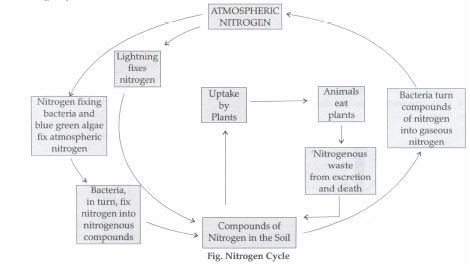
(i)Our atmosphere has 78% of nitrogen gas. Certain bacteria and blue-green algae are present in soil that fix nitrogen.
(ii) They convert it into compounds of Nitrogen.
(iii) These compounds can be used by plants through soil.
(iv) Plants synthesize proteins and other compounds.
(v)Animals feeding on plants get these.
(vi)When plants and animals die, bacteria and fungi present in the soil decompose them and again convert into nitrogenous compounds.
(vii) Certain bacteria convert them into nitrogen gas, which goes back to the atmosphere.
24.
The supply of water to crops at different intervals is called irrigation. Latest irrigation method help us to use water economically. The main methods used are as follows:
(i) Sprinkler system: This system is more useful on the uneven lands where water is available in smaller quantity. The perpendicular pipes, having rotating nozzles on the top, are joined to the main pipe lines at regular intervals. When the water is allowed to flow through the main pipe with the help of a pump, it escapes from the rotating nozzles. It is sprinkled on the crop as if it is raining. Sprinkler is very useful for the sandy soil.
(ii) Drip system: In this system, the water falls drop by drop just at the position of the roots. So it is called drip system. It is the best technique of watering fruit plants, gardens and trees. This system consists of a main pipe to which lateral pipes are joined. The specially prepared nozzles are attached to these lateral pipes. The nozzles are grounded just near the roots of the plants. It provides water to plants drop by drop. Water is not wasted at all. So, it is a boon in regions where availability of water is poor
25.
(a) Organisms that cannot be seen with eyes alone are called microbes.
(b) Microbes are useful to humans in many ways. They help in the production of curd, cheese, in cleaning the environment, etc.
(c) (i) Lactobacillus bacteria.
(ii) Penicillium
(d) Diseases caused by microbes are polio, malaria, etc.
(e) Jasmine is attentive, intelligent and curious.
26.
()
glucose units
27.
()
lesser
28.
()
endangered
29.
()
poor
30.
()
Bottles, utensils, films, wires etc.
31.
()
Pongal, Baisakhi.

8th Standard CBSE Syllabus & Materials
8th Standard CBSE
CBSE 8th Science Particulate Nature of Matter - New Model Questions Papers Study Material - QB365 Set A
NEW8th Standard CBSE
CBSE 8th Science Pressure, Winds, Stroms and Cyclones - New Model Questions Papers Study Material - QB365 Set A
NEW8th Standard CBSE
CBSE 8th Mathematics Quadrilaterals - New Model Questions Papers Study Material - QB365 Set A
NEW8th Standard CBSE
CBSE 8th Mathematics A story of Numbers - New Model Questions Papers Study Material - QB365 Set A



NCERT Books

Syllabus

Exam Pattern

Sample Question Papers

Previous year Question Papers

Important Notes

MCQ Practice test

NCERT Exemplers

Case study Questions

Image Based Questions

Passage based Questions

HOT Questions

Value Based Questions

Model Questions Papers
NCERT ( Book Back ) Questions

Assertion and Reason
Important Questions And Answers

CBSE 8th Standard CBSE Subjects
CBSE Standards


