
 100% FREE ACCESS
8th Standard CBSE Syllabus & Materials
8th Standard CBSE
CBSE 8th Social Science Theme D - Factors of Production - New Model Questions Papers Study Material - QB365 Set A
NEW8th Standard CBSE
CBSE 8th Social Science Theme C - Universal Franchise and India's Electoral System - New Model Questions Papers Study Material - QB365 Set A
NEW8th Standard CBSE
CBSE 8th Social Science Theme B - The Rise of the Marathas - New Model Questions Papers Study Material - QB365 Set A
NEW8th Standard CBSE
CBSE 8th Social Science Theme B - Reshaping India's Political Map - New Model Questions Papers Study Material - QB365 Set A
NEW8th Standard CBSE
CBSE 8th Social Science Theme A - Natural Resources and Their Use - New Model Questions Papers Study Material - QB365 Set A
NEW8th Standard CBSE
CBSE 8th Science Keeping Time with Skies - New Model Questions Papers Study Material - QB365 Set A

Published on: 29/10/2025
Download CBSE Class 8th Standard CBSE Science question papers, sample papers, important questions, and previous year solved papers in PDF format. Get free study materials, NCERT solutions, and exam preparation resources for Class 8th Standard CBSE Science
Questions + Answers key
Take MCQ Science Test
1.
What are contact and non-contact forces? Explain briefly with suitable examples.
2.
Experimentally explain that pressure is exerted by liquids and gases on the walls of the containers.
3.
Across:
1. This force always acts on all the moving objects.
2. Objects fall towards the earth due to what?
3. Force resulting due to action of muscles.
4. The strength of object is expressed by.
Down:
5. A push or pull.
6. Electrostatic force is an example of this.
7. Force can give this to a stationary object.
8. A push or pull.
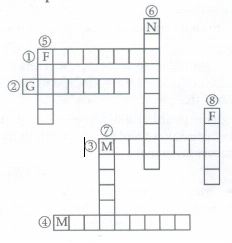
4.
Amit and Sumit were good friends. They both went to gym center for exercise. As, the coach of gym told them to complete 10 dips each. So, Amit started doing it by stretching the palms on the floor while Sumit opted to do the same job on pair of rods at some height from floor.
(a) Amit got less pain while Sumit got more pain on his palm. Why?
(b) Mention the idea used by Amit here.
5.
Mention the name of the type of forces involved in the situations given below.
(a) A horse pulling a cart.
(b) A sticker attached to steel almirah without glue.
(c) A coin falling to the ground on slipping from hand.
(d) A plastic comb rubbed in dry hair picking up tiny pieces of papers.
(e) A moving boat coming to rest when rowing is stopped.
6.
In physics class teacher ask to his student that a man carrying a load of 50 N in his hand pulling it. The area of palm where the load act is 5 cm2. Then
(a) Determine the pressure acting on the fingers of man.
(b) Also, find the pressure acting if the man carrying the same load by keeping it on the shoulder occupying an area of 50 cm2.
(c) Mention the type of teaching skill of teacher is being represented here?
7.
It is difficult to cut cloth using a pair of scissors with blunt blades. Explain.
8.
Observe the vessels A, B, C and D as shown in figure carefully.
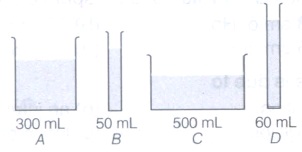
Volume of water taken in each vessel is as shown. Arrange them in the order of decreasing pressure at the base of each vessel. Explain.
9.
Two women are of the same weight. One wears sandals with pointed heels while the other wears sandals with flat sales. Which one would feel more comfortable while walking on a sandy beach? Give reasons for your answer .
10.
In walking the pressure on the ground is more as compared to that in standing on the ground. Explain this statement.
1.
Forces can be of two types:
(i) Contact forces.
(ii) Non-contact forces.
(i) Contact forces : The forces that come into play when two objects come in contact with each other.
(a) Muscular force: The force which is exerted due to action of muscles is known as the muscular force. e.g., running, bending, walking etc.
(b) Frictional Force: The force responsible for changing the state of motion of an object. Equal and opposite forces are being exerted on an object when its surface comes in contact with other surface. e.g., a car or scooter comes to rest.
(ii) Non-contact forces: The forces that can be exerted from a distance without establishing a contact are called the non-contact forces.
(a) Magnetic forces : Force exerted by a magnet on another magnet or magnetic substances like iron is called magnetic force. e.g., Car sticking to an electromagnet.
(b) Electrostatic force : Force exerted by a charged body on another charged body or uncharged body is called electrostatic force. e.g., If we rub a comb with hair and bring it near some small bits of paper it attracts the bits of paper towards itself. This is electrostatic force.
(c) Force of gravity : The earth pulls every object towards its centre. The force exerted by the earth is called the force of gravity.
2.
Pressure exerted by liquids and gases on the wall of container can be explained by the following experiments. Take a plastic bottle. Fix a cylindrical glass tube (a few ems long) near its bottom. Make sure that the water does not leak from the joint. Cover the mouth of glass tube with a thin rubber sheet. Fill the bottle up to half with water. The bulging of the rubber sheet in this case indicates that water exerts pressure on the sides of container or we can say that liquid exerts pressure on the walls of container. In the case of gas, when we inflate a balloon the balloon will be filled with air and air exerts pressure and its shape has changed. So we find that gases, too, exert pressure on the walls of their container.
3.
Across:
(1) Friction,
(2) Gravity,
(3) Muscular,
(4) Magnitude
Down:
(5) Force
(6) Non-contact
(7) Motion
(8) Force.
4.
(a) Sumit applied more pressure on his palm by baring the maximum load of his body on small area of palm while Amit applied less pressure on his palm by baring the same load on larger area of palm.
(b) Amit have the presence of mind and he thought of an excellent idea about pressure on the body part.
5.
(a) In horse pulling a cart situation muscular force is involved.
(b) Due to magnetic force, a sticker attached to steel almirah without the glue.
(c) Due to gravitational force, a coin gets fall down on the ground on slipping from the hand.
(d) Due to electrostatic force, a plastic comb rubbed in dry hair picked up tiny particles of hair.
(e) Due to frictional force, a moving boat coming to rest when rowing is stopped.
6.
(a) Here, F = 50N, A = 5 cm2 = 5 x10⁻⁴ m2
\(\therefore p=\frac{F}{A}=\frac{50}{5\times10^{-4}}=10^{5}\) Pa
(b) Here, area changes to 50 cm2= 50 x 10-4 m2
\(\therefore p=\frac{F}{A}=\frac{50}{5\times10^{-4}}=10^{4}\)Pa
(c) Here the values displayed by the teacher is the experience and his ideality.
7.
It is difficult to cut cloth using a pair of scissors with blunt blades because blunt blades have more area and due to which applied force produces very less pressure.
As we know that pressure is inversely proportional to area of cross-section, so it is difficult to cut cloth from blunt blades. \((\therefore \rho=\frac{F}{A})\).
8.
Pressure at depth due to liquid column depends upon
(i) gravitational acceleration (g)
(ii) density of liquid
(iii) height of liquid.
And in this case, g and density are same, so only thing that can change pressure is height. So, the order of pressure exerted by the fluid A, B,C and D at the base is given by Po > Pa > PA > PC
9.
While walking on a sandy surface, one needs the footwears of larger area so that the pressure exerted on the ground is minimum. So, in this case, the woman having the sandals with pointed heels will be less comfortable in walking while the other woman wears sandals with flat sales feels more comfortable while walking on sandy beach.
10.
Since, if a person is walking on the ground, then at one time his one foot is only on the ground. Therefore, the force of entire weight of man falls on smaller area of the ground which results into large pressure on the ground. While in another case, if the man is standing on the ground, then both his feet are on the ground. It causes the force of weight of man, falls on larger area of ground and results in less pressure on the ground.

8th Standard CBSE Syllabus & Materials
8th Standard CBSE
CBSE 8th Science Particulate Nature of Matter - New Model Questions Papers Study Material - QB365 Set A
NEW8th Standard CBSE
CBSE 8th Science Pressure, Winds, Stroms and Cyclones - New Model Questions Papers Study Material - QB365 Set A
NEW8th Standard CBSE
CBSE 8th Mathematics Quadrilaterals - New Model Questions Papers Study Material - QB365 Set A
NEW8th Standard CBSE
CBSE 8th Mathematics A story of Numbers - New Model Questions Papers Study Material - QB365 Set A



NCERT Books

Syllabus

Exam Pattern

Sample Question Papers

Previous year Question Papers

Important Notes

MCQ Practice test

NCERT Exemplers

Case study Questions

Image Based Questions

Passage based Questions

HOT Questions

Value Based Questions

Model Questions Papers
NCERT ( Book Back ) Questions

Assertion and Reason
Important Questions And Answers

CBSE 8th Standard CBSE Subjects
CBSE Standards


