
 100% FREE ACCESS
8th Standard CBSE Syllabus & Materials
8th Standard CBSE
CBSE 8th Social Science Theme D - Factors of Production - New Model Questions Papers Study Material - QB365 Set A
NEW8th Standard CBSE
CBSE 8th Social Science Theme C - Universal Franchise and India's Electoral System - New Model Questions Papers Study Material - QB365 Set A
NEW8th Standard CBSE
CBSE 8th Social Science Theme B - The Rise of the Marathas - New Model Questions Papers Study Material - QB365 Set A
NEW8th Standard CBSE
CBSE 8th Social Science Theme B - Reshaping India's Political Map - New Model Questions Papers Study Material - QB365 Set A
NEW8th Standard CBSE
CBSE 8th Social Science Theme A - Natural Resources and Their Use - New Model Questions Papers Study Material - QB365 Set A
NEW8th Standard CBSE
CBSE 8th Science Keeping Time with Skies - New Model Questions Papers Study Material - QB365 Set A

Published on: 29/10/2025
Download CBSE Class 8th Standard CBSE Science question papers, sample papers, important questions, and previous year solved papers in PDF format. Get free study materials, NCERT solutions, and exam preparation resources for Class 8th Standard CBSE Science
Questions + Answers key
Take MCQ Science Test
1.
Suppose your writing desk is tilted a little. A book kept on it starts sliding down. Show the direction of frictional force acting on it.
2.
Determine the pressure when a force of 200 N acts on area 8m2
3.
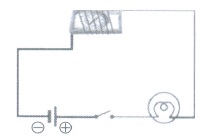
In the circuit shown in figure, when the key is closed, the compass needle placed in the match box deflects. Name the force which causes this deflection.
4.
A blacksmith hammers a hot piece of iron while making a tool. How does the force due to hammering affect the piece of iron?
5.
In the following situation, identify the agent exerting the force and the object on which it acts. State the effect of the force in each case.
(a) Squeezing a piece of lemon between the fingers to extract its juice.
(b) Taking out paste from a toothpaste tube.
(c) A load suspended from a spring while its other end is on a hook fixed to a wall.
(d) An athlete making a high jump to clear the bar at a certain height.
6.
Smooth surfaces produce ________ friction than rough surfaces.
7.
Friction produces _________
8.
As we go high on the mountain, the __________ decreases.
9.
Force can change the _________ of moving object.
10.
To draw water from a well, we have to _______ the rope.
11.
How many types of friction are there?
12.
Explain why a sportsman uses shoes with spikes.
13.
Why do kabbadi players rub their hands with soil?
14.
Why large vehicles have large tyres?
15.
Mention the SI unit of pressure
16.
A ball of dough is rolled into a flat chapati. Name the force exerted to change the shape of the dough.
17.
What are contact and non-contact forces? Explain briefly with suitable examples.
18.
Observe the vessels A, B, C and D as shown in figure carefully.
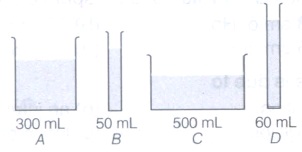
Volume of water taken in each vessel is as shown. Arrange them in the order of decreasing pressure at the base of each vessel. Explain.
19.
In figure, a boy is shown filushing the box trom right to left.
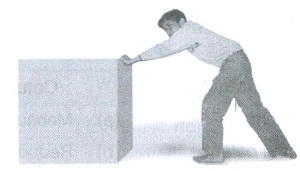
The force of friction will act on the box
from right to left (\(\leftarrow \))
from left to right (\(\rightarrow\))
vertically downwards (\(\downarrow\))
vertically upwards (\(\uparrow\))
20.
Four children were asked to arrange forces due to rolling, static and sliding frictions in a decreasing order. Their arrangements are given below. Choose the correct arrangement.
Rolling, static, sliding
Rolling, sliding, static
Static, sliding, rolling
Sliding, static, rolling
21.
Like poles exert a force of
attraction
repulsion
Both (a) and (b)
None of these
22.
Force is due to
motion
an interaction
collision
None of these
23.
During dry weather while combing hair, sometimes we experience hair flying apart. The force responsible for this is
force of gravity
electrostatic force
force of friction
magnetic force
24.
Gases are only called fluids.
25.
In 'tug of war' when both the teams apply equal pulling force then net force is maximum.
26.
Only the earth exerts gravitational force.
27.
Lubricants
28.
Shape of aeroplane
29.
Spring balance
30.
Electrostatic force
31.
Pressure
32.
Why are soles of the shoes and the tyres of the vehicles treaded ?
33.
Give an example which shows that friction can produce heat.
34.
The force acting on a unit area of a surface is called?
35.
Name two non-contact forces.
1.
A book kept on tilted writing desk starts sliding down. The direction of frictional force is in the opposite direction. Thus, frictional force will act in upward direction.
2.
Pressure = \(\frac{Force}{Area}\)
For area, A = 8m2
\(p=\frac{200}{8}=25\) N/m2 or 25 Pa
3.
On closing the switch, the current starts flowing in the wire and due to this current, a magnetic field established around the wire which exerts magnetic force on the needle and it gets deflected.
4.
When blacksmith hammers a hot piece of iron, the force due to hammering can change the shape of the piece of iron. In other words, we can say that force applied through the hammer by the blacksmith can mould the hot piece of iron into any kind of tool.
5.
| Agent exerting the force | Object on which it acts | Effect of the force | |
|---|---|---|---|
| (a) | Fingers (squeezing the lemon) | Lemon | Extraction of juice. |
| (b) | Hand (or fingers) | Toothpaste tube | Coming out of paste from toothpaste tube. |
| (c) | Suspended load | Spring | Elongation of spring due to load on the one end of it. |
| (d) | Muscles of legs | Bar | Making a high jump to clear the bar at a certain height. |
6.
()
less
7.
()
heat
8.
()
pressure
9.
()
direction
10.
()
pull
11.
There are three types of friction :
(i) Static
(ii) Sliding
(iii) Rolling
12.
Sportsman uses shoes with spikes in order to avoid getting slipped in the field. The spikes in the shoes increase the friction, so he/she can run on the ground easily.
13.
Kabbadi players rub their hands with soil to increase the friction so that they can grip the opposite team players firmly.
14.
Due to greater of large tyres, then will suffer less pressure, so the chance of tyre burst gets reduced.
15.
SI unit of pressure is N / m2 or pascal.
16.
The shape of dough is changed due to muscular force applied by the hand.
17.
Forces can be of two types:
(i) Contact forces.
(ii) Non-contact forces.
(i) Contact forces : The forces that come into play when two objects come in contact with each other.
(a) Muscular force: The force which is exerted due to action of muscles is known as the muscular force. e.g., running, bending, walking etc.
(b) Frictional Force: The force responsible for changing the state of motion of an object. Equal and opposite forces are being exerted on an object when its surface comes in contact with other surface. e.g., a car or scooter comes to rest.
(ii) Non-contact forces: The forces that can be exerted from a distance without establishing a contact are called the non-contact forces.
(a) Magnetic forces : Force exerted by a magnet on another magnet or magnetic substances like iron is called magnetic force. e.g., Car sticking to an electromagnet.
(b) Electrostatic force : Force exerted by a charged body on another charged body or uncharged body is called electrostatic force. e.g., If we rub a comb with hair and bring it near some small bits of paper it attracts the bits of paper towards itself. This is electrostatic force.
(c) Force of gravity : The earth pulls every object towards its centre. The force exerted by the earth is called the force of gravity.
18.
Pressure at depth due to liquid column depends upon
(i) gravitational acceleration (g)
(ii) density of liquid
(iii) height of liquid.
And in this case, g and density are same, so only thing that can change pressure is height. So, the order of pressure exerted by the fluid A, B,C and D at the base is given by Po > Pa > PA > PC
19.
(b)
from left to right (\(\rightarrow\))
20.
(c)
Static, sliding, rolling
21.
(b)
repulsion
22.
(b)
an interaction
23.
(b)
electrostatic force
24.
(b)
25.
(b)
26.
(b)
27.
()
Reduce friction
28.
()
Bird
29.
()
Measuring force
30.
()
Force between charges
31.
()
Force on unit area
32.
()
Due to force of friction
33.
()
Rubbing of palms
34.
()
Pressure
35.
()
Gravitational, magnetic force

8th Standard CBSE Syllabus & Materials
8th Standard CBSE
CBSE 8th Science Particulate Nature of Matter - New Model Questions Papers Study Material - QB365 Set A
NEW8th Standard CBSE
CBSE 8th Science Pressure, Winds, Stroms and Cyclones - New Model Questions Papers Study Material - QB365 Set A
NEW8th Standard CBSE
CBSE 8th Mathematics Quadrilaterals - New Model Questions Papers Study Material - QB365 Set A
NEW8th Standard CBSE
CBSE 8th Mathematics A story of Numbers - New Model Questions Papers Study Material - QB365 Set A



NCERT Books

Syllabus

Exam Pattern

Sample Question Papers

Previous year Question Papers

Important Notes

MCQ Practice test

NCERT Exemplers

Case study Questions

Image Based Questions

Passage based Questions

HOT Questions

Value Based Questions

Model Questions Papers
NCERT ( Book Back ) Questions

Assertion and Reason
Important Questions And Answers

CBSE 8th Standard CBSE Subjects
CBSE Standards


