
 100% FREE ACCESS
8th Standard CBSE Syllabus & Materials
8th Standard CBSE
CBSE 8th Social Science Theme D - Factors of Production - New Model Questions Papers Study Material - QB365 Set A
NEW8th Standard CBSE
CBSE 8th Social Science Theme C - Universal Franchise and India's Electoral System - New Model Questions Papers Study Material - QB365 Set A
NEW8th Standard CBSE
CBSE 8th Social Science Theme B - The Rise of the Marathas - New Model Questions Papers Study Material - QB365 Set A
NEW8th Standard CBSE
CBSE 8th Social Science Theme B - Reshaping India's Political Map - New Model Questions Papers Study Material - QB365 Set A
NEW8th Standard CBSE
CBSE 8th Social Science Theme A - Natural Resources and Their Use - New Model Questions Papers Study Material - QB365 Set A
NEW8th Standard CBSE
CBSE 8th Science Keeping Time with Skies - New Model Questions Papers Study Material - QB365 Set A

Published on: 29/10/2025
Download CBSE Class 8th Standard CBSE Science question papers, sample papers, important questions, and previous year solved papers in PDF format. Get free study materials, NCERT solutions, and exam preparation resources for Class 8th Standard CBSE Science
Questions + Answers key
Take MCQ Science Test
1.
Rohan visited a lake on two days. On the first day, the reflection of the surrounding mountains could be seen clearly in water of the lake. On the second day, he was not able to see the reflection of the mountains clearly. Give one possible reason for this phenomenon and explain your answer clearly.
2.
What is the Braille system?
3.
Write the structure and function of human eye.
4.
What is Kaleidoscope? How can it be made? What are its uses?
5.
Explain how could we can see the hair at the back of your head.
6.
"The law of reflection only holds true for regular reflection". Is this statement true or false? Explain your answer.
7.
"Though the image formation on retina is inverted but still we are able to see the erect objects". Explain how.
8.
Explain how do we see various objects.
9.
What is the difference between the surfaces of a sheet of sandpaper and a mirror?
10.
Eyes of the nocturnal birds have large cornea and a large pupil. How does this structure help them?
11.
(a) Find out the position of the image of an object situated at A in the plane mirror.
(b) Can Paheli at B see this image?
(c) Can Boojho at C see this image?
(d) When Paheli moves from B to C, where does the image of A move?
.jpg)
12.
Boojho stands at A just on the side of a plane mirror as shown in figure. Can he see himself in the mirror? Also can he see the image of objects situated at P, Q and R?
.jpg)
13.
What is the angle of incidence of a ray if the reflected ray is at an angle of 90° to the incident ray?
14.
Explain how you can take care of your eyes.
15.
Gurmit wanted to perform Activity using a laser torch. Her teacher advised her not to do so. Can you explain the basis of the teacher’s advise?
1.
The unclear image of the mountains on the second day is probably due to wind blowing across the lake causing it to lose its calmness. When the lake is calm the surface of the lake is smooth and regular reflection occurs, allowing a clear image of the mountains to be formed. When the wind blows across the lake, the surface of the lake becomes rough and uneven causing a diffused reflection. Hence, the image formed of the mountains will be unclear and blurred.
2.
The most popular resource for visually challenged person is Braille.
The present system was adopted in 1932. There is Braille code for common languages, mathematics and scientific notations.
It has 63 dots patterns or characters. Each character represents a letter, a combination of letters, common word or a sign.
Dots are arranged in cells of two vertical rows of three dots each.
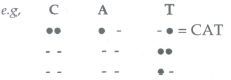
These patterns when embrassed on braille sheets, help visually challenged person to recognize words by touching.
3.
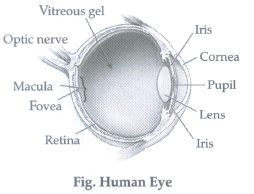
Human eye: The eye has a roughly spherical shape. The outer coat of eye is white. Its transparent front part is called cornea. Behind cornea a dark muscular structure is situated called iris. There is a small opening called the pupil. The size of the pupil is controlled by the iris. The iris controls the amount of light entering into the eye. The lens focuses light on the back of the eye, on a layer called retina. The retina contains several nerve cells. They transmit impulses to the brain through the optic nerve and hence, image is formed.
4.
Kaleidoscope is an instrument used to make numerous beautiful patterns.
To make a kaleidoscope get three rectangular mirror strips. Join them together to from a prism. Close one end of tube by cardboard disc having a hole in the centre. Paste a piece of transparent plastic sheet at the other end. Put several small pieces of coloured glass bangles. Allow enough space for the coloured pieces to move around.
Numerous beautiful patterns will be formed. It is used by designers of wall papers and fabrics and artists to get new ideas for new patterns.
5.
With the help of two plane mirrors, we could see the hair at the back of your head. One mirror to the front side and another mirror is to the back of head slightly above the level of head, and the mirror should also bend slightly towards the head.
6.
False, the law of reflection holds for both regular and diffused reflection. In a diffused reflection, the reflecting surface being rough and uneven, the parallel beam of light is reflected in different directions and angles.
7.
Yes, it is very true to say because the formation of image on the retina is conveyed to brain in the form of electrical impulses with the help of optical nerves. So, brain is able to perceive an rect image of object with the help of electrical impulses.
8.
Due to reflection, we can see various objects. Since we know that all surface reflect light, so when light falls on them (any objects), it reflects the light. In this way, this reflected light enters our eyes and due to this, late can see the object.
9.
The sand paper has a rough surface causing light that is reflected on it to be scattered at different angles. The mirror, however, allows regular reflection. Sandpaper cannot produce any image, unlike the mirror due to diffuse (irregular) reflection.
10.
The size of the eyes of nocturnal bird is large. Large eyes with a wider pupil, larger lens and increased retinal surface can collect more ambient light which help them to see the objects even at night easily.
11.
(a) Since it is plane mirror, so the image is formed behind the mirror or there is a lateral inversion in it.
.jpg)
(b) Yes, Paheli can see the image of object A.
(c) Yes, Boojho can also see the image of object A.
(d) No change in the position of the image of A.
12.
As Boojho is not in the range of reflecting surface rather, he is standing away from the mirror, so he cannot see himself in the mirror. But he can see the image of P which is in the reflecting area but not of Q and R.
13.
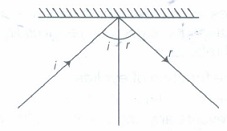
We know that, the angle of incidence is equal to the angle of reflection and the reflected ray is at an angle of 90° to the incident ray.
\(\therefore\ \angle i=\angle r=45^o\)
14.
We can take care of our eyes in the following manner:
(i) If advised, use suitable spectacles.
(ii) Too little or too much light is bad for eyes. Insufficient light can cause eye strain and headache.
(iii) Too much light like that of the sun, a powerful lamp or a laser torch can injure the retina.
(iv) Wash the eyes frequently with clean water.
(v) Always read at normal distance for vision.
(vi) Never rub your eyes.
15.
Laser light comes from a very small hole and the lens of the laser light is also very small, so the light will penetrate into one part of the eye and it can injure the retina, whereas the normal torch spreads out the light which does not cause any harm to our eyes.
So, the beam of laser light should not be used to perform an activity.

8th Standard CBSE Syllabus & Materials
8th Standard CBSE
CBSE 8th Science Particulate Nature of Matter - New Model Questions Papers Study Material - QB365 Set A
NEW8th Standard CBSE
CBSE 8th Science Pressure, Winds, Stroms and Cyclones - New Model Questions Papers Study Material - QB365 Set A
NEW8th Standard CBSE
CBSE 8th Mathematics Quadrilaterals - New Model Questions Papers Study Material - QB365 Set A
NEW8th Standard CBSE
CBSE 8th Mathematics A story of Numbers - New Model Questions Papers Study Material - QB365 Set A



NCERT Books

Syllabus

Exam Pattern

Sample Question Papers

Previous year Question Papers

Important Notes

MCQ Practice test

NCERT Exemplers

Case study Questions

Image Based Questions

Passage based Questions

HOT Questions

Value Based Questions

Model Questions Papers
NCERT ( Book Back ) Questions

Assertion and Reason
Important Questions And Answers

CBSE 8th Standard CBSE Subjects
CBSE Standards


