
 100% FREE ACCESS
8th Standard CBSE Syllabus & Materials
8th Standard CBSE
CBSE 8th Social Science Theme D - Factors of Production - New Model Questions Papers Study Material - QB365 Set A
NEW8th Standard CBSE
CBSE 8th Social Science Theme C - Universal Franchise and India's Electoral System - New Model Questions Papers Study Material - QB365 Set A
NEW8th Standard CBSE
CBSE 8th Social Science Theme B - The Rise of the Marathas - New Model Questions Papers Study Material - QB365 Set A
NEW8th Standard CBSE
CBSE 8th Social Science Theme B - Reshaping India's Political Map - New Model Questions Papers Study Material - QB365 Set A
NEW8th Standard CBSE
CBSE 8th Social Science Theme A - Natural Resources and Their Use - New Model Questions Papers Study Material - QB365 Set A
NEW8th Standard CBSE
CBSE 8th Science Keeping Time with Skies - New Model Questions Papers Study Material - QB365 Set A

Published on: 29/10/2025
Download CBSE Class 8th Standard CBSE Science question papers, sample papers, important questions, and previous year solved papers in PDF format. Get free study materials, NCERT solutions, and exam preparation resources for Class 8th Standard CBSE Science
Questions + Answers key
Take MCQ Science Test
1.
What is the difference between the surfaces of a sheet of sandpaper and a mirror?
2.
Explain in brief, how do ciliary muscles affect the functioning of eye.
3.
State in brief about angle of incidence and angle of reflection.
4.
How many images of a candle will be formed, if it is placed between two parallel plane mirrors separated by 40 cm?
5.
State the laws of reflection.
6.
Mention against each of the following whether regular or diffused reflection will take place when a beam of light strikes. Justify your answer in each case.
(a) Polished wooden table
(b) Chalk powder
(c) Cardboard surface
(d) Marble floor with water spread over it
(e) Mirror
(f) Piece of paper.
7.
Differentiate between regular and diffused reflection. Does diffused reflection mean the failure of the laws of reflection?
8.
In a movie, the still pictures in proper sequence are projected on the screen usually at the rate of ___________ pictures per second.
9.
If the still pictures of a moving object are flashed on our eyes at a rate faster than _________ pictures per second, the eye perceives the object as moving.
10.
The size of the pupil becomes ____________ when you see in dim light.
11.
The angle of __________ equals the angle of reflection.
12.
If you touch your ___________ ear with right hand in front of a plane mirror, it will be seen in the mirror that your right ear is touched with _____________.
13.
Which of the following statements is correct regarding rods and cones in the human eye?
Cones are sensitive to dim light
Cones are sensitive to bright light
Rods are sensitive to bright light
Rods can sense colour
14.
Light is falling on surfaces S1, S2, S3 as shown in figure.
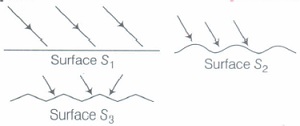
Surfaces on which the angle of incidence is equal to the angle of reflection is/are
Only S1
S1 and S2
S2 and S3
All the three surfaces
15.
The change in converging power of an eye lensis caused by the action of
retina
optic nerve
ciliary muscles
iris
16.
How does the eye change in order to focus on near or distant objects?
The eye lens moves in or out
The retina moves in or out
The eye lens becomes thicker or thinner
The pupil becomes larger or smaller
17.
We can see a non-luminous object when light
emitted by the object falls on the eye
is reflected from the object towards our eye
completely passes through the object
gets completely absorbed by the object
18.
As the angle between two plane mirrors is decreasing gradually, the number of images of an object placed between them
first increases then decreases
first decreases then increases
increases
decreases
19.
Part of the eye which controls the entering of light is called
iris
cornea
lens
retina
20.
A person cannot see the distant objects clearly, (though) he can see the nearby object clearly. He is suffering from the defect of vision called
myopia
hypermetropia
cataract
night blindness
21.
Image formed by a plane mirror is
virtual, behind the mirror and enlarged
virtual, behind the mirror and of the same sizeas the object
real at the surface of the mirror and enlarged.
real, behind the mirror and of the same sizeas the object
22.
Angle of incidence is equal to the angle of reflection
Always
Sometimes
Under special conditions
Never
23.
Why are we able to see the tap water in the glass even though it is colourless?
24.
Mention the name of device that is generally used by the designers of wall papers and fabrics.
25.
Mention the five English letters that do not show lateral inversion on suffering reflection from a plane mirror.
26.
Last Sunday morning, Pooja decided to see some bollywood movie along with her college friends. When they all entered in the cinema hall, then Pooja found some difficulty in observing the things around her but after few minutes, she got comfortable with the surroundings and she took her seat and spent 3 hrs approximately in seeing the movie. But when all of them made their exit from the all, then Pooja again left some discomfort in her eyes. At the same time, Pooja wore her goggles in order to protect herself from bright sunlight.
(a) Explain the brief that what happens to Pooja's eyes before and after seeing the movie in cinema hall.
(b) State the values showed by Pooja here.
27.
Boojho planned an activity to observe an object A through pipes as shown in figure so that he could see objects which he could not directly see.
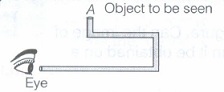
(a) Mention how many mirrors should he use to see the objects.
(b) Indicate the positions of the mirrors in the figure.
(c) State what must be the angle w.r.t. the incident light at which he should place the mirrors.
(d) Indicate the direction of rays in the figure.
(e) If any of the mirrors is removed, will he be able to see the objects?
1.
The sand paper has a rough surface causing light that is reflected on it to be scattered at different angles. The mirror, however, allows regular reflection. Sandpaper cannot produce any image, unlike the mirror due to diffuse (irregular) reflection.
2.
As we know that ciliary muscles can contract and relax, it is because they can change the kness of eye lens which results in change in its focal length. So, eye lens can make image of nearby objects and also far off objects on retina.
3.
i) Angle of incidence is an angle formed between the incident ray and the normal.
ii) The angle formed between the reflected ray and the normal is called angle of reflection.
iii) It forms the image of an object at retina.
4.
Infinite number of images will be formed due to multiple reflections of light.
5.
There are two laws of reflection as below:
(i) The angle of incidence is equal to the angle of reflection.
(ii) Incident ray reflected ray and the normal drawn at the point of incidence to the reflecting surface, all lie in the same plane.
6.
(a) Polished wooden table As the surface is smooth, so there is a regular reflection through it.
(b) Chalk powder Since, the surface is not smooth or it is uneven, thus there is a diffused reflection through it.
(c) Cardboard surface As its surface is uneven, so it will produce a diffused reflection.
(d) Marble floor with water spread over it As marble floor itself is very smooth, besides this there is a layer of water on it which makes the surface for regular reflection.
(e) Mirror Since, the surface of mirror is smooth, thus it will produce a regular reflection.
(f) Piece of paper Since, the surface is uneven, thus it will produce a diffused reflection.
7.
Differences between regular and diffused reflection are
| Regular reflection | Diffused reflection |
|---|---|
| i) It is caused by the reflection from smooth and shiny surfaces | It is caused by reflection from unpolished and rough surfaces |
| ii) Reflected rays are parallel to each other | Reflected rays are not parallel to each other |
No, the diffused reflection does not mean the failure of the laws of reflection.
8.
()
24
9.
()
16
10.
()
large
11.
()
incidence
12.
()
left, left hand
13.
(b)
Cones are sensitive to bright light
14.
Laws of reflection are always followed whatever be the surface of the object.
15.
(c)
ciliary muscles
16.
(c)
The eye lens becomes thicker or thinner
17.
(b)
is reflected from the object towards our eye
18.
(c)
increases
19.
(b)
cornea
20.
(a)
myopia
21.
(b)
virtual, behind the mirror and of the same sizeas the object
22.
(a)
Always
23.
Tap water reflects the light into our eyes. As long as an object reflects light into our eyes, we can see it.
24.
Kaleidoscope is a device that is generally used by the designers of wallpapers and fabrics.
25.
The five English letters which do not show the lateral inversion on suffering reflection are AHOTU.
26.
(a) While entering the cinema hall along with her friends, pupil of Pooja's eyes gets expanded due to which for few minutes she was unable to see the things around her. On the other hand, when she made on exit fromthe mall, at that moment, her pupil of her eyes becomes contracted and a large amount of light entered in her eyes due to which she felt discomfort to get things around her. But after few minutes, the pupil size starts increasing and she was able to observe the surroundings.
(b) Pooja seems to be very intelligent and conscious minded as she wore her goggle at the same time when she was feeling discomfort due to the large amount of light coming through the sun rays.
27.
(a) Number of mirrors = 3
(b) Positions of the mirrors are as shown in figure.
(c) Mirrors should be placed at 45° w.r.t. the incident light. So, that ray can move forward.
(d) Direction of rays is shown in figure.
(e) He will not be able to see the objects if any of the mirrors is removed since he will not get the rays after that removed mirror.

8th Standard CBSE Syllabus & Materials
8th Standard CBSE
CBSE 8th Science Particulate Nature of Matter - New Model Questions Papers Study Material - QB365 Set A
NEW8th Standard CBSE
CBSE 8th Science Pressure, Winds, Stroms and Cyclones - New Model Questions Papers Study Material - QB365 Set A
NEW8th Standard CBSE
CBSE 8th Mathematics Quadrilaterals - New Model Questions Papers Study Material - QB365 Set A
NEW8th Standard CBSE
CBSE 8th Mathematics A story of Numbers - New Model Questions Papers Study Material - QB365 Set A



NCERT Books

Syllabus

Exam Pattern

Sample Question Papers

Previous year Question Papers

Important Notes

MCQ Practice test

NCERT Exemplers

Case study Questions

Image Based Questions

Passage based Questions

HOT Questions

Value Based Questions

Model Questions Papers
NCERT ( Book Back ) Questions

Assertion and Reason
Important Questions And Answers

CBSE 8th Standard CBSE Subjects
CBSE Standards


