
 100% FREE ACCESS
8th Standard CBSE Syllabus & Materials
8th Standard CBSE
CBSE 8th Social Science Theme D - Factors of Production - New Model Questions Papers Study Material - QB365 Set A
NEW8th Standard CBSE
CBSE 8th Social Science Theme C - Universal Franchise and India's Electoral System - New Model Questions Papers Study Material - QB365 Set A
NEW8th Standard CBSE
CBSE 8th Social Science Theme B - The Rise of the Marathas - New Model Questions Papers Study Material - QB365 Set A
NEW8th Standard CBSE
CBSE 8th Social Science Theme B - Reshaping India's Political Map - New Model Questions Papers Study Material - QB365 Set A
NEW8th Standard CBSE
CBSE 8th Social Science Theme A - Natural Resources and Their Use - New Model Questions Papers Study Material - QB365 Set A
NEW8th Standard CBSE
CBSE 8th Science Keeping Time with Skies - New Model Questions Papers Study Material - QB365 Set A

Published on: 29/10/2025
Download CBSE Class 8th Standard CBSE Science question papers, sample papers, important questions, and previous year solved papers in PDF format. Get free study materials, NCERT solutions, and exam preparation resources for Class 8th Standard CBSE Science
Questions + Answers key
Take MCQ Science Test
1.
A Solar system consists of eight planets and a host of_____________ and _____________ ,
2.
Some objects can be charged by ________ with other objects.
3.
A worldwide campaign against _________ has finally led to its eradication from most parts of the world.
4.
Friction depends on the _________ of surfaces.
5.
Damaged seeds would .............. on top of water.
6.
What is an earthquake? What is its cause?
7.
Boojho wants to know how we take advantage of the knowledge that pressure can be increased or decreased by changing the area on which a force acts.
8.
A given non-metal forms sulphuric acid on reacting with nitric acid. Identify the non-metal.
9.
If you burn a candle and coal, what is the difference in their burning?
10.
Terms related to agricultural practices are given below. Rearrange them in the correct sequence.harvesting, sowing, manuring, tilling and ploughing, irrigation, weeding
11.
Sex chromosomes in a female body are
X
Y
XX
XY
12.
Which is not a property of non-metal?
Ductility
Solid state
Can be conductors
All.
13.
A pond contains clean water. Which of the following activities will produce least pollution of water?
Washing clothes in the pond
Bathing animals in the pond
Washing motor vehicles in the pond
Swimming in the pond
14.
The change in seasons on the earth occurs because
the distance between the earth and the sun is not constant
the axis of rotation of the earth is parellel to the plane of its orbit
the axis of rotation of the Earth is perpendicular to the plane of its orbit
the axis of rotation of the Earth is tilted with respect to the plane of its orbit
15.
During dry weather while combing hair, sometimes we experience hair flying apart. The force responsible for this is
force of gravity
electrostatic force
force of friction
magnetic force
16.
The maximum displacement of a vibrating body from its mean position is called
frequency
time period
amplitude
None of the above
17.
Consider the list of terms given below:
(i) Tsunami
(ii) Landslide
(iii) Floods
(iv) Lightning
Earthquakes can cause
(i), (ii) and (iii)
(ii) and (iv)
(ii), (iii) and (iv)
(iii) and (iv)
18.
The structural and functional unit of life called cell was discovered by
Robert Boyle
Charles Darwin
Robert Koch
Robert Hooke
19.
Which of the following is not a constituent of petroleum?
Paraffin wax
Lubricating oil
Petrol
Coke
20.
Given below are statements about the harmful effects of weeds on crop plants.
(i) They interfere in harvesting.
(ii) They help crop plants to grow healthily.
(iii) They compete with crop plants for water, nutrients, space and light.
(iv) They affect the plant growth.
Choose the correct combination of statements.
(i), (iii) and (iv)
Only (iii)
(iii) and (iv)
(i), (ii), (iii) and (iv)
21.
Puberty
22.
Aluminium
23.
Fundamental unit of life
24.
Satpura
25.
Pasteurisation
26.
Shikha while teaching her sister about microbes explained that microbes are useful to humans. Hearing this, her sister Sneha got confused as she knew that her Uncle was suffering from TB caused by microbes. She asked this to Shikha. Shikha appreciated Sneha was asking this question and explained her.
(i) What are microbes?
(ii) How are microbes helpful to humans?
(iii) Mention two diseases other than TB caused by microbes.
(iv) Identify the values shown by Sneha.
27.
Why does the increased level of nutrients in the water affect the survival of aquatic organisms?
28.
Imagine that an object is falling through a long straight glass tube held vertical, air has been removed completely from the tube. The object does not touch the walls of the tube. Will the object experience any force of friction?
29.
What are sex hormones? Why are they named so? State their functions.
30.
Write the difference between coke and coal
31.
Complete the crossword puzzle with the help of clues given below
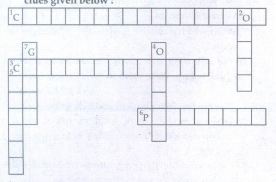
Across:
(i) Pollutant which is used in refrigerators and air conditioners. (18)
(iii) Produced on incomplete combustion of fuels. (14) 6. This chemical protects our crops and is washed into water bodies from the field. (9) Down:
(ii) This layer protects us from harmful ultraviolet rays. (5)
(iv) It is essential for combustion. (6)
(v) Disease which is caused by drinking contaminated water. (7)
(iv) River which is famous in India and sustains most of the northern, central and eastern Indian population. (5)
32.
Write a short note on. Useful micro-organisms.
33.
It is difficult to cut cloth using a pair of scissors with blunt blades. Explain.
34.
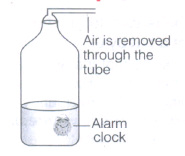
An alarm bell is kept inside a vessel as shown in figure. A person standing close to it can distinctly hear the sound of alarm. Now, if the air inside the vessel is removed completely, how will the loudness of alarm get affected for the same person?
35.
(a) A jelly-like substance is present in a cell. What is it called as? Also give its function.
(b) Give the meaning of protoplasm. Name the four elements which make up major part of protoplasm.
36.
The substance A is a fossil fuel. It occurs deep below the earth's crust in certain areas. Another fossil fuel B is found above the substance A. When A is subjected to a process C, a number of different products (fractions) are collected at different temperature ranges which have different uses. A special grade of product D obtained in this process is used as aviation fuel in jet aeroplanes. The product D is also used in stoves, lamps, etc
Now give the answer of the following questions.
(a) What are the substances, A and B?
(b) Write the physical states of substances A and B.
(c) What is the process C called?
(d) Name the product D.
37.
Use of lubricants increases the friction.
38.
Only to and fro motion of an object is called vibration
39.
Water which is suitable for drinking is called soft water.
40.
Each sperm is a single cell.
41.
Melamine is a thermoplastic.
42.
How many kinds of nerve cells are there in retina?
43.
Define potable water
44.
When does puberty end?
45.
Does sound travel through all mediums?
46.
The process of transferring of charge from a charged object to the Earth.
47.
A group of similar cells performing a specific function
48.
Name the biosphere reserve where the plants and animals are found similar to the upper Himalayan peaks.
49.
Name the material that is used to make ropes for rock climbing.
50.
Where is the sprinkler water system useful?
1.
()
asteroids, comets, meteors
2.
()
rubbing
3.
()
small pox.
4.
()
nature
5.
()
float
6.
An earthquake is a sudden shaking or trembling of the earth, which lasts for a very short time. It is caused by movement of plates of outermost layer of earth.
7.
We make use of the relation between force, area and pressure to our advantage in many situations. To walk over a muddy patch of wet kachcha road without slipping, a wooden plank is used, the foundation is made wider than the width of the wall to be erected on it, width of tyres used for heavy vehicles like trucks and buses is larger than those used in cars or bicycles. On the other hand, tools meant for cutting and piercing always have a sharp edge. This ensures that the area of their surfaces in contact with the material to be cut pierced is as small as possible.
8.
Sulphur.
9.
Candle burns with a flame whereas coal does not.
10.
The correct sequence in the series of agricultural practices is:
Tilling and ploughing \(\rightarrow \) sowing \(\rightarrow \) manuring \(\rightarrow \) irrigation \(\rightarrow \) weeding \(\rightarrow \) harvesting.
11.
(c)
XX
12.
13.
(d)
Swimming in the pond
14.
(a)
the distance between the earth and the sun is not constant
15.
(b)
electrostatic force
16.
(c)
amplitude
17.
(a)
(i), (ii) and (iii)
18.
(d)
Robert Hooke
19.
(d)
Coke
20.
(a)
(i), (iii) and (iv)
21.
()
Marked changes during adolescence
22.
()
Wrapping food
23.
()
Cell
24.
()
National park
25.
()
L Pasteur
26.
(i) Organisms that cannot be seen with eyes alone or with naked eyes are called microbes.
(ii) Microbes are useful to humans in many ways:
They help in the production of curd, cheese, in cleaning the environment etc.
(iii) Diseases caused by microbes are polio, malaria etc.
(iv) Sneha is attentive, responsive and curious.
27.
The increased level of nutrients in the water increases the growth of algae. Once these algae dies, they serve as food for decomposers like bacteria. A lot of oxygen is utilised in this process, consequently leading to a decrease in the level of Dissolved Oxygen (DO) in the waterbody. This, in turn causes fishes and other aquatic organisms to die.
28.
No, the object will not experience any frictional force because to experience the force of friction, two surfaces must be there and there is only one surface in this case.
29.
(i) The hormones which are responsible for the male and female secondary sexual characters are called sex hormones.
(ii) They are called sex hormones as they control the sexual activities and help us to distinguish boys from girls.
(iii) In boys, sex hormones control formation of sperms by testes and growth of facial hair, etc and in girls, they help to develop breasts, control menstrual cycle, etc.
30.
Difference between coke and coal are as follows:
| Coke | Coal |
| It is almost pure form of carbon | It mainly contains mainly carbon. |
| It is an amorphous form of carbon | It is a non-crystalline form of carbon |
| It is obtained by heating coal in the absence of air. | It is obtained by the decay of vegetation which existed millions of year ago. |
31.
Across:
(i) Chlorofluorocarbons
(iii) Carbon monoxide
(iv) Pesticide
Down:
(ii) Ozone
(iv) Oxygen
(v) Cholera
(vii) Ganga
32.
Useful micro-organisms:
(i) Friendly micro-organisms: They are used for various purposes. They are used in making curd (Lactobacillus bacteria) and bread. They are ingredients of Idli, Dhoklas and Bhaturas.
(ii) Commercial uses: Micro-organisms are used for the large scale production of alcohol and wine. Yeast is grown on natural sugars present in grains such as barley, wheat, rice, fruit juices for this purpose.
(iii) Medicinal uses: A very useful medicine group 'antibiotics' is prepared from micro-organisms. Commonly-used antibiotics are formed by fungi and bacteria. Vaccine also protects us from microbes.
(iv) Increasing soil fertility: Some bacteria and bluegreen algae are able to fixnitrogen from atmosphere and form nitrogen compounds which increase the soil fertility.
(v) Decomposers: They decompose the dead organic substances into their constituents and clean the environment.
33.
It is difficult to cut cloth using a pair of scissors with blunt blades because blunt blades have more area and due to which applied force produces very less pressure.
As we know that pressure is inversely proportional to area of cross-section, so it is difficult to cut cloth from blunt blades. \((\therefore \rho=\frac{F}{A})\).
34.
Initially, the person is able to hear the sound coming from air and from water distinctly. But after sometime, when the air is completely removed from the bottle, the sound will pass through the water and then through the glass. So, the man will not hear through the sound which was coming through the air initially.
35.
(a) Cytoplasm is the transparent, jelly-like substance that makes up most of the inside of a cell. It is present between the cell membrane and nucleus.
Various structures such as the nucleus, mitochondria are present in it. These are called organelles. Salts, proteins, sugars and other substances are dissolved in this fluid.
Function Most of the chemical reactions which keep the cell alive take place in the cytoplasm.
(b) The nucleus and the cytoplasm together make up the protoplasm which is called the living substance of the cell.
The main constituent elements of protoplasm are carbon, hydrogen, oxygen and nitrogen
36.
(a) A is petroleum and B is natural gas.
(b) A is thick liquid while B is gas.
(c) C is called fractional distillation
(d) D is kerosene.
37.
(b)
38.
(b)
39.
(b)
40.
(a)
41.
(b)
42.
()
There are two kinds of cells :
(i) Cones: Sensitive to bright light.
(ii) Rods: Sensitive to dim light.
43.
()
Water that is suitable for drinking
44.
()
Puberty ends when an adolescent reaches reproductive maturity
45.
()
Yes, it travels through all mediums such as solid, liquid and gases
46.
()
Earthing
47.
()
Tissue
48.
()
Pachmarhi Biosphere Reserve.
49.
()
Nylon.
50.
()
Sprinkle water system is useful on the uneven land and at the land where water is not available. It is good for sandy soil.

8th Standard CBSE Syllabus & Materials
8th Standard CBSE
CBSE 8th Science Particulate Nature of Matter - New Model Questions Papers Study Material - QB365 Set A
NEW8th Standard CBSE
CBSE 8th Science Pressure, Winds, Stroms and Cyclones - New Model Questions Papers Study Material - QB365 Set A
NEW8th Standard CBSE
CBSE 8th Mathematics Quadrilaterals - New Model Questions Papers Study Material - QB365 Set A
NEW8th Standard CBSE
CBSE 8th Mathematics A story of Numbers - New Model Questions Papers Study Material - QB365 Set A



NCERT Books

Syllabus

Exam Pattern

Sample Question Papers

Previous year Question Papers

Important Notes

MCQ Practice test

NCERT Exemplers

Case study Questions

Image Based Questions

Passage based Questions

HOT Questions

Value Based Questions

Model Questions Papers
NCERT ( Book Back ) Questions

Assertion and Reason
Important Questions And Answers

CBSE 8th Standard CBSE Subjects
CBSE Standards


