
 100% FREE ACCESS
8th Standard CBSE Syllabus & Materials
8th Standard CBSE
CBSE 8th Social Science Theme D - Factors of Production - New Model Questions Papers Study Material - QB365 Set A
NEW8th Standard CBSE
CBSE 8th Social Science Theme C - Universal Franchise and India's Electoral System - New Model Questions Papers Study Material - QB365 Set A
NEW8th Standard CBSE
CBSE 8th Social Science Theme B - The Rise of the Marathas - New Model Questions Papers Study Material - QB365 Set A
NEW8th Standard CBSE
CBSE 8th Social Science Theme B - Reshaping India's Political Map - New Model Questions Papers Study Material - QB365 Set A
NEW8th Standard CBSE
CBSE 8th Social Science Theme A - Natural Resources and Their Use - New Model Questions Papers Study Material - QB365 Set A
NEW8th Standard CBSE
CBSE 8th Science Keeping Time with Skies - New Model Questions Papers Study Material - QB365 Set A

Published on: 29/10/2025
Download CBSE Class 8th Standard CBSE Science question papers, sample papers, important questions, and previous year solved papers in PDF format. Get free study materials, NCERT solutions, and exam preparation resources for Class 8th Standard CBSE Science
Questions + Answers key
Take MCQ Science Test
1.
The process of conversion of sugar into alcohol is called
nitrogen fixation
moulding
fermentation
infection
2.
The bread or idli dough rises because of
heat
grinding
growth of yeast cells
kneading
3.
The following is an antibiotic
sodium bicarbonate
streptomycin
alcohol
yeast
4.
Yeast is used in the production of
sugar
alcohol
hydrochloric acid
oxygen
5.
Cooling helps in food preservation. How?
6.
Do microorganisms play any useful role in environment? If yes, explain.
7.
Write a short paragraph on the harmful effects of microorganisms.
8.
Name the microorganisms which can fix atmospheric nitrogen in the soil.
9.
Name any two algae which helps in nitrogen fixation.
10.
Preservatives are used in kitchen on daily basis. List a few of them.
11.
Give example of a disease that can spread through direct contact with infected person.
12.
A gas is responsible for increase in volume of dough. Name it.
13.
A popular vaccination programme was launched in India in 1995. Name it.
14.
Write the name of two groups of microorganisms which live in colonies.
15.
Identify protozoan from the list of microorganisms given: Rhizopus, Rhizobium, Penicillium, Amoeba
16.
Do we have a separate branch of biology for the study of microorganisms, what is it called as?
17.
Observe the figure and answer the following questions.
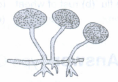
(a) Name the microorganism and the group to which it belongs.
(b) Name the food item on which the organism grows.
(c) Does it grow well in dry or in moist conditions?
(d) Is it safe to eat infected bread?
18.
During biology class, teacher was telling about microbes and how they are useful to humans. Hearing this, Jasmine got confused as she knew the TB caused to her uncle is due to a microbe. She asked his teacher about it. The teacher appreciated her for question and explained the whole class.
(a) What are microbes?
(b) How are microbes helpful to humans?
(c) Name one microbe
(i) used in household products.
(ii) used in antibiotics.
(d) Mention two diseases other than TB caused by microbes.
(e) Identify the values shown by Jasmine.
19.
Paramecium is a slipper- shaped ___________________
20.
______________ is a nitrogen fixing bacteria.
21.
Pathogens are___________ causing organisms.
22.
Under unfavourable conditions, microorganisms form a _______________ around themselves.
23.
Microorganisms can be found only in air and water.
24.
Foot and mouth disease is a bacterial disease in animals.
1.
(c)
fermentation
2.
(c)
growth of yeast cells
3.
(b)
streptomycin
4.
(b)
alcohol
5.
Cooling helps in food preservation by inhibiting the growth of microbes. This is because most of the microorganisms are able to multiply only under warm conditions.
6.
Yes, microorganisms play an important and useful role in environment by making it clean. They decompose dead organic waste of plants and animals into simpler substances. These simpler harmless substances contain nutrients and are used by plants as manures. Thus, microorganisms can be used for degradation and thereby cleaning the environment.
7.
Microorganisms are harmful for human beings in many ways. They cause diseases in humans, plants and animals, e.g.
(i) In humans, bacteria cause diseases such as cholera, typhoid, tuberculosis, etc.
(ii) In cattle, the foot and mouth disease is caused by a virus.
(iii) Also several microbes cause diseases in plants, e.g. tikka disease, late blight of potato. Some microbes grow on food and secrete toxic substances which make the food poisonous.
8.
Bacteria such as Rhizobium and certain blue-green algae (Anabaena, Nostoc) present in the soil can fix atmospheric nitrogen and convert it into usable nitrogenous compounds.
9.
Anabaena and Nostoc are two blue-green algae which help in nitrogen fixation.
10.
Vinegar and oil are common preservatives, used in kitchen.
11.
Chickenpox and ringworm are diseases that can spread through direct contact with infected person.
12.
Carbon dioxide given out by yeast is responsible for increase in volume of dough.
13.
Pulse Polio Immunisation Programme was launched in India in 1995 for eradication of polio.
14.
The groups of microorganisms which live in colonies are bacteria and fungi.
15.
Amoeba is a protozoan in the list given.
16.
Yes, the study of microorganisms is called Microbiology.
17.
(a) Microorganism is bread mould (Rhizopus) and the group is fungi.
(b) Organism grows on moist and stale bread.
(c) It grows well in moist condition.
(d) No, the fungus spoils the bread by producing poisonous substances (toxins).
18.
(a) Organisms that cannot be seen with eyes alone are called microbes.
(b) Microbes are useful to humans in many ways. They help in the production of curd, cheese, in cleaning the environment, etc.
(c) (i) Lactobacillus bacteria.
(ii) Penicillium
(d) Diseases caused by microbes are polio, malaria, etc.
(e) Jasmine is attentive, intelligent and curious.
19.
()
Protozoa
20.
()
Rhizobium
21.
()
disease
22.
()
cyst
23.
(b)
24.
(b)

8th Standard CBSE Syllabus & Materials
8th Standard CBSE
CBSE 8th Science Particulate Nature of Matter - New Model Questions Papers Study Material - QB365 Set A
NEW8th Standard CBSE
CBSE 8th Science Pressure, Winds, Stroms and Cyclones - New Model Questions Papers Study Material - QB365 Set A
NEW8th Standard CBSE
CBSE 8th Mathematics Quadrilaterals - New Model Questions Papers Study Material - QB365 Set A
NEW8th Standard CBSE
CBSE 8th Mathematics A story of Numbers - New Model Questions Papers Study Material - QB365 Set A



NCERT Books

Syllabus

Exam Pattern

Sample Question Papers

Previous year Question Papers

Important Notes

MCQ Practice test

NCERT Exemplers

Case study Questions

Image Based Questions

Passage based Questions

HOT Questions

Value Based Questions

Model Questions Papers
NCERT ( Book Back ) Questions

Assertion and Reason
Important Questions And Answers

CBSE 8th Standard CBSE Subjects
CBSE Standards


