
 100% FREE ACCESS
8th Standard CBSE Syllabus & Materials
8th Standard CBSE
CBSE 8th Social Science Theme D - Factors of Production - New Model Questions Papers Study Material - QB365 Set A
NEW8th Standard CBSE
CBSE 8th Social Science Theme C - Universal Franchise and India's Electoral System - New Model Questions Papers Study Material - QB365 Set A
NEW8th Standard CBSE
CBSE 8th Social Science Theme B - The Rise of the Marathas - New Model Questions Papers Study Material - QB365 Set A
NEW8th Standard CBSE
CBSE 8th Social Science Theme B - Reshaping India's Political Map - New Model Questions Papers Study Material - QB365 Set A
NEW8th Standard CBSE
CBSE 8th Social Science Theme A - Natural Resources and Their Use - New Model Questions Papers Study Material - QB365 Set A
NEW8th Standard CBSE
CBSE 8th Science Keeping Time with Skies - New Model Questions Papers Study Material - QB365 Set A

Published on: 29/10/2025
Download CBSE Class 8th Standard CBSE Science question papers, sample papers, important questions, and previous year solved papers in PDF format. Get free study materials, NCERT solutions, and exam preparation resources for Class 8th Standard CBSE Science
Questions + Answers key
Take MCQ Science Test
1.
Write the characteristics and some important uses of coal.
2.
Last Monday, Ankush woke up late in the morning. So, he saw the time and suddenly realised that he had got late for an interview, which he was supposed to give after reaching the venue by the right time. Immediately, he turned on the geyser but it did not work. He got more tensed, then he used an electric iron rod through which he could get some boiled water for his bath. Actually, there was an earthing problem in the switch board about which he was unawared of. He was barefooted and was just about to switch on the electric iron rod but at the same he got restricted to do so by one his room partner living with him. It could be dangerous for Ankush.
(a) Explain in brief that what could be happened with Ankush, if he switched on the electric iron rod (without wearing any slippers in his foot).
(b) Mention, the values showed by Ankush's friend
3.
Paheli wants to deposit silver on an iron spoon. She took silver nitrate (AgNO3) solution in a beaker and set up a simple circuit for electroplating. Which terminal of the battery should the spoon be connected to? What material should the other electrode be made of?
4.
The test-tube babies are called so as they grow inside a test tube. Give your opinion.
5.
You might have observed on a dry day that when you touch the screen of a television or computer monitor (with picture tube), you get a slight shock. Why does it happen?
6.
Describe the two modes of reproduction.
7.
Some natural resources are given below. Classify them into the exhaustible and inexhaustible natural resources. Air, coal, natural gas, sunlight, petroleum, minerals, forests, oxygen.
8.
Explain protection against earthquake.
9.
What are clones? What are the various steps of this process? Explain with examples.
10.
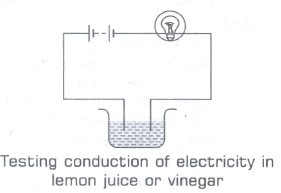
Prove that lemon juice and vinegar are good conductors of electricity.
11.
The substance A is a fossil fuel. It occurs deep below the earth's crust in certain areas. Another fossil fuel B is found above the substance A. When A is subjected to a process C, a number of different products (fractions) are collected at different temperature ranges which have different uses. A special grade of product D obtained in this process is used as aviation fuel in jet aeroplanes. The product D is also used in stoves, lamps, etc
Now give the answer of the following questions.
(a) What are the substances, A and B?
(b) Write the physical states of substances A and B.
(c) What is the process C called?
(d) Name the product D.
12.
It was used for street lighting for the first time in London.
Coke
Coal-tar
Coal gas
Petrol
13.
The presence of a small amount of impurities makes water
a good conductor of electricity
a bad conductor of electricity
pure
None of the above
14.
Tadpole is the larva of
fish
frog
mosquito
butterfly
15.
Major earthquakes are less likely to occur in
North-East India
Rajasthan
Rann of Kutch
Orissa
16.
Petroleum was formed from organisms
living on the land
living on the plants
living in the sea
living on the rocks
17.
Fossil fuels are obtained from
remains of non-living materials
dead remains of birds only
dead remains of insects only
dead remains of living organisms
18.
What is the magnetic effect of electric current?
19.
What are two types of charges?
20.
What is foetus?
1.
Characteristics of coal:
(i) Coal is a hard, black, combustible fossil fuel.
(ii) It mainly contains carbon and is a good source of energy.
(iii) When heated in air, coal burns and produces mainly carbon dioxide gas.
Uses of coal:
(i) It is used in thermal power plants to produce electricity.
(ii) It is used as a fuel in various industries.
(iii) It is used for the manufacture of coke, coal-tar and coal gas.
2.
(a) If Ankush switched on the electric iron rod and (without wearing any footwears), then he could get met with some accident, either in the form of electrical sparking or short circuit of switch board.
(b) Ankush's friend seems to be very intelligent and very much concerned for Ankush as well.
3.
Spoon should be connected to the negative terminal of the battery. The other electrode should be of silver so that silver ions get deposited on an iron spoon.
4.
The babies born through IVF technique are called test-tube babies because the fertilisation takes place in a glass test tube. This is however, a misleading name as a very brief period is spent in a test tube. After which, the entire growth and development of the baby takes place inside the uterus of the woman as in normal pregnancy.
5.
It happens because the television screen or computer monitor are charged and have static charges and when we touch them with our hands which are uncharged, the charges attract our hands and transfer through our hands and we get a small shock.
6.
Two modes of reproduction are
(i) Asexual reproduction It does not involve fusion of gametes, it results from multiplication of body cells from a single parent. Daughter organisms are genetically identical to the parent. No fertilisation takes place.
(ii) Sexual reproduction It is characterised by the union of male and female gametes coming from two parents. Daughter organisms differ from the parents genetically. Fertilisation takes place.
7.
Exhaustible natural resources are as below: Coal, natural gas, petroleum, minerals, forests. Inexhaustible natural resources are as below: Air, sunlight, oxygen.
8.
Protections against earthquake :
Earthquakes cannot be predicted. They can be highly destructive. It is, therefore, important that we take necessary precautions to protect ourselves all the time. It is advisable to make the structure 'Quake Safe'.
(i) Consult qualified architects and structural engineers.
(ii) In highly seismic area, the use of mud and timber is better. They keep roofs light.
(iii) Fix shelves and cupboards to the walls.
(iv)Be careful where you hang wall clocks, photo frames, water heaters etc.
(v) Building can catch fire during earthquake. So all buildings must have fire fighting equipments in working order.
In the event that an earthquake does strike, take the following steps to protect yourself.
At home: Take shelter under a table, stay away from tall and heavy objects and if you are in bed, do not get up. Protect your head with a pillow.
Outdoors: Find a clean spot, away from buildings, trees, and overhead power lines. Drop to ground. If you are in car or bus do not come out.
9.
Cloning is the production of an exact copy of a cell any other living part, or a complete organism. Ian Wilmut and his colleagues at the Roslin Institute, Edinburgh, Scotland successfully cloned a sheep named Dolly.
Following steps were involved in cloning:
(i) A cell was collected from the mammary gland of a female sheep.
(ii)An egg was obtained from a Scottish blackface and its nucleus was removed.
(iii)The nucleus from the mammary gland cellof Dorset sheep was introduced in the egg.
(iv)This egg was then implanted in the uterus.
10.
Take a few plastics or rubber caps of bottles. Put one teaspoon of lemon juice or vinegar in one cap. Now, bring the tester over the cap and let the ends of the tester dip into lemon juice or vinegar. So, we see that bulb starts to glow. It indicates that lemon juice and vinegar are good conductors of electricity.
11.
(a) A is petroleum and B is natural gas.
(b) A is thick liquid while B is gas.
(c) C is called fractional distillation
(d) D is kerosene.
12.
(c)
Coal gas
13.
(a)
a good conductor of electricity
14.
(b)
frog
15.
(d)
Orissa
16.
(c)
living in the sea
17.
(d)
dead remains of living organisms
18.
()
The electric current flowing in a wire produces the magnetic field around it. A current carrying conductor behaves like a magnet.
19.
()
Positive charge, negative charge.
20.
()
The stage of embryo in which all the body parts can be identified is called a foetus

8th Standard CBSE Syllabus & Materials
8th Standard CBSE
CBSE 8th Science Particulate Nature of Matter - New Model Questions Papers Study Material - QB365 Set A
NEW8th Standard CBSE
CBSE 8th Science Pressure, Winds, Stroms and Cyclones - New Model Questions Papers Study Material - QB365 Set A
NEW8th Standard CBSE
CBSE 8th Mathematics Quadrilaterals - New Model Questions Papers Study Material - QB365 Set A
NEW8th Standard CBSE
CBSE 8th Mathematics A story of Numbers - New Model Questions Papers Study Material - QB365 Set A



NCERT Books

Syllabus

Exam Pattern

Sample Question Papers

Previous year Question Papers

Important Notes

MCQ Practice test

NCERT Exemplers

Case study Questions

Image Based Questions

Passage based Questions

HOT Questions

Value Based Questions

Model Questions Papers
NCERT ( Book Back ) Questions

Assertion and Reason
Important Questions And Answers

CBSE 8th Standard CBSE Subjects
CBSE Standards


