
 100% FREE ACCESS
8th Standard CBSE Syllabus & Materials
8th Standard CBSE
CBSE 8th Social Science Theme D - Factors of Production - New Model Questions Papers Study Material - QB365 Set A
NEW8th Standard CBSE
CBSE 8th Social Science Theme C - Universal Franchise and India's Electoral System - New Model Questions Papers Study Material - QB365 Set A
NEW8th Standard CBSE
CBSE 8th Social Science Theme B - The Rise of the Marathas - New Model Questions Papers Study Material - QB365 Set A
NEW8th Standard CBSE
CBSE 8th Social Science Theme B - Reshaping India's Political Map - New Model Questions Papers Study Material - QB365 Set A
NEW8th Standard CBSE
CBSE 8th Social Science Theme A - Natural Resources and Their Use - New Model Questions Papers Study Material - QB365 Set A
NEW8th Standard CBSE
CBSE 8th Science Keeping Time with Skies - New Model Questions Papers Study Material - QB365 Set A

Published on: 29/10/2025
Download CBSE Class 8th Standard CBSE Science question papers, sample papers, important questions, and previous year solved papers in PDF format. Get free study materials, NCERT solutions, and exam preparation resources for Class 8th Standard CBSE Science
Questions + Answers key
Take MCQ Science Test
1.
Presence of excessive or unwanted sounds in the environment is called noise pollution. List some sources of noise pollution. What are the harms of noise pollution. What are the measures to control noise pollution?
2.
How can noise pollution be controlled?
3.
Sketch larynx and explain its function in your own words
4.
Anjali's grandfather was talking to her about the quality of sound produced by different musical instruments. The instruments like sitar, harmonium, flute, etc., give us a pleasant sensation of hearing. The dholak on the other side creates a noise.
(a) Mention the name of the vibrating part of sitar.
(b) Briefly explain how the loudness is created by dholak.
(c) We hear a shrilling sound by flute. Explain why?
(d) Mention the values displayed by Anjali's grandfather
5.
The town hall building is situated close to Boojho's house. There is a clock on the top of the town hall building which rings the bell every hour. Boojho has noticed that the sound of the clock appears to be much cleared at night. Explain
6.
Explain in brief about eardrum. Also explain how does it play an important role in hearing.
7.
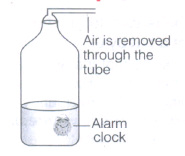
An alarm bell is kept inside a vessel as shown in figure. A person standing close to it can distinctly hear the sound of alarm. Now, if the air inside the vessel is removed completely, how will the loudness of alarm get affected for the same person?
8.
Explain in detail how sound travel slower than light.
9.
How is sound produced and how is it transmitted and heard by us?
10.
Mention the property of vibrations which determine the pitch of the sound. Briefly explain along with some examples.
1.
Sources of Noise Pollution : Major sources of noise pollution are-sounds of vehicles, explosions including bursting of crackers, machines, loudspeakers etc. At horne high volume of television, transistor, radio and sound of some kitchen appliances, desert cooler etc. all contribute to noise pollution.
Name of Diseases caused by Noise Pollution: This noise pollution may cause many health related problems. Lack of sleep, hypertension, anxiety and many more health disorders may be caused, such as impairment of hearing.
Measures to limit Noise Pollution : For this, silencing devices must be installed in machines. All noisy operations must be conducted away from any residential area. TVand music should be run at low volumes. Trees must be planted along the roads and around the buildings to cut down the sounds.
2.
Presence of excessive noise in the surrounding may cause noise pollution, which is harmful to human health. Here are some measures to limit noise pollution:
(i) Noise producing industries should be set up away from residential areas.
(ii) Silencing devices must be installed in aircraft engines, transport vehicles, industrial machines and heavy appliances.
(iii)Use of automobile horn should be minimized.
(iv) TVand music system should be run at low volumes.
(v) Trees must be planted along the sides of the roads and around buildings to cut down the sounds reaching the residents
3.
In humans, the sound is produced by the voice box or the larynx. Put your fingers on the throat and find a hard bump that seems to move when you swallow. This part of the body is known as the voice box. Belowit is the windpipe. Two vocal cords, are stretched across the voice box or larynx in such a way that it leaves a narrow slit between them for the passage of air
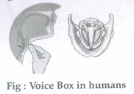
When the lungs force air through the slit, the vocal cords vibrate, producing sound. Muscles attached to the vocal cords may make the cords tight or loose. When the vocal cords are tight and thin, the type or quality of voice is different from that when these are loose and thick.
4.
(a) String of sitar is a vibrating part of sitar.
(b) Since if we beat the dholak, then the membrane of dholak starts vibrating with high amplitude and as a fact, the loudness is directly proportional to the square of amplitude. Therefore, in the form of the loudness created by beating dholak
(c) The sound wave produced by flute is regular curving. So, there is no part of noise.Thus, we hear shrilling sound of flute.
(d) The values displayed by Anjali's grandfather are scientific methods and critical thinking.
5.
We know that speed, pitch, loudness all are initiated with a vibration. During the day, there is a number of vibrations around us. So, the sound coming from the clock gets disturbed and amplitude of vibrations becomes small. But during the night, there are not such multiple vibrations in the environment. So, sound is more clear. Further, the dew factor at night increases the speed of sound as moisture level increases.
6.
As, we all hear sound through our ears. The moment like eardrum when sound enters in outer part of ear then it travels down a canal at the end of which a thin membrane is stretched tightly which is called the eardrum. It performs an important function. The stretched rubber sheets like eardrum sound vibrations which make the them vibrate (see figure). In this way the eardrum sends vibrations to the inner ear and the signal goes to the brain.
7.
Initially, the person is able to hear the sound coming from air and from water distinctly. But after sometime, when the air is completely removed from the bottle, the sound will pass through the water and then through the glass. So, the man will not hear through the sound which was coming through the air initially.
8.
As we know that the speed of sound in air is about 340 m/s and the speed of light in air is 300,000,000 m/s. It means that sound travels at a slow speed while light travels much faster than sound.
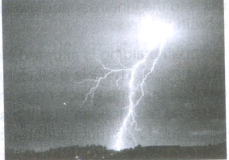
So, though sound may take a few seconds to travel a distance of a few hundred metres, light will take practically negligible time to reach a distance of even a few kilometres. e.g. in the rainy season, the flash of lightning is observed first and the sound of thunder is heard a little later (though both are produced at the same time in clouds) (see figure). It is because of the very high speed of light that we see the flash of lightning first and it is due to comparatively low speed of sound that the thunder is heard a little later.
9.
Sound is produced when any object starts vibrating by any means. These vibrations travel from the source all around the environment through the particles of the environment, thus, it reaches to its destination, i.e. our ear. Now, it enters our ear and travels down a canal at the end of which a thin membrane is stretched tightly known as eardrum. The eardrum sends vibrations to inner part of the ear and finally reaches to the brain and we hear the sounds.
10.
The property which determines the shrillness or pitch of a sound is the frequency. So, if the frequency of vibration is higher, then we can say that the sound has a higher pitch. If the frequency of vibration is lower, we say that the sound has a lower pitch.
e.g. the drum vibrates with a low frequency. Thus, it produces a low pitched sound. Besides this, a whistle has a high frequency produces a sound of higher pitch. A bird makes a high pitched sound while a lion makes a low pitched roar. However, the roar of a lion is very loud while the sound of bird is quite feeble.

8th Standard CBSE Syllabus & Materials
8th Standard CBSE
CBSE 8th Science Particulate Nature of Matter - New Model Questions Papers Study Material - QB365 Set A
NEW8th Standard CBSE
CBSE 8th Science Pressure, Winds, Stroms and Cyclones - New Model Questions Papers Study Material - QB365 Set A
NEW8th Standard CBSE
CBSE 8th Mathematics Quadrilaterals - New Model Questions Papers Study Material - QB365 Set A
NEW8th Standard CBSE
CBSE 8th Mathematics A story of Numbers - New Model Questions Papers Study Material - QB365 Set A



NCERT Books

Syllabus

Exam Pattern

Sample Question Papers

Previous year Question Papers

Important Notes

MCQ Practice test

NCERT Exemplers

Case study Questions

Image Based Questions

Passage based Questions

HOT Questions

Value Based Questions

Model Questions Papers
NCERT ( Book Back ) Questions

Assertion and Reason
Important Questions And Answers

CBSE 8th Standard CBSE Subjects
CBSE Standards


