
 100% FREE ACCESS
8th Standard CBSE Syllabus & Materials
8th Standard CBSE
CBSE 8th Social Science Theme D - Factors of Production - New Model Questions Papers Study Material - QB365 Set A
NEW8th Standard CBSE
CBSE 8th Social Science Theme C - Universal Franchise and India's Electoral System - New Model Questions Papers Study Material - QB365 Set A
NEW8th Standard CBSE
CBSE 8th Social Science Theme B - The Rise of the Marathas - New Model Questions Papers Study Material - QB365 Set A
NEW8th Standard CBSE
CBSE 8th Social Science Theme B - Reshaping India's Political Map - New Model Questions Papers Study Material - QB365 Set A
NEW8th Standard CBSE
CBSE 8th Social Science Theme A - Natural Resources and Their Use - New Model Questions Papers Study Material - QB365 Set A
NEW8th Standard CBSE
CBSE 8th Science Keeping Time with Skies - New Model Questions Papers Study Material - QB365 Set A

Published on: 27/09/2019
Friction
Download CBSE Class 8th Standard CBSE Science question papers, sample papers, important questions, and previous year solved papers in PDF format. Get free study materials, NCERT solutions, and exam preparation resources for Class 8th Standard CBSE Science
Questions + Answers key
Take MCQ Science Test
1.
Why is it easy to drag a mat when nobody is sitting on it but difficult when somebody is sitting on it?
2.
Friction is called a necessary evil. Why?
3.
Mention three examples that show that friction produces heat.
4.
When the cutting edge of a knife is put against a fast rotating stone to sharpen it, sparks are seen to fly. Explain the reason.
5.
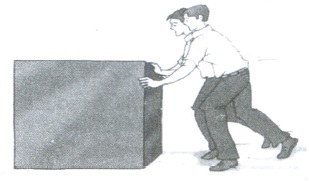
Two friends are trying to push a heavy load as shown in figure below. Suggest a way which will make this task easier for them.
6.
It is easier to move the box from rest or to move it when it is already in motion. Explain why.
7.
Explain which principle is involved in machine belts.
8.
Explain why a pencil will write on paper but not on glass.
9.
The handle of a cricket bat or a badminton racquet is usually rough. Explain the reason.
10.
Is there a force of friction between the wheels of a moving train and iron rails? If yes, name the type of friction. If an air cushion can be introduced between the wheel and the rail, what effect will it have on the friction?
11.
You might have noticed that when used for a long time, slippers with rubber soles become slippery. Explain the reason.
12.
Explain why objects moving in fluids must have special shapes.
13.
Give examples to show that friction is both a friend and a foe.
14.
Explain why sliding friction is less than the static friction.
1.
We know that friction is caused by the interlocking of the irregularities in the two surfaces. It is obvious that the force of friction will increase if the two surfaces are pressed harder. So it is easy to drag a mat when nobody is sitting on but difficult when someone is sitting on it but difficult when someone is sitting on it.
2.
Friction is called a necessary evil because we cannot do anything without friction and it also shows effects. No movement would come to an end without friction. No body would rest without friction. We cannot write with pen or pencil if there is no friction. If an object starts moving, it would never stop if there was no friction. It is also necessary for grip and bringing movements to rest.
3.
Following examples show that the friction produces heat:
(i) Warming of our palms when we rub them.
(ii) Rubbing sticks together to produce fire.
(iii) Warming of the parts of a machine when it is operated.
4.
Due to the friction between knife and stone, the temperature of the knife and hence stone increases and it increases to such a level that the sparks are produced which can be seen while sharpening it.
5.
Both the friends can put rollers below the heavy load. Since, the rolling friction is smaller than the sliding friction. Therefore, putting rollers below the heavy load will make this task easier for them.
6.
When the object is at rest we have to apply more force to interlock the irregularities. On the other hand, when the object starts moving the contact points on its surface do not get enough time to lock into the contact points on the ground. So, it is easier to move the block when it is already in motion.
7.
Since, in many machines (like flour mills), belts are used to drive wheels for running the machines. Greater friction is required between the belts and machine wheels so that the belts can drive the machine wheels properly without slipping off wheels. So, in order to increase friction, machine belts are made up of special materials having rough surfaces.
8.
Since, due to friction, a pencil writes on paper but there is smoothness on the surface of glass, a pencil cannot write on glass.
9.
The handle of a cricket bat or badminton racquet is rough, so that while playing, the bat or badminton racquet does not slip away from the hands of the player. Roughness is responsible for the frictional force without which gripping is not possible.
10.
Yes, there is always a force of friction between the wheels of a moving train and iron rails. The name of this friction is rolling friction, since, the wheels are rolling on the track. On introducing air cushion, the frictional force becomes less, since there is no contact between rails and wheels.
11.
It is due to continuous rubbing of soles with the ground, the spikes on the sole get damaged slowly and the soles become Slippery.
12.
The frictional force exerted by fluids is also called drag. When objects move through fluids, they have to overcome friction acting on them. In this process, they lose their energy. Efforts are made to minimise friction. So, objects are given special shapes and this type of shape is known as streamlined shape.
13.
Friction as a friend
(i) It allows us to walk comfortably.
(ii) It allows us to minimise the speed or to stop the moving objects.
(iii) It allows us to write on a board with chalk.
Friction as a foe
(i) It causes wear and tear in objects.
(ii) It causes damage to the parts of machines.
(iii) It does not allow the free movement of objects.
14.
We know that friction is caused by the interlocking of irregularities in the two surfaces. In case of static friction, interlocking between two objects is very strong but in case of sliding friction, there is a less time of getting interlocked with each other. Thus, the sliding friction is less than the static friction.

8th Standard CBSE Syllabus & Materials
8th Standard CBSE
CBSE 8th Science Particulate Nature of Matter - New Model Questions Papers Study Material - QB365 Set A
NEW8th Standard CBSE
CBSE 8th Science Pressure, Winds, Stroms and Cyclones - New Model Questions Papers Study Material - QB365 Set A
NEW8th Standard CBSE
CBSE 8th Mathematics Quadrilaterals - New Model Questions Papers Study Material - QB365 Set A
NEW8th Standard CBSE
CBSE 8th Mathematics A story of Numbers - New Model Questions Papers Study Material - QB365 Set A



CBSE 8th Standard CBSE Subjects
CBSE Standards




