
 100% FREE ACCESS
8th Standard CBSE Syllabus & Materials
8th Standard CBSE
CBSE 8th Social Science Theme D - Factors of Production - New Model Questions Papers Study Material - QB365 Set A
NEW8th Standard CBSE
CBSE 8th Social Science Theme C - Universal Franchise and India's Electoral System - New Model Questions Papers Study Material - QB365 Set A
NEW8th Standard CBSE
CBSE 8th Social Science Theme B - The Rise of the Marathas - New Model Questions Papers Study Material - QB365 Set A
NEW8th Standard CBSE
CBSE 8th Social Science Theme B - Reshaping India's Political Map - New Model Questions Papers Study Material - QB365 Set A
NEW8th Standard CBSE
CBSE 8th Social Science Theme A - Natural Resources and Their Use - New Model Questions Papers Study Material - QB365 Set A
NEW8th Standard CBSE
CBSE 8th Science Keeping Time with Skies - New Model Questions Papers Study Material - QB365 Set A

Published on: 09/09/2019
Light
Download CBSE Class 8th Standard CBSE Science question papers, sample papers, important questions, and previous year solved papers in PDF format. Get free study materials, NCERT solutions, and exam preparation resources for Class 8th Standard CBSE Science
Questions + Answers key
Take MCQ Science Test
1.
Which of the following statements is correct regarding rods and cones in the human eye?
Cones are sensitive to dim light
Cones are sensitive to bright light
Rods are sensitive to bright light
Rods can sense colour
2.
The change in converging power of an eye lensis caused by the action of
retina
optic nerve
ciliary muscles
iris
3.
How does the eye change in order to focus on near or distant objects?
The eye lens moves in or out
The retina moves in or out
The eye lens becomes thicker or thinner
The pupil becomes larger or smaller
4.
As the angle between two plane mirrors is decreasing gradually, the number of images of an object placed between them
first increases then decreases
first decreases then increases
increases
decreases
5.
Angle of incidence is equal to the angle of reflection
Always
Sometimes
Under special conditions
Never
6.
Draw figure showing the position of the plane mirror. Also, label the angle of incidence and angle of reflection on it.
.jpg)
7.
Explain in brief, how do ciliary muscles affect the functioning of eye.
8.
(a) Find out the position of the image of an object situated at A in the plane mirror.
(b) Can Paheli at B see this image?
(c) Can Boojho at C see this image?
(d) When Paheli moves from B to C, where does the image of A move?
.jpg)
9.
Explain how you can take care of your eyes.
10.
Gurmit wanted to perform Activity using a laser torch. Her teacher advised her not to do so. Can you explain the basis of the teacher’s advise?
11.
White light is a combination of which colours?
12.
Black objects appear black. Why?
13.
Why are we able to see the tap water in the glass even though it is colourless?
14.
Mention for how much duration, image stays on retina.
15.
State the function of eyelids.
16.
How is the phenomenon of reflection used in making a kaleidoscope? What are the applications of a kaleidoscope?
17.
Boojho planned an activity to observe an object A through pipes as shown in figure so that he could see objects which he could not directly see.
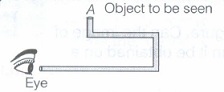
(a) Mention how many mirrors should he use to see the objects.
(b) Indicate the positions of the mirrors in the figure.
(c) State what must be the angle w.r.t. the incident light at which he should place the mirrors.
(d) Indicate the direction of rays in the figure.
(e) If any of the mirrors is removed, will he be able to see the objects?
18.
The muscles attached to the eye lens make it thicker to see _________ objects.
19.
In a movie, the still pictures in proper sequence are projected on the screen usually at the rate of ___________ pictures per second.
20.
If the still pictures of a moving object are flashed on our eyes at a rate faster than _________ pictures per second, the eye perceives the object as moving.
21.
The image of an object persists on the retina of an eye for about _______ second even after the object has disappeared.
22.
The size of the pupil becomes ____________ when you see in dim light.
23.
The part of the eye that renders colour to it is cornea.
24.
An eye lens focuses light behind the eye at cornea.
25.
Visually challenged people can read and write with hearing aid.
26.
Sunlight, called white light consists of seven colours.
27.
Diffused/Irregular reflection takes place from rough surfaces.
1.
(b)
Cones are sensitive to bright light
2.
(c)
ciliary muscles
3.
(c)
The eye lens becomes thicker or thinner
4.
(c)
increases
5.
(a)
Always
6.
.jpg)
7.
As we know that ciliary muscles can contract and relax, it is because they can change the kness of eye lens which results in change in its focal length. So, eye lens can make image of nearby objects and also far off objects on retina.
8.
(a) Since it is plane mirror, so the image is formed behind the mirror or there is a lateral inversion in it.
.jpg)
(b) Yes, Paheli can see the image of object A.
(c) Yes, Boojho can also see the image of object A.
(d) No change in the position of the image of A.
9.
We can take care of our eyes in the following manner:
(i) If advised, use suitable spectacles.
(ii) Too little or too much light is bad for eyes. Insufficient light can cause eye strain and headache.
(iii) Too much light like that of the sun, a powerful lamp or a laser torch can injure the retina.
(iv) Wash the eyes frequently with clean water.
(v) Always read at normal distance for vision.
(vi) Never rub your eyes.
10.
Laser light comes from a very small hole and the lens of the laser light is also very small, so the light will penetrate into one part of the eye and it can injure the retina, whereas the normal torch spreads out the light which does not cause any harm to our eyes.
So, the beam of laser light should not be used to perform an activity.
11.
White light can be formed by mixing the primary colours red, green and blue.
12.
Black objects appear black because they absorb all the colours, no light is reflected.
13.
Tap water reflects the light into our eyes. As long as an object reflects light into our eyes, we can see it.
14.
Image stays on retina for about 1/16th of a second.
15.
Since eyelid is also known as eye-shutter. So, it prevents any object entering the eye.
16.
Kaleidoscope is a cylinder with mirrors containing loose, coloured objects such as beads or pebbles and bits of glass. As the viewer looks into one end, light entering the other creates a colourful pattern due to reflection. Its applications are given below:
(i) It works on the principle of multiple reflections, where several mirrors are placed at an angle (usually 60°) to one another. Typically, these are three rectangular mirrors set at 60° to each other so that they form an equilateral triangle.
(ii) The 60° angle creates seven duplicate images of the objects, 5 at 60° and 2 at 90°. As the tube is rotated, the tumbling of the coloured objects presents varying colours and patterns.
(iii) It is used in decoration purposes, toys, etc.
17.
(a) Number of mirrors = 3
(b) Positions of the mirrors are as shown in figure.
(c) Mirrors should be placed at 45° w.r.t. the incident light. So, that ray can move forward.
(d) Direction of rays is shown in figure.
(e) He will not be able to see the objects if any of the mirrors is removed since he will not get the rays after that removed mirror.
18.
()
Under special conditions
19.
()
24
20.
()
16
21.
()
1/16
22.
()
large
23.
(b)
24.
(b)
25.
(b)
26.
(a)
27.
(a)

8th Standard CBSE Syllabus & Materials
8th Standard CBSE
CBSE 8th Science Particulate Nature of Matter - New Model Questions Papers Study Material - QB365 Set A
NEW8th Standard CBSE
CBSE 8th Science Pressure, Winds, Stroms and Cyclones - New Model Questions Papers Study Material - QB365 Set A
NEW8th Standard CBSE
CBSE 8th Mathematics Quadrilaterals - New Model Questions Papers Study Material - QB365 Set A
NEW8th Standard CBSE
CBSE 8th Mathematics A story of Numbers - New Model Questions Papers Study Material - QB365 Set A



CBSE 8th Standard CBSE Subjects
CBSE Standards




