
 100% FREE ACCESS
8th Standard CBSE Syllabus & Materials
8th Standard CBSE
CBSE 8th Social Science Theme D - Factors of Production - New Model Questions Papers Study Material - QB365 Set A
NEW8th Standard CBSE
CBSE 8th Social Science Theme C - Universal Franchise and India's Electoral System - New Model Questions Papers Study Material - QB365 Set A
NEW8th Standard CBSE
CBSE 8th Social Science Theme B - The Rise of the Marathas - New Model Questions Papers Study Material - QB365 Set A
NEW8th Standard CBSE
CBSE 8th Social Science Theme B - Reshaping India's Political Map - New Model Questions Papers Study Material - QB365 Set A
NEW8th Standard CBSE
CBSE 8th Social Science Theme A - Natural Resources and Their Use - New Model Questions Papers Study Material - QB365 Set A
NEW8th Standard CBSE
CBSE 8th Science Keeping Time with Skies - New Model Questions Papers Study Material - QB365 Set A

Published on: 20/09/2019
Synthetic Fibres and Plastics
Download CBSE Class 8th Standard CBSE Science question papers, sample papers, important questions, and previous year solved papers in PDF format. Get free study materials, NCERT solutions, and exam preparation resources for Class 8th Standard CBSE Science
Questions + Answers key
Take MCQ Science Test
1.
Write disadvantages of plastics.
2.
What is 4R principle?
3.
Write any three positive characteristics of plastic.
4.
How can we say that plastic is non-reactive?
5.
Why do plastic containers seem most convenient?
6.
Take two cloth pieces of the same size, one from natural fibre and another from synthetic fibre. Soak them in different mugs containing same amount of water. After five minutes spread them in the Sun. Observe and answer the following:
(i) How much water is soaked by both fibres?
(ii) Which fibre soaks more water?
(iii) Which fibre dries quickly?
7.
What are the disadvantages of synthetic fibres?
8.
A bucket made up of plastic does not rust like a bucket made up of iron. Why?
9.
Plastics are poor conductors of heat and electricity. Explain by giving examples.
10.
What are the properties of nylon?
11.
Describe an activity to show that thermoplastic is a poor conductor of electricity
12.
'Avoid plastics as far as possible'. Comment on this advise
13.
Should the handle and bristles of a toothbrush be made of the same material? Explain your answer.
14.
Explain why plastic containers are favoured for storing food?
15.
Give examples which indicate that nylon fibres are very strong.
1.
Plastics take several years to decompose, so they are not environment-friendly. Plastic causes environmental pollution. Besides, the burning process of synthetic material is quite slow and it does not burn completely. In this way, it releases lots of poisonous fumes in the atmosphere causing air pollution.
2.
The 4Rprinciple means Reduce, Reuse, Recycle and Recover. One should develop these habits, which are environment friendly.
3.
Plastic is very strong, light and durable. It can be moulded into different shapes and sizes. It is used for various purposes. Plastics are generally cheaper than metals. They are widely used in industry and for household articles.
4.
When plastic is left exposed to moisture and air it is not corroded easily. So they are non-reactive.
5.
Plastic containers seem most convenient because of their light weight, lower price, good strength and easy handling.
6.
(i) Synthetic fibre soaks less water, whereas natural fibre soaks more water.
(ii) Natural fibre.
(iii) Synthetic fibre.
7.
Disadvantages of synthetic fibres are :
(i) It melts on heating.
(ii) Its clothes catch fire easily
(iii) It melts and sticks to the body of the person wearing it, when it is heated.
8.
Plastic is non-reactive material. When left exposed to moisture and air, it does not react with air and water which are essential for corrosion, therefore does not rust
9.
Plastics are poor conductors of heat and electricity. So, handles of cooking utensils (like frying pans and pressure cookers) are made up of plastic so that we can hold the hot utensils safely without getting our hands burnt.
Plastics are poor conductors of electricity. So, electrical wires have plastic covering and handles of screw drivers (used by electricians) are made up of plastic, so as to protect us from electric current passing through them.
10.
Properties of nylon are:
(i) Nylon is a synthetic fibrous material that is known for its high tensile strength, abrasion resistance and chemical stability.
(ii) It is a very resilient fibre that is often used to make cords and ropes that need to support a lot of weight and withstand in wet, hot or dirty condition.
(iii) When used in clothing, nylon is both light weight and warm.
11.
Take two wires. One wire is kept naked and another wire has plastic covering. Make two circuits, one with naked wire and another with plastic covering. We will feel shock with naked wire while plastic covered wire will not give any shock.
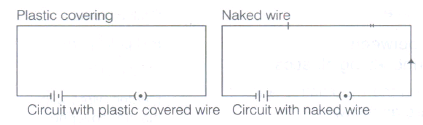
It shows that thermoplastic is a poor conductor of electricity.
12.
We should avoid plastics as far as possible because plastics are non-biodegradable materials. Plastics take several years to decompose, thus cause environmental pollution. Burning of plastics releases poisonous gases into the atmosphere causing air pollution.
13.
No, handle and bristles of a toothbrush should not be made of the same material because the handle should be hard while bristles should be made of the soft materials. Bristles should be soft so that it does not harm the gum of teeth. Handle should be made of hard material so that it gives the firm grip.
14.
Advantages of storing foods in plastic containers are as follows:
(i) Plastics do not react with food items.
(ii) Plastics are strong, light and durable.
(iii) Plastic containers are airtight.
(iv) They are easy to handle.
15.
Nylon fibres are very strong. Thus, they are used for making parachutes and ropes for rock climbing. A nylon thread is actually stronger than a steel wire.

8th Standard CBSE Syllabus & Materials
8th Standard CBSE
CBSE 8th Science Particulate Nature of Matter - New Model Questions Papers Study Material - QB365 Set A
NEW8th Standard CBSE
CBSE 8th Science Pressure, Winds, Stroms and Cyclones - New Model Questions Papers Study Material - QB365 Set A
NEW8th Standard CBSE
CBSE 8th Mathematics Quadrilaterals - New Model Questions Papers Study Material - QB365 Set A
NEW8th Standard CBSE
CBSE 8th Mathematics A story of Numbers - New Model Questions Papers Study Material - QB365 Set A



CBSE 8th Standard CBSE Subjects
CBSE Standards




