
 100% FREE ACCESS
8th Standard CBSE Syllabus & Materials
8th Standard CBSE
CBSE 8th Social Science Theme D - Factors of Production - New Model Questions Papers Study Material - QB365 Set A
NEW8th Standard CBSE
CBSE 8th Social Science Theme C - Universal Franchise and India's Electoral System - New Model Questions Papers Study Material - QB365 Set A
NEW8th Standard CBSE
CBSE 8th Social Science Theme B - The Rise of the Marathas - New Model Questions Papers Study Material - QB365 Set A
NEW8th Standard CBSE
CBSE 8th Social Science Theme B - Reshaping India's Political Map - New Model Questions Papers Study Material - QB365 Set A
NEW8th Standard CBSE
CBSE 8th Social Science Theme A - Natural Resources and Their Use - New Model Questions Papers Study Material - QB365 Set A
NEW8th Standard CBSE
CBSE 8th Science Keeping Time with Skies - New Model Questions Papers Study Material - QB365 Set A

Published on: 29/10/2025
Download CBSE Class 8th Standard CBSE Social Science question papers, sample papers, important questions, and previous year solved papers in PDF format. Get free study materials, NCERT solutions, and exam preparation resources for Class 8th Standard CBSE Social Science
Questions + Answers key
Take MCQ Social Science Test
1.
Discuss the impact of the shortage of judges on the delivery of justice to Litigants.
2.
What values can be learned from the functioning of Indian Judiciary?
3.
Describe the evolution of courts in India.
4.
Why do you think the introduction of Public Interest Litigation (PIL) in the 1980s is a significant step in ensuring access to justice for all?
5.
Write two sentences of what you understand about the appellate system from the case .
6.
Which is the highest judicial authority in a state?
The Supreme Court
The High Court
The District Court
Subordinate Court
7.
What is the full form of PAC?
Private Armed Constabulary
Provincial Armed Constabulary
Provincial Art Collection
Public Art Community
8.
Which Article of the Constitution established the Right to Life?
Article 14
Article 15
Article 18
Article 21
9.
What is the full form of PIL?
Public Interest Litigation
Private Interest Litigation
Public Information Litigation
Public Information Law
10.
The number of courts at the apex level is
One
Two
Three
Four
11.
How many levels of courts are there in our country?
12.
Who presides over the Supreme Court
13.
What does the Judiciary do?
14.
When did the Supreme Court move to lt's present location at Mathura Road, New Delhi?
15.
Name some issues which come under civil law.
16.
The following is a poster made by the Right to Food campaign. Read this poster and list the duties of the government to uphold the Right to Food. How does the phrase "Hungry stomachs, overflowing godowns! Will we not accept it!!" used in the poster relate to the photo essay on the Right to Food on page 61?
Poster:
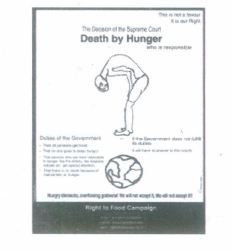
Photo essay
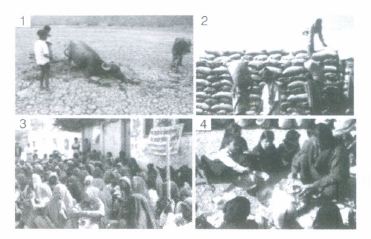
Photo 1. In 2001, the drought in Rajasthan and Orissa meant that millions faced an acute shortage of food.
Photo 2. Meanwhile, the government godowns were full of grain. Often this was being eaten away by rats.
Photo 3. In this situation of 'hunger amidst plenty' an organisation called the People's Union of Civil Liberties or PUCL filed a PIL in the Supreme Court. It stated that the Fundamental Right to Life guaranteed in Article 21 of the Constitution included the Right to Food. The state's excuse that it did not have adequate funds was shown to be wrong because the godowns were overflowing with grains. The Supreme Court ruled that the State had a duty to provide food to all.
Photo 4. It, therefore, directed the government to provide more employment, to provide food at cheaper prices through the government ration shops and to provide mid-day meals to children. It also appointed two Food Commissioners to report on the implementation of government schemes.
17.
What was the 'State (Delhi Administration) vs Laxman Kumar and Others (1985)' case about? Describe it in your own words.
18.
Discuss the role of PIL in Indian Judiciary. What values have you learnt from the workings of PIL in Indian judicial system?
19.
Only an____________ Judiciary can give verdict against the government.
20.
The Supreme Court acts as the court of _____________ also.
21.
The decisions made by the ___________ are binding on all other courts of India.
22.
The ______________ playa significant role in protecting our Fundamental Rights.
23.
The mechanism of PILs was devised in the early ___________ .
24.
If they do not like the Supreme Court verdict, the accused can go back again to the Trial Court.
25.
They went to the High Court after the Supreme Court had given its decision
26.
The decisions made by the lower courts are binding on the higher courts.
27.
There is only one Supreme Court in India
28.
The seven North-Eastern states have a common High Court.
1.
The number of vacancies in district and subordinate courts is 382 as per the given table. This has a significantly negative impact as many cases remain pending in the courts. In the course of extended period of cases remaining pending, many litigants die while others suffer as the accused and the criminals get enough time to negotiate and turn the cases in their favour. And as we all know, justice delayed is justice denied.
2.
One must conclude after examining the functions of Indian Judiciary that it plays a critical role in its democracy. It protects the citizens of the country against any possible misuse of authority by the Legislature and Executive.
Moreover, a citizen can go to the Judiciary directly to seek justice in case his/her Fundamental Rights have been violated.
From this, I have learned the value and importance of Indian Judiciary in strengthening the country's democracy besides my personal well-being.
3.
1. The first High Courts were established during the British rule in 1862. They were set-up in the three presidency cities of Calcutta, Bombay and Madras.
2. The Supreme Court that we have at present was preceded by the Federal Court of India
3. The Federal Court of India was established in 1937 during British rule.
4. It was located in the Chamber of Princes in the Parliament House. It was in operation till 1949.
5. The Supreme Court that we have today replaced that. The Delhi High Court was established in 1966. Now, the country has one Supreme Court at the top and 24 High Courts.
4.
Before the 1980s, litigation in courts was costly and time-consuming affair. As a result of this, the poor could not afford going to courts and get justice.
The introduction of the mechanism of Public Interest Litigation (PIL) by the Supreme Court in early 1980s gave increased access to justice. It allowed any individual or organisation to file a PIL in the High Court or the Supreme Court on behalf of those whose rights had been violated. The legal process was greatly simplified. Now even a letter or telegram addressed to the Supreme Court or the High Court could be treated as a PIL.So, the introduction of PIL was a significant step in ensuring access to justice for all.
5.
1. The appellate system of the Indian Judiciary is one through which an appeal is made in the higher court against the judgement of the lower court if the person is not satisfied with the verdict.
2. In the case 'State (Delhi Administration) Vs Laxma n Kumar and others', the three accused went to the High Court to appeal against the verdict of the Trial Court and later women's organisation appealed against the High Court decision in the Supreme Court through the Indian Federation of women lawyers.
6.
(b)
The High Court
7.
(b)
Provincial Armed Constabulary
8.
(d)
Article 21
9.
(a)
Public Interest Litigation
10.
(a)
One
11.
()
There are three different levels of courts in our country.
12.
()
The Chief Justice of India presides over the Supreme Court.
13.
()
The Judiciary is that organ of the state which upholds the law of the land.
14.
()
The Supreme Court moved to its present location at Mathura Road, New Delhi in 1958.
15.
()
Disputes related to sale or purchase of land or other goods, rent matters, divorce cases etc. come under civil law.
16.
Duties of the government to uphold the Right to Food
(i) All persons should get food.
(ii) No one should go to sleep with a hungry stomach.
(Iii) Persons who are most vulnerable to hunger like the elderly, disabled, widows etc., should get special attention.
(iv) There should not be any death because of malnutrition or hunger.
In 2001, millions of people faced shortage of food due to drought in Rajasthan and Orissa. However, the government godowns were full of grains and even getting wasted. This situation of hunger amidst plenty was not acceptable to people. This sentiment is captured in the poster for 'Right to Food' campaign.
17.
Laxman Kumar married Sudha Goel in February 1980. On 2nd December, 1980, Sudha died in hospital due to burns. Her family filed a case in trial court.
Witnesses in this case, stated that on the night of 1st December, they had heard her scream and Sudha told them that her husband and mother in law had set her on fire. The trial court, convicted Laxman, Shakuntala and brother-in-law Subhash Chandra and sentenced all three to death. The accused then went to the High Court to appeal against this verdict and it acquitted them. Some women's groups were agitated by this verdict of the High Court and they filed a separate appeal in Supreme Court. The Supreme Court heard the arguments and found Laxman and his mother guilty and sentenced the two to life imprisonment.
18.
The legal procedures take up a lot of time and involve lots of money. Those who cannot afford to put in lots of time and money for getting justice get deprived of it. For poor people especially, the idea of going to court often becomes remote.
The system of Public Interest Litigations (PILs) introduced by the Supreme Court in the early 1980s played an important role in removing this problem.
Through PIL. any individual or organisation can approach the court on behalf of those whose rights have been violated. From this, I have learnt that now poor people can also have access to justice through PILs. I have learnt how the Judiciary of my country always works toward upholding equality and fairness.
19.
()
Independent
20.
()
record
21.
()
SupremeCourt
22.
()
Supreme Court and High Court
23.
()
1980s
24.
(b)
25.
(b)
26.
(b)
27.
(a)
28.
(b)

8th Standard CBSE Syllabus & Materials
8th Standard CBSE
CBSE 8th Science Particulate Nature of Matter - New Model Questions Papers Study Material - QB365 Set A
NEW8th Standard CBSE
CBSE 8th Science Pressure, Winds, Stroms and Cyclones - New Model Questions Papers Study Material - QB365 Set A
NEW8th Standard CBSE
CBSE 8th Mathematics Quadrilaterals - New Model Questions Papers Study Material - QB365 Set A
NEW8th Standard CBSE
CBSE 8th Mathematics A story of Numbers - New Model Questions Papers Study Material - QB365 Set A



NCERT Books

Syllabus

Exam Pattern

Sample Question Papers

Previous year Question Papers

Important Notes

MCQ Practice test

NCERT Exemplers

Case study Questions

Image Based Questions

Passage based Questions

HOT Questions

Value Based Questions

Model Questions Papers
NCERT ( Book Back ) Questions

Assertion and Reason
Important Questions And Answers

CBSE 8th Standard CBSE Subjects
CBSE Standards


