
 100% FREE ACCESS
8th Standard CBSE Syllabus & Materials
8th Standard CBSE
CBSE 8th Social Science Theme D - Factors of Production - New Model Questions Papers Study Material - QB365 Set A
NEW8th Standard CBSE
CBSE 8th Social Science Theme C - Universal Franchise and India's Electoral System - New Model Questions Papers Study Material - QB365 Set A
NEW8th Standard CBSE
CBSE 8th Social Science Theme B - The Rise of the Marathas - New Model Questions Papers Study Material - QB365 Set A
NEW8th Standard CBSE
CBSE 8th Social Science Theme B - Reshaping India's Political Map - New Model Questions Papers Study Material - QB365 Set A
NEW8th Standard CBSE
CBSE 8th Social Science Theme A - Natural Resources and Their Use - New Model Questions Papers Study Material - QB365 Set A
NEW8th Standard CBSE
CBSE 8th Science Keeping Time with Skies - New Model Questions Papers Study Material - QB365 Set A

Published on: 29/10/2025
Download CBSE Class 8th Standard CBSE Social Science question papers, sample papers, important questions, and previous year solved papers in PDF format. Get free study materials, NCERT solutions, and exam preparation resources for Class 8th Standard CBSE Social Science
Questions + Answers key
Take MCQ Social Science Test
1.
Why is it important to separate religion from the state?
2.
Why untouchability is regarded as a social evil?
3.
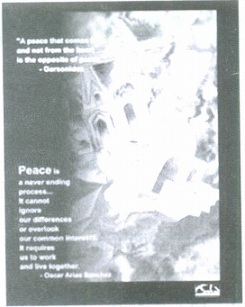
This poster alongside highlights the need for ‘Peace’. It says, “Peace is a never-ending process....It cannot ignore our differences or overlook our common interests.” Write in your own words what you think the above sentences are trying to convey? How does it relate to the need for religious tolerance?
4.
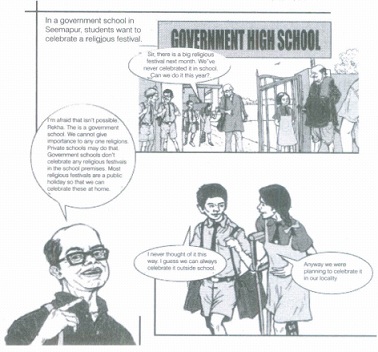
In the given storyboard, discuss the answer given by the teacher.
5.
What is the nature of the State in Israel and Saudi Arabia? How is it different from India?
6.
Discuss the nature of Indian Secularism.
7.
Why is it necessary to separate religion from the State?
8.
Suppose, secular country like India wants to adopt the state religion, then, what would be the consequences?
9.
Is India a secular state?
10.
Which concept of secularism is followed by the U.S.A?
1.
(i) The most important aspect of secularism is its separation of religion from state power. This is important for a country to function democratically.
(ii) Almost all countries of the world will have more than one religious group living in them. Among these religious groups, there will almost likely be one group that is in majority.
(iii) If this majority religious group has access to state power, then it could quite easily use this power and financial resources to discriminate against and persecute persons of other religions. This tyranny of the majority could result in the discrimination, coercion, and at times, even the killing of religious minorities.
(iv) The majority could quite easily prevent minorities from practicing their religions. Any form of domination based on religion is in violation of rights that a democratic society guarantees to each and every citizen irrespective of their religion.
(v) Therefore, the tyranny of the majority and violation of fundamental rights that can result is one reason why it is important to separate the state and religion in democratic societies.
(vi) Another reason is because we also need to protect the freedom of individuals to exit from their religion, embrace another religion or have the freedom to interpret religious teachings differently. If you are part of dominant religious group, you might face a lot of resistance from fellow members of your co!I'munity. These members who have control of state power might say that there is only one interpretation of Hinduism and you do not have the freedom to interpret this differently.
2.
(i) It is an evil as it spreads inequality in society, creating disturbances and where there is lack of peace, there is no happiness and there can be no social justice. These are referred as Depressed Classes, Scheduled Castes and Scheduled Tribes. Local names for the 'untouchable communities' vary in different parts of India: Bhangi, Pakhi, Chandala etc.
(ii) They were discriminated against in many ways. They lived on the outskirts of villages. The mere sight of them was considered as "bad omen". Not only were they restricted in terms of space, but their houses were also supposed to be inferior in quality and devoid of any facilities like water and electricity.
(iii) Their jobs included tanning leather, making and fixing shoes, and washing clothes.
3.
Peace is a long-cherished goal of all citizens. It is a basic human need as it helps maintain harmony, security and lets people live with dignity.
But peace does not come on its own. We have to work towards upholding peace by being tolerant of each other, respecting our differences and focus on achieving the larger common interest. It is a never-ending process. Being tolerant should become a part of our nature. Only then can we truly achieve unity in diversity.
4.
The Indian State works to prevent domination by one majority religion by distancing itself from all religions. It is not ruled by any one religious group and it does not support any one religion. Consequently, all government institutions, including government schools, offices etc, are debarred from displaying or promoting any one religion. That is why the teacher in the storyboard says that government schools cannot celebrate any religious festival in the school premises.
5.
The countries of Israel and Saudi Arabia have a non-secular type of State. The States of Israel and Saudi Arabia profess and promote the Jewish and Islamic religion respectively in their programmes and policies.
Israel and Saudi Arabia are completely different from India in the sense that India is a secular State where all religions are treated equally. Unlike India, the position of religious minorities is very bad in Israel and Saudi Arabia. Minorities are not free to follow their religion freely nor can they assemble in public spaces for prayer, religious gatherings etc. In Saudi Arabia, the followers of other religions cannot set-up their places of worship. The people of minority religions live in constant fear and are even killed and persecuted as is the case in Israel.
6.
The nature of Secularism in India is unique in the sense that the State follows the policy of distancing as well as intervention in matters of religion.
(i) Distancing The Indian State distances itself from all religions. It gives equal respect to all religions yet does not officially promote any one particular religion on its own. This is to maintain neutrality.
(ii) Intervention Though the Indian State follows the policy of keeping away from religious matters, it may intervene in exceptional cases. This happens when the State feels that some citizen's/citizens' Fundamental Rights have been violated by religion.
7.
Fora country to function democratically, it is important to separate religion from the State.Because
(i) Almost all countries of the world have more than one religious group and within these, there is at least one religious group in majority. If a majority religious group has access to State power, it could use this power and financial resources to discriminate against other religious groups.
This could result in tyranny of the majority.
Separation of religion from the State will make invalid any such excess.
(ii) It is important to protect the freedom of individuals to embrace or exit from any religion and interpret its thoughts and beliefs differently.
8.
If one religion has the control of the State power, then it will affect the freedom of all the individuals in the society and eventually the citizens of the whole country. The minorities will be suppressed by the majority. It will also prevent the freedom of the individuals to exit from their religion and to embrace another religion or to interpret religious teachings of his/her religion differently.
9.
India is indeed a secular state. It means that the state has no religion of its own. The state is neither religious nor anti-religious. In the Indian Constitution, from Articles 25 to 28, right to freedom of religion has been granted to all persons residing in India. According to Article 25, subject to public order and morality, everybody is entitled to freedom of conscience and the right to freely practice and propagate the religion of their choice. The Government of India or any other person cannot interfere in the religious affairs of the individuals, otherwise the citizens have the right to go to the court.
10.
(i) In U.S.A, the Constitution forbids the legislature from making any law, that can help the cause of founding of a religion or free exercise of any religion or religion related activity.
(ii) The legislature cannot declare any religion as the official belief and nor it can give preference to any religion.
(iii) In U.S.A., the state is separate from religion, which means State or religion cannot interfere in spheres of each other.

8th Standard CBSE Syllabus & Materials
8th Standard CBSE
CBSE 8th Science Particulate Nature of Matter - New Model Questions Papers Study Material - QB365 Set A
NEW8th Standard CBSE
CBSE 8th Science Pressure, Winds, Stroms and Cyclones - New Model Questions Papers Study Material - QB365 Set A
NEW8th Standard CBSE
CBSE 8th Mathematics Quadrilaterals - New Model Questions Papers Study Material - QB365 Set A
NEW8th Standard CBSE
CBSE 8th Mathematics A story of Numbers - New Model Questions Papers Study Material - QB365 Set A



NCERT Books

Syllabus

Exam Pattern

Sample Question Papers

Previous year Question Papers

Important Notes

MCQ Practice test

NCERT Exemplers

Case study Questions

Image Based Questions

Passage based Questions

HOT Questions

Value Based Questions

Model Questions Papers
NCERT ( Book Back ) Questions

Assertion and Reason
Important Questions And Answers

CBSE 8th Standard CBSE Subjects
CBSE Standards


