
 100% FREE ACCESS
8th Standard CBSE Syllabus & Materials
8th Standard CBSE
CBSE 8th Social Science Theme D - Factors of Production - New Model Questions Papers Study Material - QB365 Set A
NEW8th Standard CBSE
CBSE 8th Social Science Theme C - Universal Franchise and India's Electoral System - New Model Questions Papers Study Material - QB365 Set A
NEW8th Standard CBSE
CBSE 8th Social Science Theme B - The Rise of the Marathas - New Model Questions Papers Study Material - QB365 Set A
NEW8th Standard CBSE
CBSE 8th Social Science Theme B - Reshaping India's Political Map - New Model Questions Papers Study Material - QB365 Set A
NEW8th Standard CBSE
CBSE 8th Social Science Theme A - Natural Resources and Their Use - New Model Questions Papers Study Material - QB365 Set A
NEW8th Standard CBSE
CBSE 8th Science Keeping Time with Skies - New Model Questions Papers Study Material - QB365 Set A

Published on: 29/10/2025
Download CBSE Class 8th Standard CBSE Social Science question papers, sample papers, important questions, and previous year solved papers in PDF format. Get free study materials, NCERT solutions, and exam preparation resources for Class 8th Standard CBSE Social Science
Questions + Answers key
Take MCQ Social Science Test
1.
How can you say that composition of Indian Parliament has changed recently?
2.
Why do you think reservation for Dalits and women is important in Parliament?
3.
What is a Parliament and how does the executive control the government?
4.
Explain the procedure for ordinary or non-money bills.
5.
Which party do you think will form the government? Give reasons why.
6.
Which political party has won the most seats in all states?
7.
Which state has the least number of MPs in the Lok Sabha?
8.
Observe the image of the Parliament given below.
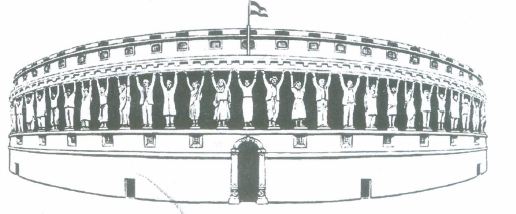
What do you think the artist is trying to convey through this image?
9.
With reference to British rule in India, explain why it is important that people should decide.
10.
How is government formed in a democracy?
1.
(i) The Parliament now has more and more people from different backgrounds.
There are more rural members and members from other regional parties.
(ii) Groups and peoples that were up till now unrepresented, are beginning to get elected to parliament.
(iii) There has also been an increase in the political participation from the Dalits and the backward castes and the minorities.
(iv) Similarly, it has more recently been suggested that there should be reserved seats for women.
(v) This issue is still being debated 60 years ago, only 4% of MPs were women and today it is above 9%. This is a small share where we consider the fact that half of the population is that of women.
2.
(i) It has been observed that representative democracy cannot produce a perfect reflection of the society.
(ii) There is a realisation that when interests and experiences separate, then it is important to ensure that communities that have been historically marginalized, are given adequate representation.
(iii) Similarly, it has more recently been suggested that there should be reservation of seats for women.
(iv) With this in mind, some seats are reserved in the Parliament for SCs and STs. This has been done so that the MPs elected from these constituencies will be familiar with and can represent Dalit and Adivasi interests in Parliament
3.
The Parliament of India consists of the President, the Rajya Sabha and the Lok Sabha.
The Executive is a group of persons who work together to implement the laws made by the Parliament. The Parliament session begins with a questions hour. The question hour is an important mechanism through which MPs (executives) can elicit information about the working of the government.
By asking questions, the government is alerted to its shortcomings and also comes to know the opinion of the people. Similarly, executives from the opposition party highlight the drawbacks in various policies and programmes of the government. In this way, the) play a critical role in healthy functioning of democracy.
4.
An ordinary or non-money bill passes through the following stages:
(i) First Reading: At this stage, the mover introduces the bill stating its main features. This is called the first reading.
(ii) Second Reading: On a fixed date, a general discussion is conducted on the bill. The bill is then referred to a selected committee.
(iii) Committee Stage: The committee examines the bill thoroughly, clause by clause. After that it drafts its report.
(iv) Report Stage: After the committee stage that is, clause by clause consideration of the bill, each clause and amendment is put to vote.
(v) Third Reading: At this stage, a restricted debate takes place on the bill after which the bill is sent to the other House.
(vi) Passage by other House: After being passed by one House, the bill goes to the other House where it goes through all the above mentioned stages once again.
(vii) President's assent: After both the Houses pass the bill, it goes to the President for his consideration. The President can sent the bill back once for re-consideration. If the bill is passed again, the President has to give his assent after which the bill becomes a law.
(viii) Special Stages: It includes joint sitting of both houses in case of a deadlock on a particular bill. The President summons a joint sitting of both the Houses presided over by the speaker. If at a joint sitting, the bill is passed by a two-third majority of members present and voting, it is deemed as passed by both the Houses.
5.
The Congress party will form the government because it has got clear majority in the Lok Sabha.
6.
The Congress Party has won the most seats in all states.
7.
Manipur has the least number of MPs in the Lok Sabha.
8.
Through this image of the Parliament, the artist is trying to convey that it is the people Parliament is based on the people strength. The Parliament is the supreme law-making body of Indian democracy and it is composed of representatives elected directly by the people. Who come from different religions and backgrounds. So it is ultimately the people who make rules for their country.
9.
During British rule, the people of India were made to obey laws they had no role in the making of. People did not agree with the decisions imposed on them and lived in fear of the British Government.
As they fought for independence, they were inspired by the ideals of freedom, equality and participation. They wanted to have a say in the government and its decision-making.
With independence from British rule, it was now up to the people of India to decide their destiny. It is important to let the people decide because the actions and decisions of the government affect the people of the country directly. They have every right to decide on matters which affect them.
10.
In a democracy, government is formed after elections. After the elections, a list is
prepared which indicates the winner of each Lok Sabha seat. These winners become the Members of Parliament (MPs). The political party with the majority of these MPs forms the government.
Since there are 543 seats in Lok Sabha, a party must secure at least half i.e. 272 seats in Parliament to form government. Sometimes, no single political party is able
to win 272 seats on its own and get the majority to form the government. In that
situation, two or more political parties with similar concerns join together to get the
majority and form a Coalition Government.

8th Standard CBSE Syllabus & Materials
8th Standard CBSE
CBSE 8th Science Particulate Nature of Matter - New Model Questions Papers Study Material - QB365 Set A
NEW8th Standard CBSE
CBSE 8th Science Pressure, Winds, Stroms and Cyclones - New Model Questions Papers Study Material - QB365 Set A
NEW8th Standard CBSE
CBSE 8th Mathematics Quadrilaterals - New Model Questions Papers Study Material - QB365 Set A
NEW8th Standard CBSE
CBSE 8th Mathematics A story of Numbers - New Model Questions Papers Study Material - QB365 Set A



NCERT Books

Syllabus

Exam Pattern

Sample Question Papers

Previous year Question Papers

Important Notes

MCQ Practice test

NCERT Exemplers

Case study Questions

Image Based Questions

Passage based Questions

HOT Questions

Value Based Questions

Model Questions Papers
NCERT ( Book Back ) Questions

Assertion and Reason
Important Questions And Answers

CBSE 8th Standard CBSE Subjects
CBSE Standards


