
 100% FREE ACCESS
8th Standard CBSE Syllabus & Materials
8th Standard CBSE
CBSE 8th Social Science Theme D - Factors of Production - New Model Questions Papers Study Material - QB365 Set A
NEW8th Standard CBSE
CBSE 8th Social Science Theme C - Universal Franchise and India's Electoral System - New Model Questions Papers Study Material - QB365 Set A
NEW8th Standard CBSE
CBSE 8th Social Science Theme B - The Rise of the Marathas - New Model Questions Papers Study Material - QB365 Set A
NEW8th Standard CBSE
CBSE 8th Social Science Theme B - Reshaping India's Political Map - New Model Questions Papers Study Material - QB365 Set A
NEW8th Standard CBSE
CBSE 8th Social Science Theme A - Natural Resources and Their Use - New Model Questions Papers Study Material - QB365 Set A
NEW8th Standard CBSE
CBSE 8th Science Keeping Time with Skies - New Model Questions Papers Study Material - QB365 Set A

Published on: 29/10/2025
Download CBSE Class 8th Standard CBSE Social Science question papers, sample papers, important questions, and previous year solved papers in PDF format. Get free study materials, NCERT solutions, and exam preparation resources for Class 8th Standard CBSE Social Science
Questions + Answers key
Take MCQ Social Science Test
1.
Explain the population pyramid of Japan?
2.
Why is the population pyramid of Kenya broad at the base and narrow towards the top?
3.
Define death rate
4.
What is birth rate?
5.
What are population pyramids? How do they help in understanding about the population of a country?
6.
The Ministry of Human Resource Development was established by the Government of India in the year.
1955
1965
1975
1985
7.
Which of the following countries has slow growth rate of population?
Russia
Brazil
Australia
United Kingdom
8.
How much population lives on 30% of the land surface?
60%
70%
80%
90%
9.
The factors which influence population change are
birth rate
death rate
migration
All of these
10.
What is a population pyramid?
A graphical presentation of the age, sex composition of a population.
When the population density of an area is so high that people live in tall buildings.
Pattern of population distribution in large urban areas.
11.
Complete the sentences below using some of the following words. (sparsely, favourable, fallow, artificial, fertile, natural. extreme, densely)
When people are attracted to an area, it becomes ___________populated.
Factors that influence this include ____________climate; good supplies of ____________resources and _____________land.
12.
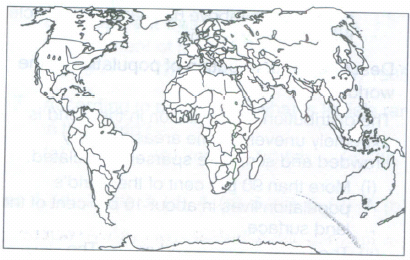
Look at the given figure and find out of these countries how many are in Asia? Locate them on a world map
13.
Describe the distribution of population in the world.
14.
What are the bad effects of population explosion on society? How does population pyramid help in understanding the population of the country?
15.
In 1999, less than 30 years later, the population doubled to............ billion.
16.
Varanasi, Jerusalem and Vatican city are some examples of........... factors.
17.
...............in Japan and in........... India are two densely populated areas.
18.
................is the ultimate resource.
19.
Green land has the lowest population density,
20.
The age group 0-15 comes under the economically dependent group,
21.
Emigrants are people who arrive in a country,
22.
Deaths are usually measured using the death rate
23.
Almost three-quarters of the world's people live in two continents, namely Asia and Africa,
24.
What do you understand by population distribution?
25.
What do you mean by population explosion?
26.
What is emigration?
27.
What are the people called who have come from other countries?
28.
Which hemisphere has more population?
1.
The pyramid of Japan is narrow at the base whic means low birth rate. Decreased death rates all less number of people to reach old age.
The working population is more compared to the children and old population.
2.
The population pyramid of Kenya is broad at the base and narrow towards the top because:
(i) many children are born
(ii) a large percentage of them die in their infancy
(iii) relatively few become adults and there arev few old people
3.
Death rate is an influencing factor of population change. Deaths are usually measured using the death rate i.e. the number deaths per 1000 people. When death rate is more than birth rate, it is a population decrease
4.
Birth rate is one of the influencing factors of population change. Births are usually measured using the birth rate i.e. the number of live births per 1000 people. When birth rate is more than death rate, it is a population increase
5.
The population pyramids are the graphical method to show:
(a) total population into male and femalei.es composition.
(b) age group from 0-14, 15-59,59 years and above.
(c) work force.
(d) dependent and productive population.
The shape of the population pyramid helps to know about the people living in that
particular country. The numbers of children below 15 years age-group are shown at the bottom and reflect the level of births.
The size of the top shows the numbers of people above the age-group of 60 years and reflects the number of deaths.
The population pyramid also shows that ho many dependents and working force/class there in a country.
6.
(d)
1985
7.
(d)
United Kingdom
8.
(d)
90%
9.
(d)
All of these
10.
(a)
A graphical presentation of the age, sex composition of a population.
11.
Densely, favourable, natural, fertile
12.
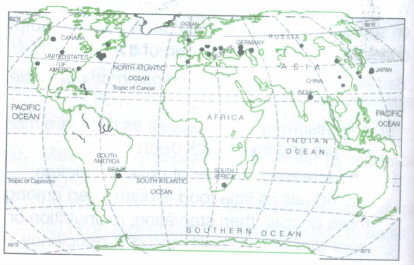
The Countries in Asia are China, India, Indonesia, Pakistan, Bangladesh and Japan
13.
The distribution of population in the world is extremely uneven. Some areas are very
crowded and some are sparsely populated.
(i) More than 90 per cent of the world's population lives in about 10 per cent of the land surface.
(ii) The densely populated areas- The crowded areas are South and South-East
Asia, Europe and North-Eastern North America.
(iii) The sparsely populated areas-Very few people live in high latitude areas, tropical
deserts, high mountains and areas of equatorial forests.
(iv) Almost three-quarters of the world's people live in two continents, Asia and Africa.
(v) Sixty per cent of the uneven distribution of people stay in just 10 countries. All of them have more than 100 million people.
14.
Bad effects of population explosion on our society are:
(i) A pressure upon resources as there are more people and their quick depletion.
(ii) An increased number of poverty-stricken individuals as little food is distributed among more people, then starvation. malnutrition or poor diet with ill health and diet-deficiency diseases would increase.
(iii) Loss of natural environment (forests and such) and loss of ecosystems because they are destroyed to make way for farming and urban developments to accommodate the rising population.
(iv) Irreversible loss of arable land and increase in desertification.
Population pyramid is also called the age-sex pyramid. Population pyramid shows:
(i) The total population which is divided into various age groups. For example 5 to 9 years, 10 to 14 years.
(ii) The percentage of the total population, subdivided into males and females, in each of those groups.
(iii) The numbers of children (below 15 years) are shown at the bottom and reflect the level of births.
(iv) The size of the top shows the numbers of aged people (above 65 years) and reflects the number of deaths.
15.
()
6
16.
()
religious of cultural
17.
()
Osaka
18.
()
Human resource
19.
(a)
20.
(a)
21.
(b)
22.
(a)
23.
(a)
24.
()
The way in which people are spread across the Earth's surface is known as the pattern of population distribution
25.
()
A sudden and rapid increase in population is considered to be a population explosion
26.
()
Movement of people to other countries is called emigration
27.
()
immigrants
28.
()
Northen Hemisphere

8th Standard CBSE Syllabus & Materials
8th Standard CBSE
CBSE 8th Science Particulate Nature of Matter - New Model Questions Papers Study Material - QB365 Set A
NEW8th Standard CBSE
CBSE 8th Science Pressure, Winds, Stroms and Cyclones - New Model Questions Papers Study Material - QB365 Set A
NEW8th Standard CBSE
CBSE 8th Mathematics Quadrilaterals - New Model Questions Papers Study Material - QB365 Set A
NEW8th Standard CBSE
CBSE 8th Mathematics A story of Numbers - New Model Questions Papers Study Material - QB365 Set A



NCERT Books

Syllabus

Exam Pattern

Sample Question Papers

Previous year Question Papers

Important Notes

MCQ Practice test

NCERT Exemplers

Case study Questions

Image Based Questions

Passage based Questions

HOT Questions

Value Based Questions

Model Questions Papers
NCERT ( Book Back ) Questions

Assertion and Reason
Important Questions And Answers

CBSE 8th Standard CBSE Subjects
CBSE Standards


