
 100% FREE ACCESS
8th Standard CBSE Syllabus & Materials
8th Standard CBSE
CBSE 8th Social Science Theme D - Factors of Production - New Model Questions Papers Study Material - QB365 Set A
NEW8th Standard CBSE
CBSE 8th Social Science Theme C - Universal Franchise and India's Electoral System - New Model Questions Papers Study Material - QB365 Set A
NEW8th Standard CBSE
CBSE 8th Social Science Theme B - The Rise of the Marathas - New Model Questions Papers Study Material - QB365 Set A
NEW8th Standard CBSE
CBSE 8th Social Science Theme B - Reshaping India's Political Map - New Model Questions Papers Study Material - QB365 Set A
NEW8th Standard CBSE
CBSE 8th Social Science Theme A - Natural Resources and Their Use - New Model Questions Papers Study Material - QB365 Set A
NEW8th Standard CBSE
CBSE 8th Science Keeping Time with Skies - New Model Questions Papers Study Material - QB365 Set A

Published on: 29/10/2025
Download CBSE Class 8th Standard CBSE Social Science question papers, sample papers, important questions, and previous year solved papers in PDF format. Get free study materials, NCERT solutions, and exam preparation resources for Class 8th Standard CBSE Social Science
Questions + Answers key
Take MCQ Social Science Test
1.
Describe various industries classified on the basis of ownership.
2.
Explain the factors which favour the location of steel plant at Jamshedpur.
3.
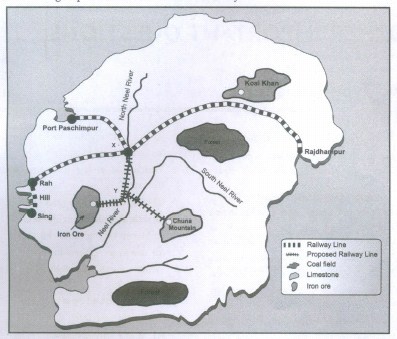
Report Factors/ Resources affecting the location of a proposed Iron and Steel Plant on Developen Dweep.
4.
How to identify a location for establishing an industry :
5.
Bengaluru has some important public sector industries and research institutions. Find out the full forms of the organizations listed below:
6.
Write a short note on the Chernobyl disaster
7.
What are the factors that helped Ahmedabad to become a textile centre?
8.
"The iron and steel industry is the basic as well as heavy industry." Support the statement with suitable examples.
1.
On the basis of ownership, industries can be classified as :
(i) Private sector: Owned or operated by an individual or a group of individuals.
(ii) Public sector: Owned and operated by the government.
(iii) Joint sector: Owned and operated by the state and an individual or a group of individuals.
(iv) Co-operative sector: Owned and operated by the producers or suppliers of raw material or by both.
2.
The factors which favour the location of steel plant at Jamshedpur are:
(i) High grade hematite ore is obtained from Noamundi mines of Singhbhum.
(ii) Power from D.V.C and coal mines is in close proximity at Jharia and Raniganj.
(iii) Manganese is obtained from Keonjhar district in Odisha.
(iv) Limestone and Dolomite are obtained from Sundergarh (Odisha).
(v) Well-developed network of transport.
(vi) Kolkata provides port facilities.
(vii) Plenty of water is available from the river Damodar.
(viii) Cheap and skilled labour is drawn from nearby states.
3.
1. Iron ore: This is a very large deposit of low grade iron ore. Long-distance transportation of the ore would be uneconomic.
2. Coal: The only coalfield contains rich deposits of high grade coal. Transportation of the coal is by railway, which is relatively cheap.
3. Limestone: This is widely available over the island, but the purest deposits are in the Chuna Mountains.
4. Water: Both the tributaries of River Neel carry sufficient water to supply large iron and steel plant in all seasons. The sea water because of its high salt content is unsuitable.
5. Market: It is expected that the chief market for the Plant's products will be the engineering works of Rajdhanipur. Transport costs for the products mainly small steel bars and light steel plates would be relatively low.
6. Labour supply: This will have to be recruited mainly from the unskilled workers in the 3 fishing villages of Hil, Rah, and Sing. It is expected that most workers will commute daily from their present homes.
7. Port facilities: These are at present minimal. There is a good, deep natural harbour at port Paschimpur developed to import metal alloys.
| Resource | Distance from X | Distance from Y | Weighting*1-10 | Distance X weight for site X | Distance X weight for siteY |
| Iron ore | 100 | 25 | 10 | 1000 | 250 |
| Coal | 200 | 275 | 10 | 2000 | 2750 |
| Limestone | 200 | 100 | 8 | 1600 | 800 |
| Water | 25 | 25 | 8 | 200 | 200 |
| Chief market | 300 | 375 | 8 | 2400 | 3000 |
| Labour supply | 50 | 25 | 9 | 450 | 225 |
| Total = | 7650 | 7225 |
The larger the pull, the higher the weighting.Looking at the above statistics, the steel plant should be located at site Y.
4.
Divide your class into groups. Each group is a Board of Directors faced with the problem of choosing a suitable site for an iron and steel plant of Developen Dweep. A team of technical experts has submitted a report with notes and a map. The team considered access to iron ore, coal, water and limestone, as well as the main market, sources of labour and port facilities. The team has suggested two sites, X and Y. The Board of Directors has to take the final decision about where to locate the steel plant.
1, Read the report submitted by the team.
2. Study the map to find out the distances of the resources from each site.
3. Give each resource a 'weight' from 1 to 10, according to its importance. The greater the 'pull' of the factor on the industry the higher the weight from 1 to 10.
4. Complete the table on the next page.
5. The site with the lowest total should be the most satisfactory site.
6. Remember each group of directors can decide differently.
5.
1. BEL: Bharat Electronics Limited
2. BHEL: Bharat Heavy Electricals Limited
3. HAL: Hindustan Aeronautics Limited
4. NAL: National Aerospace Laboratories
5. DRDO: Defense Research Development Organization
6. ISRO: Indian Space Research Organization
7. ITI: Indian Telephone Industries Limited
8. IISc: Indian Institute of Science
9. NCBS: National Centre for Biological Sciences
10. UAS: University of Agricultural Sciences.
6.
The Chernobyl disaster was a nuclear reactor accident in the Chernobyl Nuclear Power Plant in the Soviet Union. It was the worst nuclear power plant accident in history. On 26th April, 1986, a nuclear reactor at the Chernobyl plant exploded. Further explosions and the resulting fire sent a plume of highly radioactive fallout into the atmosphere and over an extensive geographical area. Nearly thirty to forty times more fallout was released than had been by atomic bombings of Hiroshima and Nagasaki. Large areas in Ukraine, Belarus and Russia were badly contaminated, resulting in the evacuation and resettlement of over 336,000 people.The accident raised concerns about the safety of the nuclear power industry.
7.
Factors that helped the city to become a textile centre are:
i) Ahmedabad is situated in the heart of a cotton growing area, hence the major raw material is easily available.
ii) The humid climate is ideal for spinning and weaving.
iii) The flat terrain and easy availability of land is suitable for the establishment of the mills.
iv) The densely populated states of Gujarat and Maharashtra provide both skilled and semi-skilled labour.
v) The Mumbai port which is situated nearby facilitates import of machinery and export of cotton textiles.
8.
The iron and steel is called basic industry because all other industries depend on it for their machinery.
Steel is needed to manufacture a variety of engineering goods, construction material, defense, medical, telephones, scientific equipment and variety of consumer goods.
Iron and steel is a heavy industry because all the raw materials and finished goods are heavy. They are bulky also. They are entailing heavy transportation costs.
Iron one and limestone are required in high quantity

8th Standard CBSE Syllabus & Materials
8th Standard CBSE
CBSE 8th Science Particulate Nature of Matter - New Model Questions Papers Study Material - QB365 Set A
NEW8th Standard CBSE
CBSE 8th Science Pressure, Winds, Stroms and Cyclones - New Model Questions Papers Study Material - QB365 Set A
NEW8th Standard CBSE
CBSE 8th Mathematics Quadrilaterals - New Model Questions Papers Study Material - QB365 Set A
NEW8th Standard CBSE
CBSE 8th Mathematics A story of Numbers - New Model Questions Papers Study Material - QB365 Set A



NCERT Books

Syllabus

Exam Pattern

Sample Question Papers

Previous year Question Papers

Important Notes

MCQ Practice test

NCERT Exemplers

Case study Questions

Image Based Questions

Passage based Questions

HOT Questions

Value Based Questions

Model Questions Papers
NCERT ( Book Back ) Questions

Assertion and Reason
Important Questions And Answers

CBSE 8th Standard CBSE Subjects
CBSE Standards


