
 100% FREE ACCESS
8th Standard CBSE Syllabus & Materials
8th Standard CBSE
CBSE 8th Social Science Theme D - Factors of Production - New Model Questions Papers Study Material - QB365 Set A
NEW8th Standard CBSE
CBSE 8th Social Science Theme C - Universal Franchise and India's Electoral System - New Model Questions Papers Study Material - QB365 Set A
NEW8th Standard CBSE
CBSE 8th Social Science Theme B - The Rise of the Marathas - New Model Questions Papers Study Material - QB365 Set A
NEW8th Standard CBSE
CBSE 8th Social Science Theme B - Reshaping India's Political Map - New Model Questions Papers Study Material - QB365 Set A
NEW8th Standard CBSE
CBSE 8th Social Science Theme A - Natural Resources and Their Use - New Model Questions Papers Study Material - QB365 Set A
NEW8th Standard CBSE
CBSE 8th Science Keeping Time with Skies - New Model Questions Papers Study Material - QB365 Set A

Published on: 29/10/2025
Download CBSE Class 8th Standard CBSE Social Science question papers, sample papers, important questions, and previous year solved papers in PDF format. Get free study materials, NCERT solutions, and exam preparation resources for Class 8th Standard CBSE Social Science
Questions + Answers key
Take MCQ Social Science Test
1.
Explain Doctrine of Lapse
2.
Why did the East India Company become worried in the late 1830s? What did they do to allay this Worry?
3.
What caused huge loss of revenue in Bengal?
4.
How did the EIC expand its rule in India?
5.
How did the East India Company began trade in Bengal? What demands were put by them to the rulers?
6.
Why did English develop a strong army?
7.
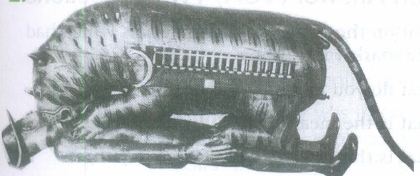
(iii) Where is the toy tiger now kept?
8.
Who possessed the mechanical toy in the picture?
9.
Who introduced the policy of pramountcy? What did it mean? What sort of resistance did the Company face?
10.
Look at the Map along with a present-day political map, of India. In each of these maps try and identify the different parts of India that were under the British rule.
.JPG)
1.
(i) The Doctrine of Lapse was introduced by Lord Dalhousie.
(ii) According to this, if the ruler of a protected or dependent state died without a natural heir, his state would automatically lapse.
(iii) The victims of this doctrine were Satara (1848), Jaitpur, Sambalpur (1850), Udaipur (1852), Nagpur (1853)and Jhansi (1854
2.
In the late 1830s, the East India Company became worried about Russia. It imagined that Russia might expand across Asia and this fear, the British now wanted to secure their control over the North-West. Sind was taken over in 1843. After Maharaja Ranjit Singh's death in 1839, two prolonged wars were fought with the Sikh kingdom. Ultimately, in 1849, Punjab was annexed.
3.
Aurangzeb's Farman had granted the Company only the right to trade duty-free. But the officials of the Company misused this facility. They were carrying on private trade and stopped paying duty for their personal profit. This caused a huge loss of revenue in Bengal.
4.
The EIC used various political, economic and diplomatic methods to expand its rule in India:
(i) Direct Annexation: At times, British fought direct wars. e.g. State of Punjab w~s annexed after the death of Punjab king Maharaja Ranjit Singh.
(ii) Appointment of Residents : EIC residents began interfering in internal affairs deciding as to which person has to be appointed at political or administrative posts.
(iii) Doctrine of Lapse : It was a policy made by lord Dalhousie. The doctrine declared that if an Indian ruler died without a male heir, his kingdom would 'lapse', and would become a part of Company's property, e.g., Udaipur, Jhansi.
(iv) Introduction of 'Subsidiary Alliance' : According to the terms of subsidiary alliance, Indian rulers were not allowed to have their independent armed forces. They were to be protected by the company. Also, they had to pay for the 'subsidiary forces' that the company was supposed to maintain for the purpose of their protection. If the Indian rulers failed to make the payment, then a part of their territory was taken away as penalty.
5.
Beginning of trade in Bengal by East India Company
(i) The first English factory was set up on the banks of the river Hugli in 1651. This was the base, from which the Company traders, known at that time as "factors", operated.
(ii) The factory had a warehouse where goods for export were stored, and it had offices where company officials used to sit. As trade expanded, the company persuaded merchants and traders to come and settle near the factory.
(iii) By 1696, it began building a fort around the settlement. Demands put up by East India Company:
(i)Two years later, EIC bribed Mughal officials to give the Company, zamindari rights over three villages.
(ii) One of these was Kalikata, which later grew into the city of Calcutta or Kolkata (as it is known today).
(iii) It also persuaded the Mughal emperor Aurangzeb to issue a farman, granting the Company the right to trade duty free.
6.
The English developed a strong army due to the following reasons :
(i)The army was needed to establish control upon the vast empire.
(ii) It was also required to suppress internal revolts against the British.
(iii) The army consisted of Indian soldiers who were known as sepoys.
(iv) The army was well disciplined, well trained and regularly paid.
7.
This toy tiger was taken by the British when Tipu Sultan died defending he capital Seringapatam in 1799. The toy was then kept in the Victoria and Albert Museum in London.
8.
Tipu Sultan, the ruler of Mysore, possessed the mechanical toy in the above picture.
9.
Governor -General Lord Hastings (1813-1828) introduced a new policy of paramountcy' in India. It meant that the power of the Company was paramount or supreme, i.e. the power of the Company was greater than that of Indian states. In order to protect its business interest, the Company could annex or threaten to annex any Indian kingdom.
This policy of the British was followed by the later rulers. But this policy of the British did not go unchallenged. For example, when the British tried to capture the small state of Kitoor, Rani Channamma revolted against this annexation. As a result, she was arrested and later died in the prison in 1829. This resistance movement did not stop. It was carried on by Rayanna, a poor chowkidar of Sangoli in Kitoor.
He got support from the common people and destroyed many British camps and records.In 1830, he was caught and hanged by the British
10.
In the above map, the areas which are under the British rule are-some parts of East UP, Bihar, Bengal, Coastal Andhra Pradesh, Madras city, some parts of Tamil Nadu and Kerala.

8th Standard CBSE Syllabus & Materials
8th Standard CBSE
CBSE 8th Science Particulate Nature of Matter - New Model Questions Papers Study Material - QB365 Set A
NEW8th Standard CBSE
CBSE 8th Science Pressure, Winds, Stroms and Cyclones - New Model Questions Papers Study Material - QB365 Set A
NEW8th Standard CBSE
CBSE 8th Mathematics Quadrilaterals - New Model Questions Papers Study Material - QB365 Set A
NEW8th Standard CBSE
CBSE 8th Mathematics A story of Numbers - New Model Questions Papers Study Material - QB365 Set A



NCERT Books

Syllabus

Exam Pattern

Sample Question Papers

Previous year Question Papers

Important Notes

MCQ Practice test

NCERT Exemplers

Case study Questions

Image Based Questions

Passage based Questions

HOT Questions

Value Based Questions

Model Questions Papers
NCERT ( Book Back ) Questions

Assertion and Reason
Important Questions And Answers

CBSE 8th Standard CBSE Subjects
CBSE Standards


