
 100% FREE ACCESS
8th Standard CBSE Syllabus & Materials
8th Standard CBSE
CBSE 8th Social Science Theme D - Factors of Production - New Model Questions Papers Study Material - QB365 Set A
NEW8th Standard CBSE
CBSE 8th Social Science Theme C - Universal Franchise and India's Electoral System - New Model Questions Papers Study Material - QB365 Set A
NEW8th Standard CBSE
CBSE 8th Social Science Theme B - The Rise of the Marathas - New Model Questions Papers Study Material - QB365 Set A
NEW8th Standard CBSE
CBSE 8th Social Science Theme B - Reshaping India's Political Map - New Model Questions Papers Study Material - QB365 Set A
NEW8th Standard CBSE
CBSE 8th Social Science Theme A - Natural Resources and Their Use - New Model Questions Papers Study Material - QB365 Set A
NEW8th Standard CBSE
CBSE 8th Science Keeping Time with Skies - New Model Questions Papers Study Material - QB365 Set A

Published on: 29/10/2025
Download CBSE Class 8th Standard CBSE Social Science question papers, sample papers, important questions, and previous year solved papers in PDF format. Get free study materials, NCERT solutions, and exam preparation resources for Class 8th Standard CBSE Social Science
Questions + Answers key
Take MCQ Social Science Test
1.
Complete the following table:
| Objective | Why is this important? | Example of a violation of this objective |
|---|---|---|
| One religious community does not dominate another. | - | - |
| The State does not enforce any particular religion nor take away the religious freedom of individuals | - | - |
| That some members do not dominate other members of the same religious community. | - | - |
2.
Why should we conserve biodiversity?
3.
The Constitution also mentions Fundamental Duties. Find out with the help of your teacher what these include and why it is important for citizens in a democracy to observe these.
4.
Give reasons:
Most industries are concentrated around coal mines.
5.
Who lived in the "white" areas in cities such as Madras?
6.
Why were the planters reluctant to expand the area under nij cultivation?
7.
Imagine that you have come across two old newspapers reporting on the Battle of Seringapatam and the death of Tipu Sultan. One is a British paper and the other is from Mysore. Write the headline for each of the two newspapers.
8.
What is the problem with the periodisation of Indian history that James Mill offers?
9.
Which of the following is a repressive law?
Hindu Succession Amendment Act, 2005
The Domestic Violence Act, 2005
The Seditions Act, 1870
All of the above
10.
Which of the following is correct with reference to Saudi Arabia?
It is a secular country.
All religions are treated equally
Non-muslims are free to practise their religion the way they want.
Non-muslims cannot gather in public spaces for prayer.
11.
Members of Lok Sabha are
nominated by President
nominated by Prime Minister
elected by the people
chosen on first-come-first-serve basis
12.
Resources drawn from nature and used without much modification are called
human-made resources
cultural resources
natural resources
All of the above
13.
The use of land is determined by factors such as
(i) topography
(ii) soil
(iii) climate
(iv) mineral
Choose the correct option.
(i), (ii) and (iii)
(i), (iii) and (iv)
(ii), (iii) and (iv)
All are correct.
14.
Geothermal energy is found in
Manikaran
Gujarat
Karnataka
Jharkhand
15.
The two most important staple food crops of the world are
ragi and bajra
tea and coffee
rice and wheat
millets and maize
16.
According to the Fundamental Rights mentioned in the Indian Constitution, which of the following is prohibited?
Human trafficking
Forced labour
Children under 14 years of age working in hazardous occupations
All of the above
17.
A/An ____________ was a ritual hand loom cloth woven in Gujarat.
patola weave
jamdani weave
bandanna
odhni
18.
What was in the centre of Shajahanabad?
Jama Masjid
Chandni Chowk
Faiz Bazaar
Faiz Bazaar
19.
The Bastar Rebellion took place in the year
1895
1910
1930
1940
20.
Rani Channamma was the ruler of
Bengal
Kitoor
Agra
Delhi
21.
Who was the Governor of Madras in 1819 to 1826?
Thomas Munro
William Bentinck
Thomas Disilva
Warren Hastings
22.
Usually, census operations in India are held
every five years
every seven years
every ten years
every twelve years
23.
Prayer place of Muslims
24.
Spinning Jenny
25.
France
26.
Begum Zinat Mahal
27.
12th August 1765
28.
Historian
29.
Observe the image of the Parliament given below.
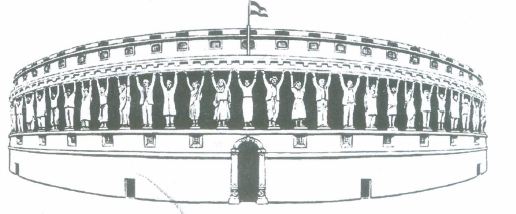
What do you think the artist is trying to convey through this image?
30.
What are abiotic resources?
31.
What is rainwater harvesting? Give some advantages of rainwater harvesting.
32.
In what ways were the steps followed for industrialising Japan different from those followed by the British in industrialising India?
33.
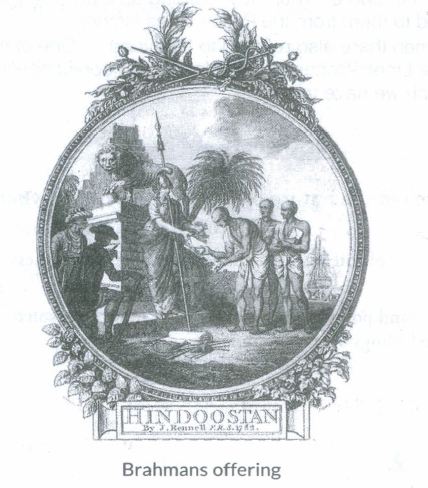
Look carefully and write a paragraph explaining how this image projects an imperial perception.
34.
The_________ was passed in the year 1720 by the British government.
35.
The British conquest of Bengal began with the Battle of ______________
36.
The colonial laws were __________
37.
70% of fresh water exists as _____
38.
Muslims in India are counted as ________________.
39.
Delhi's famous canals brought water to homes for _________and for other_________ uses.
40.
The British described the tribal people as_________
41.
Ryotwari system was also known as _____________
42.
The Rajya Sabha is also called Council of States.
43.
Petroleum deposits of West Asia are an example of actual resources.
44.
Mahatma Gandhi visited Champaran in 1917.
45.
Parliament session begins with Zero Hour.
46.
Deep bores also known as shafts.
47.
Maharaja Ranjit Singh was the ruler of Punjab.
48.
What do you understand by Patent?
49.
What is quarrying?
50.
What did the Portuguese first come to India in search of?
51.
What is the position of minorities in Israel?
52.
Why did the havelis decline during British rule?
53.
On what charges was Birsa convicted?
54.
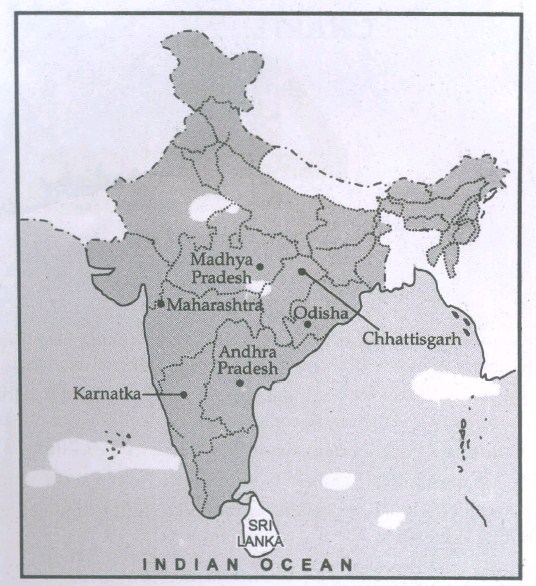
In the given outline map of India, identify and name the five major manganese producing states .
55.
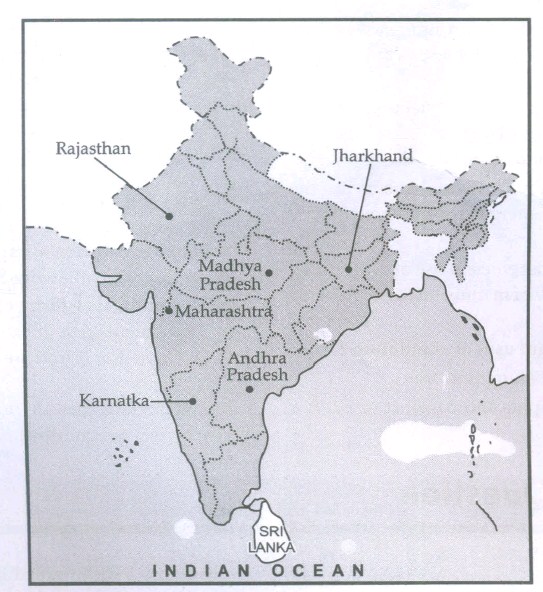
On the given political map of India, identify the five major copper producing states.
56.
Indentify the Canadian Shield, the Appalachians, Western Cordilleras, Lake Superior
57.
How did "Charakha" symbolise India?
58.
Write a short note on Nuclear Power.
59.
What is PIL ?
60.
Name the major types of vegetation.
61.
What is Green Revolution?
62.
Explain the Lahore Gate Improvement Scheme.
63.
Why was the revolt known as a sepoy mutiny?
64.
Write a note on the following:
(i) Charter Act (ii) Dual government
65.
Who were 'Calligraphists'?
66.
Read the following passage and answer the questions given below:
Here is an excerpt from the memoirs of Sitaram Pande, 'From Sepoy to Subedar':
It chanced that about this time the Sarkar sent parties of men from each regiment to different garrisons for instructions in the use of the new rifle. These men performed the new drill for some time until a report got about by some means or the other, that the cartridges used for these new rifles were greased with the fat of cows and pigs. The men from our regiment wrote to others in the regiment telling them about this, and there was soon excitement in every regiment Some men pointed out that in forty years' service nothing had ever been done by the Sarkar to insult their religion, but as I have already mentioned the sepoys' minds had been inflamed by the seizure of Oudh. Interested parties were quick to point out that the great aim of the English was to turn us all into Christians, and they had therefore introduced the cartridge in order to bring this about, since both Mahommedans and Hindus would be defiled by using it.
(i) Who translated the writing of Sitaram Pande into English?
(ii) Why did the sepoys rebel against the English?
(iii) Where did the Sepoy Mutiny begin?
1.
| Objective | Why is this important? | Example of a violation of this objective |
|---|---|---|
| One religious community does not dominate another. | Because all citizens are equal irrespective of their religion. There should not be any discrimination against any community on grounds of religion. All are free to follow the religion of their choice | A Hindu religious procession is not allowed to pass through the road where a mosque is located |
| The State does not enforce any particular religion nor take away the religious freedom of individuals | Because as citizens of a secular State, all are free to follow the religion of their choice. All religions are equal for the State. That is why it does not promote anyone religion on its own. | Demolition of the Babri Masjid (mosque). Burning of churches) |
| That some members do not dominate other members of the same religious community. | Every member of a religious community has equal right to follow his/her religion and no one can suppress his/her right to do so. All citizens should also have the freedom to interpret the religion in his/her way. There cannot be one single way of interpreting it. | The Dalit members of the Hindu religious community do not have equal access to temples. Any person speaking against a religious practice is discriminated against by the community. |
2.
We should conserve biodiversity because it is very important for all living organisms and for the environment. We should conserve biodiversity to save it from becoming extinct.
3.
The Part IV A of the Constitution of India contains the Fundamental Duties. The duties are listed under Article 51-A.
The Fundamental duties are as follows:
It shall be the duty of every citizen of India
(i) to abide by the Constitution and respect its ideals and institutions, the National Flag and the National Anthem.
(ii) to cherish and follow the noble ideals which inspired our national struggle for freedom.
(iii) to uphold and protect the sovereignty, unity and integrity of India.
(iv) to defend the country and render national service when called upon to do so.
(v) to promote harmony and the spirit of common brotherhood amongst all the people of India transcending religious, linguistic and regional or sectional diversities, to renounce practices derogatory to the dignity of women.
(vi) to value and preserve the rich heritage of our composite culture.
(vii) to protect and improve the natural environment including forests, lakes, rivers and wildlife and to have compassion for living creatures.
(viii) to develop the scientific temper, humanism and the spirit of inquiry and reform.
(ix) to safeguard public property and to abjure violence.
(x) to strive towards excellence in all spheres of individual and collective activity so that the nation constantly rises to higher levels of endeavour and achievement.
(xi) who is a parent or guardian to provide opportunities for education to his child or as the case may be, ward between the age of six and fourteen years.
Fundamental Duties serve as a reminder to the citizens that while enjoying their rights, they should also be aware of their duties towards their country and fellow citizens. Fundamental Duties serve as a source of inspiration for the citizens and encourage a sense of discipline and commitment among them.
4.
Coal is used as a source of energy and power and also as a raw material in most of the industries. Hence, most industries are concentrated around coal mines for the purpose of saving cost of transportation of coal (cost-effectiveness).
5.
The British and other Europeans lived in the "white" areas in cities such as Madras.
6.
The planters were reluctant to expand the area under nij cultivation because of the following reasons:
(i) Indigo could be cultivated only on fertile lands, but these were already densely populated. The planters hardly got large areas in compact blocks.
(ii) The planters needed a large number of labour at a time when peasants were busy with rice cultivation.
(iii) Nij cultivation on a large scale also required many ploughs and bullocks. They could not get the supplies from peasants as their ploughs and bullocks were busy on rice fields. Investing on purchase and maintenance of ploughs was a big problem.
7.
Headline for the British paper "The East India Company crushes Tipu Sultan." Headline for the local paper "Mysore Tiger sacrifices life for the people of Mysore".
8.
James Mill divided Indian history into three periods-Hindu, Muslim and British. But this periodisation is not proper.
There were some problems with this periodisation as follows:
(i) It is improper to refer any period of history as 'Muslim' or 'Hindu' because a variety of faiths existed Simultaneously.
(ii) It is also not justified to characterise an age through the religion of the rulers of the time. During ancient period, all the rulers did not share the same faith.
(iii) Mill, through his periodisation suggested that only British rule could civilize India. He suggested that the British should conquer all the territories in India to ensure the enlightenment as if India was not capable of progress without British help.
9.
(c)
The Seditions Act, 1870
10.
(a)
It is a secular country.
11.
(c)
elected by the people
12.
(c)
natural resources
13.
(d)
All are correct.
14.
(a)
Manikaran
15.
(c)
rice and wheat
16.
(d)
All of the above
17.
(a)
patola weave
18.
(b)
Chandni Chowk
19.
(b)
1910
20.
(b)
Kitoor
21.
(a)
Thomas Munro
22.
(c)
every ten years
23.
()
Idgah
24.
()
1764
25.
()
The first tidal energy station
26.
()
Delhi
27.
()
The Company got Diwani of Bengal
28.
()
Scholar who write history
29.
Through this image of the Parliament, the artist is trying to convey that it is the people Parliament is based on the people strength. The Parliament is the supreme law-making body of Indian democracy and it is composed of representatives elected directly by the people. Who come from different religions and backgrounds. So it is ultimately the people who make rules for their country.
30.
Abiotic resources are comprising of non-living things like land, water, air and minerals such as gold, iron, copper and silver.
Abiotic resources are not renewable, as they can be exhausted by excessive use and their rate of formation is very slow.
The usefulness of the abiotic resources depends upon this accessibility and their value. Their total reserves cannot be increased by human efforts. These resources are in great demand for the development of industries.
31.
Rainwater harvesting is the accumulation and storage of rainwater for reuse before it reaches the aquifers under the ground. Uses include water for the garden, water for livestock water for irrigation.
The advantages of rainwater harvesting are as follows:
(i) It reduces the consumption of groundwater.
(ii) It is free from pollutants as well as salts, minerals and other natural and man-made contaminants.
(iii) It is considered as the purest form of natural water.
(iv) The stored water is a reliable source of water when other sources dry up.
32.
The basic difference between India and Japan was that India was run by the British colonial government, while Japan was an independent country. While the colonial government in India, which wanted to expand the market for British goods, did not support Indian industrialists, the Japanese Government encouraged the growth of industries.
They did this by developing postal and telegraph services, railways and steam-powered shipping. They also imported advanced technology from the West and gave generous loans to industrialists, besides selling large industries started by the government to business families very cheaply. Thus in India, colonial domination created barriers to industrialization, while in Japan the fear of foreign conquest spurred industrialisation.
33.
Shastras to Britannia, frontispiece to the first map produced by James Rennel, 1782 Renne! was asked by Robert Clive to produce maps of Hindustan. An enthusiastic supporter of British conquest of India, Renne! saw the preparation of maps as essential to the process of domination. The picture here tries to suggest that Indians
willingly gave over their ancient texts to Britannia - the symbol of British power - as if asking her to become the protector of Indian culture.
34.
()
Spinning jenny
35.
()
Plassey
36.
()
arbitrary
37.
()
ice sheets
38.
()
minority
39.
()
drinking, domestic
40.
()
savage
41.
()
Munro system
42.
(a)
43.
(a)
44.
(a)
45.
(b)
46.
(a)
47.
(a)
48.
()
Patent means the exclusive right over any idea or invention.
49.
()
Minerals that lie near the surface are simply dug out by the process known as quarrying.
50.
()
The Portuguese first came to India in search of spices.
51.
()
The position of minorities is very poor in Israel as they are treated unfairly.
52.
()
The havelis declined during British rule because the Mughal amirs could not maintain these large establishments.
53.
()
Birsa was convicted on the charges of rioting.
54.
55.
56.
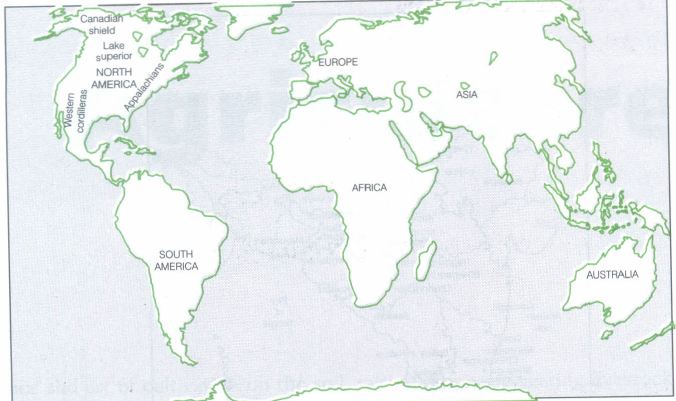
57.
The "Charkha" represented India and it was put at the centre of the tricolour flag of the Indian National Congress adopted in 1931.
58.
Nuclear power is obtained from energy stored in the nuclei of atoms of naturally occurring radio active elements like Uranium and Thorium. These fuels undergo nuclear fission in nuclear reactors and emit power.
59.
PIL stands for Public Interest Litigation. In Public Interest Litigation, the court gives judgement in public interest on matters such as exploitation, environment, child labour, etc. If any person or institution informs the courts the court investigates the matter and decides in the context of facts. These cases constitute Public Interest Litigation. These cases can be presented only in High Court or Supreme Court.
60.
The major types of vegetation are grouped as forests, grasslands, scrubs, shrubs and tundra.
61.
Green revolution refers to that tremendous increase in agricultural production, which was possible due to the adoption of new agricultural strategy.
62.
An extension scheme called the Lahore Gate Improvement Scheme was started in 1888by Robert Clarke for the Walled City residents. The idea was to draw residents away from the old city to a new type of market square, with a mosque in the centre and shops around the edges. The main reason behind this scheme was to persuade a flow of population from the crowded parts of the town of Delhi to certain other areas and relieve congestion within the old city.
63.
In this revolt, all the sepoys marched to the Britishers' buildings, houses, police stations and burnt them. They killed the British officials. The main role in these activities was that of sepoys. Therefore, the Revolt of 1857 is also called sepoy mutiny (Sepoy means soldiers and mutiny means 'Soldiers March').
64.
(i) Charter Act : Charter Act 1813 or East India Company Act 1813 was passed by the British Parliament to renew the charter of British East India Company and continue the rule of the same in India.
(ii) Dual Government : Dual Government meant double government under which the executive powers and responsibility for collection of revenue were shared by two different authorities.
65.
Calligraphists were experts in the art of beautiful handwriting. In the early years of the 19th century, important documents were carefully copied and beautifully written by the Calligraphists.
66.
(i) His Commanding Officer, Norgate translated his writings into English.
(ii) (a) Annexation of Awadh ignited the minds of the sepoys and turned them against the English.
(b) Secondly, the use of cartridges greased with the fat of cows and pigs was considered as an insult by both the Hindus and the Muslims.
(iii) The Sepoy Mutiny began in Meerut.

8th Standard CBSE Syllabus & Materials
8th Standard CBSE
CBSE 8th Science Particulate Nature of Matter - New Model Questions Papers Study Material - QB365 Set A
NEW8th Standard CBSE
CBSE 8th Science Pressure, Winds, Stroms and Cyclones - New Model Questions Papers Study Material - QB365 Set A
NEW8th Standard CBSE
CBSE 8th Mathematics Quadrilaterals - New Model Questions Papers Study Material - QB365 Set A
NEW8th Standard CBSE
CBSE 8th Mathematics A story of Numbers - New Model Questions Papers Study Material - QB365 Set A



NCERT Books

Syllabus

Exam Pattern

Sample Question Papers

Previous year Question Papers

Important Notes

MCQ Practice test

NCERT Exemplers

Case study Questions

Image Based Questions

Passage based Questions

HOT Questions

Value Based Questions

Model Questions Papers
NCERT ( Book Back ) Questions

Assertion and Reason
Important Questions And Answers

CBSE 8th Standard CBSE Subjects
CBSE Standards


