
 100% FREE ACCESS
8th Standard CBSE Syllabus & Materials
8th Standard CBSE
CBSE 8th Social Science Theme D - Factors of Production - New Model Questions Papers Study Material - QB365 Set A
NEW8th Standard CBSE
CBSE 8th Social Science Theme C - Universal Franchise and India's Electoral System - New Model Questions Papers Study Material - QB365 Set A
NEW8th Standard CBSE
CBSE 8th Social Science Theme B - The Rise of the Marathas - New Model Questions Papers Study Material - QB365 Set A
NEW8th Standard CBSE
CBSE 8th Social Science Theme B - Reshaping India's Political Map - New Model Questions Papers Study Material - QB365 Set A
NEW8th Standard CBSE
CBSE 8th Social Science Theme A - Natural Resources and Their Use - New Model Questions Papers Study Material - QB365 Set A
NEW8th Standard CBSE
CBSE 8th Science Keeping Time with Skies - New Model Questions Papers Study Material - QB365 Set A

Published on: 29/10/2025
Download CBSE Class 8th Standard CBSE Social Science question papers, sample papers, important questions, and previous year solved papers in PDF format. Get free study materials, NCERT solutions, and exam preparation resources for Class 8th Standard CBSE Social Science
Questions + Answers key
Take MCQ Social Science Test
1.
Who discovered the sea route to India in 1498?
Columbus
Dutch
East India Company
Vasco-da-Gama
2.
The international demand of indigo was affected by the discovery of
synthetic dyes
woad
blue colour
none of these
3.
Fallow land is a :
Group of plants in areas having similar climatic condition.
Land covered with grass shrubs on which animals graze freely
Marginal lands kept fallow for a certain period to restore their fertility
Breaking up and decaying of exposed rocks due to various factors.
4.
Civil cases are related to :
kidnapping
cheating
disputes over property
robberies
5.
The President of India holds office for a period of:
6 years
5 years
4 years
7 years
6.
When all the citizens of a country are equal before law, it implies
Parliamentary Rule
Independence of the Judiciary
Right to Equality
Fundamental Rights
7.
Muslim league demanded for _____ Constitutional Assembly.
2
2
3
4
8.
The rights provided by Constitution are called:
Governmental Rights
Optional Rights
Economic Rights
Fundamental Rights
9.
The breeding of fish is known as :
Horticulture
Sericulture
Viticulture
Pisciculture
10.
Tribals were recruited in large numbers to work in:
(A) tea plantations of Assam
(B) coal mines in Jharkhand
(C) iron mining
(D) road construction
A, B
A, C
C, D
A,D
11.
Which is the highest judicial authority in a state?
The Supreme Court
The High Court
The District Court
Subordinate Court
12.
The term/tenure of Lok Sabha is
1 year
3 years
5 years
It is a permanent house
13.
Which is not an example of ground water?
Water flowing in rivers
Water through hand pumps
Water through submersible pumps
Water through wells
14.
The word agriculture has been derived from two________words.
German
American
Latin
Arabic
15.
The political system in Nepal till 2006 was
democracy
dictatorship
Panchayati Raj
monarchy
16.
___________ were flowers used to dye clothes and color leather.
Mahua and sal
Kusum and sleeper
Palash and kusum
Palash and rnahua
17.
The first English factory was set-up in the year
1651
1600
1630
1665
18.
The East India Company was appointed as the Diwan of Bengal in
1760
1762
1764
1765
19.
An advertisement for Lipton tea suggested that royalty all over the world was associated with this tea. When did the advertisement appear?
1920
1925
1922
1932
20.
The first Governor-General of India was
Lord Dalhousie
Warren Hastings
Lord Canning
Lord William Bentinck
21.
Look at the Map along with a present-day political map, of India. In each of these maps try and identify the different parts of India that were under the British rule.
.JPG)
22.
"There are Court judgment, that people believe work against the best interests of common person." How? Explain with example.
23.
Explain coalition government.
24.
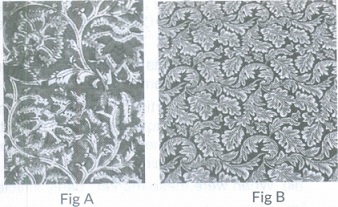
(i) Who designed and produced the floral cotton design in the pictures of Fig A and Fig B?
(ii) How was the blue in these prints produced?
(iii) What do you know about Kalamkari art?
25.
Why is agriculture called the main stay of the people of the world India including India?
26.
What are the implications of Judicial Activism and PIL?
27.
The vast change in the land use pattern is associated with the cultural change. Explain briefly.
28.
What happened during the Freedom Movement?
29.
Why are human resources important?
30.
Why does a democratic country need a Constitution?
31.
Which forests were called 'reserved'?
32.
What was the key aspect of Company's policy from 1757 to 1857?
33.
How was the blue colour produced?
34.
Why is judiciary important?
35.
What is Renaissance?
36.
From where did forest people get their supplies of rice and other
grains?
37.
How does the Constitution limit the power of government?
38.
Explain briefly the classification of resources on the basis of their distribution. What are the important factors that affect their distribution?
39.
"Today Indian farmers are facing a big challenge from international competition." What are the various factors responsible for this situation?
40.
This is a picture of Santhal girl carrying firewood. On the basis of the given picture, answer the following questions:
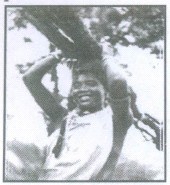
(i) What is the occupation of the Santhals?
(ii) Why were the Santhai unhappy under the British Raj?
1.
(d)
Vasco-da-Gama
2.
(a)
synthetic dyes
3.
(c)
Marginal lands kept fallow for a certain period to restore their fertility
4.
(c)
disputes over property
5.
(b)
5 years
6.
(c)
Right to Equality
7.
(b)
2
8.
(d)
Fundamental Rights
9.
(d)
Pisciculture
10.
(b)
A, C
11.
(b)
The High Court
12.
(c)
5 years
13.
(a)
Water flowing in rivers
14.
(c)
Latin
15.
(d)
monarchy
16.
(c)
Palash and kusum
17.
(a)
1651
18.
(d)
1765
19.
(c)
1922
20.
(b)
Warren Hastings
21.
In the above map, the areas which are under the British rule are-some parts of East UP, Bihar, Bengal, Coastal Andhra Pradesh, Madras city, some parts of Tamil Nadu and Kerala.
22.
There are Court judgments that, people believe, work against the best interests of the common person.
Examples:
(i) Activists who work on issues concerning the right to shelter and housing for the poor feel that the recent judgments on evictions are far away from earlier judgments.
(ii) Recent judgments tend to view the slum dweller as an encroacher in the city, but earlier judgments (like the 1985 Olga Tellis us BombayMunicipal Corporation) protected the livelihood of slum-dwellers.
23.
(i) Sometimes, it becomes difficult for a single political party to get the majority, that is required to form the government.
(ii) They then, join together with different political parties who are interested in similar policies and programmes to form the government.
(iii) This is known as coalition government.
24.
(i) The picture in Fig A is Kalamkari print. It was created by weavers of Andhra Pradesh in India. The picture in Fig B is a floral cotton print. It was designed and produced by William Morris, a famous poet and artist of 19th century Britain.
(ii) In both of these prints, the blue colour was produced by indigo. This indigo gave rich blue colour and was produced in India.
(iii) Kalamkari is a type of hand-painted or block-printed cotton textile, produced in parts of India. It is also produced in Iran. There are two distinctive styles of Kalamkari art in India.
25.
Because of the following:
(i) More than 50 per cent of the worlds population is engaged in agriculture.
(ii) 67 per cent of the population of India depends upon agriculture for their livelihood.
26.
Judicial Activism and PIL have the following implications:
First, these have overburdened the courts. Secondly, Judicial activism has blurred the line of distinction between the executive and legislature. The court has been involved in solving the questions which belong to executive. For example, air pollution, investigation of corruption cases etc, are the matters to be handled by administration under the supervision of legislature. These are not the duties of judiciary. Therefore, some feel that judicial activism has made the balance among the three organs of government very delicate. In a democratic country like India, each organ of government has its own power and jurisdiction. They cannot encroach upon others jurisdiction but judicial activism may be creating strain on this democratic principle.
27.
(i) The change in the culture has resulted in tremendous change in the land use pattern.
(ii) In the urban areas, people have started encroachment of the common lands to build commercial complexes and housing complexes.
(iii) In the rural areas, they cut down the forests to expand agricultural land.
28.
During the Freedom Movement, people from various. backgrounds joined the struggle to break the power of the British rule. Under colonial rule, people lived in fear of the British Government, they were made to follow repressive rules even if they did not agree with it. The Freedom Movement changed this situation. Inspired by the ideas of freedom, equality, and participation in decision-making, they openly criticised the government and made demands
29.
Human resources are important because nation's development is mostly dependent upon human resources which include human's skill, technology, thinking and knowledge, that leads to a nation's power. Only human skill and technology change the natural substances into a valuable resource.
30.
A democratic country needs a Constitution because:
(i) It is a written record of rules that guard against the misuse of power by political representations of the people.
(ii) It guarantees equality to all persons and no citizen can be discriminated on the basis of caste, creed, sex, religion etc.
(iii) It prevents the domination of one majority group over the less powerful minority groups.
(iv) It states the ideals that the people of the country, coming from different communities, have agreed upon and chosen to uphold.
31.
Some forests that produced timber which the British wanted, were classified as the reserved forests i.e., under state property where hunting, cultivation was not allowed.
32.
During this period the Company rarely launched a direct attack on any unknown territory. They tried political, economic and diplomatic measures before annexing a kingdom.
33.
The blue colour used in the picture was produced from a plant called indigo. India was the biggest producer and supplier of indigo in the world at that time.
34.
Judiciary is important as it settles disputes and performs several other interpretative functions. Independence of judiciary is necessary to protect the liberty of individuals. It is the foundation stone of democracy.
35.
It means re-birth and refers to European history from 14th to 16th century when there was revival of art, learning and culture
36.
1. The forest people exchanged goods and got what they needed in return for
their valuable forest produce.
2. They also bought goods with the small amount of earnings they had.
3. Some of them did odd jobs in the villages, carrying loads or building roads.
4. Others laboured in the fields of peasants and farmers.
5. With the decrease in supplies of forest produce, the tribal people wandered
around in search of work as labourers.
37.
The Constitution limits the power of government in many ways. The most common way of limiting the power of government is to specify certain Fundamental rights, that no government is allowed to violate. Citizens will be protected from being arrested arbitrarily. This is one basic limitation upon the power of government. Normally, citizens will have the right to some basic liberties: freedom of speech, freedom of conscience, freedom of association, freedom to conduct a trade or business, etc. But, these right can be limited only during the time of national emergency.
38.
On the basis of their distribution, resources are classified as :
(1) Ubiquitous and
(2) Localised Resources.
(1) Ubiquitous resources are those resources that are found everywhere in the biosphere. For example, air.
(2)Localised resources are those resources that are found only in certain places. For example, iron ore, copper, petroleum, etc.
Important factors that affect the distribution of resources include physical factors such as :
(a) climate,
(b) altitude, and
(c) terrain.
39.
(i) The Indian government is going ahead with reduction in the public investment in the agriculture sector, particularly in irrigation, power, rural, roads, market and mechanization.
(ii) Subsidy on fertilizers is decreased leading to increase in the cost of production.
(iii) Reduction in import duties on agricultural products have proved detrimental to agriculture in the country.
(iv) Farmers are withdrawing their investment from agriculture, causing a downfall in rate of employment in agriculture.
40.
(i) The primary occupation of the Santhals is agriculture, though food gathering and hunting are their important subsidiary occupations. They also engage in fishing and making musical instruments, mats, and baskets from plants.
(ii) The Santhals were unhappy due to the following reasons:
(a) Under the British rule, the familiar ways of life of the Santhals seemed to be disappearing. There was greater mobility of the non-tribals in the tribal community.
(b) Under British rule, a number of Anglican and Catholic missions appeared, which were considered as a threat to their religion.
(c) The moneylenders and the zamindars that first appeared to them as mere businessmen gave them loans, cheated them and turned them into slaves; thus, they threatened their livelihoods

8th Standard CBSE Syllabus & Materials
8th Standard CBSE
CBSE 8th Science Particulate Nature of Matter - New Model Questions Papers Study Material - QB365 Set A
NEW8th Standard CBSE
CBSE 8th Science Pressure, Winds, Stroms and Cyclones - New Model Questions Papers Study Material - QB365 Set A
NEW8th Standard CBSE
CBSE 8th Mathematics Quadrilaterals - New Model Questions Papers Study Material - QB365 Set A
NEW8th Standard CBSE
CBSE 8th Mathematics A story of Numbers - New Model Questions Papers Study Material - QB365 Set A



NCERT Books

Syllabus

Exam Pattern

Sample Question Papers

Previous year Question Papers

Important Notes

MCQ Practice test

NCERT Exemplers

Case study Questions

Image Based Questions

Passage based Questions

HOT Questions

Value Based Questions

Model Questions Papers
NCERT ( Book Back ) Questions

Assertion and Reason
Important Questions And Answers

CBSE 8th Standard CBSE Subjects
CBSE Standards


