
 100% FREE ACCESS
8th Standard CBSE Syllabus & Materials
8th Standard CBSE
CBSE 8th Social Science Theme D - Factors of Production - New Model Questions Papers Study Material - QB365 Set A
NEW8th Standard CBSE
CBSE 8th Social Science Theme C - Universal Franchise and India's Electoral System - New Model Questions Papers Study Material - QB365 Set A
NEW8th Standard CBSE
CBSE 8th Social Science Theme B - The Rise of the Marathas - New Model Questions Papers Study Material - QB365 Set A
NEW8th Standard CBSE
CBSE 8th Social Science Theme B - Reshaping India's Political Map - New Model Questions Papers Study Material - QB365 Set A
NEW8th Standard CBSE
CBSE 8th Social Science Theme A - Natural Resources and Their Use - New Model Questions Papers Study Material - QB365 Set A
NEW8th Standard CBSE
CBSE 8th Science Keeping Time with Skies - New Model Questions Papers Study Material - QB365 Set A

Published on: 29/10/2025
Download CBSE Class 8th Standard CBSE Social Science question papers, sample papers, important questions, and previous year solved papers in PDF format. Get free study materials, NCERT solutions, and exam preparation resources for Class 8th Standard CBSE Social Science
Questions + Answers key
Take MCQ Social Science Test
1.
Why was Prime Minister Jawaharlal Nehru against the creation of linguistic states?
2.
On the eve of independence what was the composition of India's population?
3.
Why was the nation in mourning less than 6 month after Independence?
4.
Who was Mira Behn? Find out more about her life and her ideas
5.
Discuss in your class, one advantage and one disadvantage today of the decision to keep English as a language of India
6.
What happened when Nehru went to Telugu speaking districts of Madras Presidency
People warmly welcomed him
He was met with black flags and slogans
People threw stone at him
People stopped his car and insulted him
7.
When was the Second Five Year Plan formulated?
1950
1948
1956
1960
8.
In 1966, the state of Punjab was divided into........
Punjab and Haryana
Punjab and Delhi
Punjab an Chandigarh
Chandigarh and Haryana
9.
Who is called the father of the Indian Constitution?
Mahatma Gandhi
BR Ambedkar
Jawaharlal Nehru
Sardar Vallabhbhai Patel
10.
According to Dr. BR Ambedkar, political democracy has to be accompanied by two kinds of democracy, namely economic democracy and
representative democracy
linguistic democracy
religious democracy
social democracy
11.
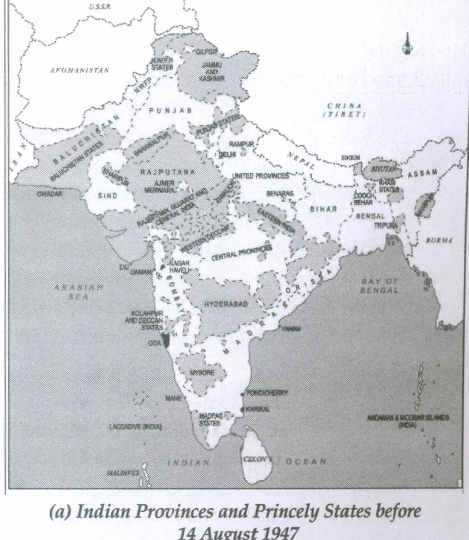
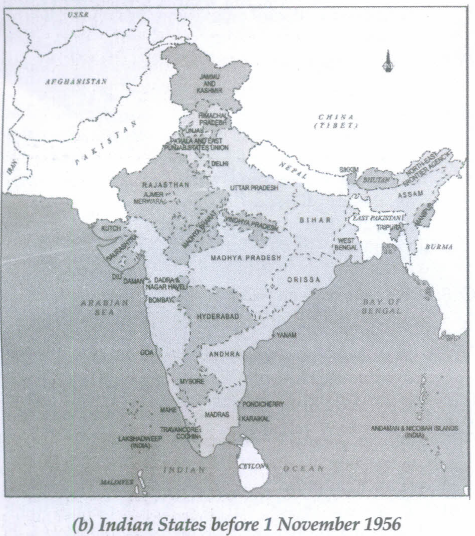
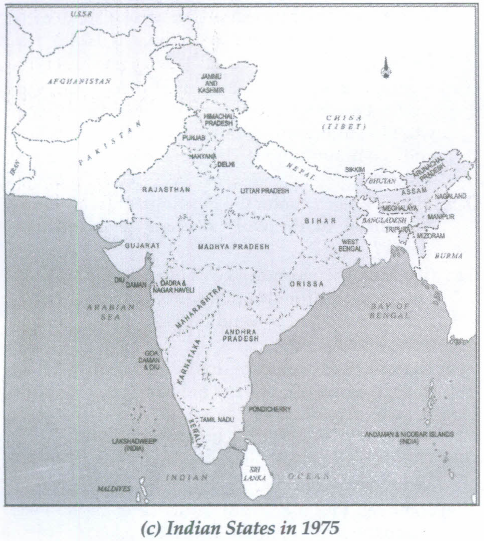
Look at the given figures 5(a), 5(b) and 5(c). Notice how the Princely States disappear in 5(b). Identify the new states that were formed in 1956 and later and the languages of these states
12.
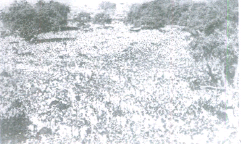
(i) Whose ashes are being immersed in the picture?
(ii) When was he assassinated?
(iii) By whom was he assassinated
13.
When was the Indian Constitution adopted and what were its features?
14.
.............was of the opinion that India could not and must not become a 'Hindu Pakistan'
15.
The death of....................sparked off such violent protests that the government was forced to give in to the demand for the linguistic state of Andhra.
16.
Soon after independence, India chose to grant.............. right to all its citizens regardless of gender, class or education.
17.
Prime Minister Jawaharlal Nehru was also the.......minister of newly independent India.
18.
When India became independent in August 1947, it faced a series of great..........
19.
Indian Constitution came into effect on 26th January, 1947.
20.
In 1960 the bilingual state of Bombay was divided into two separate states
21.
The United Nations formed in 1945.
22.
Jawaharlal Nehru said that 'Do or die'.
23.
Mahatma Gandhi returned to India leaving South Africa for ever in 1920
24.
Name two subjects of the concurrent list
25.
When was the Bhilai Steel Plant set-up?
26.
Who were against the creation of Andhra state on the basis of language?
27.
How many Indians were involved in forming the Constitution
28.
What was the population of India in 1947?
1.
India was divided on the basis of religion. As a result more than a million people had been killed in riots. Thus, we could not afford further divisions on the basis of language.
Prime Minister Jawaharlal Nehru was against the creation of linguistic states because he believed that disruptionist tendencies had come to the fore and to check them, the nation had to be strong and united
2.
In 1947, India's population was large, it was almost 345 million. This large population was divided. It was divided between high castes, low castes between the majority Hindu community and other religious communities.
The citizens of this vast land spoke many different languages, wore different kinds of dresses, ate different kinds of foods and practised different professions
3.
Less than six months after Independence, the nation was in mourning as on 30th January, 1948, the father of the Nation Mahatma Gandhi was assassinated. He was assassinated by a fanatic Nathuram Godse. Nathuram Godse did not believe in Gandhiji's conviction that Hindus and Muslims should live together in harmony. So he killed Mahatma. Jawaharlal Nehru described it as 'the light has gone out of our lives and there is darkness everywhere'.
4.
Mira Behn (Madeleine Slade 1892-1982)1 daughter of the British Rear-Admiral Sir Edmond Slade, was a British woman who left her home in Britain to live and work with Mahatma Gandhi.
Madeleine devoted her life to human development, the advancement of Gandhiji's principles and the freedom struggle in India Gandhiji gave her the name 'Mira Behn', after Mira Bai, the great devotee of Lord Krishna. She arrived in India in 1925 and took active part in Non-cooperation Movement and imprisoned during 1932-33. She established the Kisan Ashram near Roorkee. After Independence, she established Pashulok Ashram near Rishikesh and a settlement name Bapu Gram and the Gopal Ashram in Bhilangana in 1952.
5.
The Constituent Assembly took the decision that while Hindi would be the official language of India, English would be used in the courts, the services and communications between one state and another.
The advantage of this decision is:
It would keep the whole of India united. The South Indian states would not separate themselves from India.
The disadvantage of this decision is :
It would hamper the development and growth of Hindi all over India.
6.
(b)
He was met with black flags and slogans
7.
(c)
1956
8.
(a)
Punjab and Haryana
9.
(b)
BR Ambedkar
10.
(d)
social democracy
11.
After the creation of Andhra Pradesh, A States Reorganisation commission was set up in 1956, recommending the redrawing of district and provincial boundaries to form compact provinces of Assamese, Bengal, Oriya, Tamil, Malayalam, Telugu and Kannada speakers respectively. North India was broken into several states. In 1960, the bilingual state of Bombay was divided into separate sates for Marathi and Gujarati speakers. In 1956, the state of Punjab was also divided into Punjab and Haryana, the former for the Punjabi speakers (who were mostly Sikhs), the latter for the rest (who did not speak Punjabi but versions of Haryanvi or Hindi).
12.
(i) Mahatma Gandhi's ashes are being immersed in the picture.
(ii) He was assassinated on 30 January, 1948
(iii) He was assassinated by a frantic Nathuram Godse
13.
The Indian Constitution was adopted on 26th January 1950. Main features of the Indian
constitution are:
(i) Universal Adult Franchise It adopted Universal Adult Franchise. According to this, all Indians above the age of 21 would be allowed to vote in state and national elections
(ii) Equality to all citizens It guaranteed equality before the law to all citizens, regardless of their caste or religious affiliations.
All the people of different religions would be given the same opportunities when it came to seeking jobs in government or the private sector, they have the same rights before the law.
(iii) Granting special privilege to Scheduled Castes (SC) and Scheduled Tribes (ST) It offered privileges for the poorest and most disadvantaged Indians. A certain percentage of seats in legislatures, as well as jobs in government services, are reserved for them.
(iv) Abolition of untouchability The practice of untouchability was abolished. The Hindu temples were open to all including the untouchables.
14.
()
Jawaharlal Nehru
15.
()
Potti Sriramulu
16.
()
voting
17.
()
foreign
18.
()
challenges
19.
(b)
20.
(a)
21.
(a)
22.
(b)
23.
(b)
24.
()
Forest and Agriculture
25.
()
The Bhilai Steel Plant was set-up with the help of the former Soviet Union in 1959
26.
()
Prime Minister Jawaharlal Nehru and Deputy Prime Minister Sardar Vallabhbhai Patel were against the creation of state on the basis of language.
27.
()
Three hundred Indians were involved in forming the Constitution.
28.
()
India's population in 1947 was almost 345 million

8th Standard CBSE Syllabus & Materials
8th Standard CBSE
CBSE 8th Science Particulate Nature of Matter - New Model Questions Papers Study Material - QB365 Set A
NEW8th Standard CBSE
CBSE 8th Science Pressure, Winds, Stroms and Cyclones - New Model Questions Papers Study Material - QB365 Set A
NEW8th Standard CBSE
CBSE 8th Mathematics Quadrilaterals - New Model Questions Papers Study Material - QB365 Set A
NEW8th Standard CBSE
CBSE 8th Mathematics A story of Numbers - New Model Questions Papers Study Material - QB365 Set A



NCERT Books

Syllabus

Exam Pattern

Sample Question Papers

Previous year Question Papers

Important Notes

MCQ Practice test

NCERT Exemplers

Case study Questions

Image Based Questions

Passage based Questions

HOT Questions

Value Based Questions

Model Questions Papers
NCERT ( Book Back ) Questions

Assertion and Reason
Important Questions And Answers

CBSE 8th Standard CBSE Subjects
CBSE Standards


