
 100% FREE ACCESS
8th Standard CBSE Syllabus & Materials
8th Standard CBSE
CBSE 8th Social Science Theme D - Factors of Production - New Model Questions Papers Study Material - QB365 Set A
NEW8th Standard CBSE
CBSE 8th Social Science Theme C - Universal Franchise and India's Electoral System - New Model Questions Papers Study Material - QB365 Set A
NEW8th Standard CBSE
CBSE 8th Social Science Theme B - The Rise of the Marathas - New Model Questions Papers Study Material - QB365 Set A
NEW8th Standard CBSE
CBSE 8th Social Science Theme B - Reshaping India's Political Map - New Model Questions Papers Study Material - QB365 Set A
NEW8th Standard CBSE
CBSE 8th Social Science Theme A - Natural Resources and Their Use - New Model Questions Papers Study Material - QB365 Set A
NEW8th Standard CBSE
CBSE 8th Science Keeping Time with Skies - New Model Questions Papers Study Material - QB365 Set A

Published on: 29/10/2025
Download CBSE Class 8th Standard CBSE Social Science question papers, sample papers, important questions, and previous year solved papers in PDF format. Get free study materials, NCERT solutions, and exam preparation resources for Class 8th Standard CBSE Social Science
Questions + Answers key
Take MCQ Social Science Test
1.
Mention the factors for healthy IT industry
2.
What are the main reasons for the water problems?
3.
Is India a secular state?
4.
How did the Aligarh Movement influence the field of education?
5.
Read the data related to schooling provided by the Sachar Committee Report: 25 per cent of Muslim children in the 6-14 year age group have either never been enrolled in school or have dropped out. This percentage is much higher than that of any other socio-religious community. Do you think special measures are required to address this situation?
6.
What do you think was the main cause of the uprising against British rule in India?
7.
After the British conquest of Bengal, Calcutta grew from a small village to a big city. Find out about the culture, architecture and the life of Europeans and Indians of the city during the colonial period.
8.
Petroleum deposits of West Asia are an example of actual resources.
9.
Favourable topography of soil and climate are vital for agriculture.
10.
Rashsundari Debi secretly learned to read and write in the flickering light of candles at night.
11.
In the 20th century, the majority of Indians lived in cities.
12.
Mahalwari system came into effect in 1825.
13.
When Shanti was arrested for theft, sub-inspector Rao kept her brother Sushil in the police custody for two days. It was not legal because:
(A)The police forcibly kept Sushil in custody. He was not presented with a memo.
(B) Sushil was abused.
(C) He was beaten.
(D) They forcibly tried to extract a confession from him.
Which of the options above is correct?
A, B, C
B, C, D
A, C, D
A, B, C, D
14.
The important characteristic of public facility is that:
It benefits privileged section of the society
It benefits can be shared by many people
It benefits underprivileged sections of the society
None of these
15.
It is______to deny workers from their wages
legal
justice
illegal
all of above
16.
Fundamental Duties were included in the Constitution in 1976 through the
38th Amendment
42nd Amendment
40th Amendment
39th Amendment
17.
The important centres of Jamdani weaving in India were:
(A) Dhaka (Dacca)
(B) Lucknow
(C) Murshidabad
(D) Varanasi
A, C
A, B
C, D
B, D
18.
Which of the following were not the sources of information of the British administration?
Memos
Reports
Notes
Diaries of Indians
19.
When did the 'Protection of Women from Domestic Violence Act' come into effect.
1990
2001
2005
2006
20.
These resources are inorganic in nature and constitute minerals, rocks, soils etc
Natural resources
Man-made resources
Biotic resources
Abiotic resources
21.
The salt in your food and graphite in your pencil are also
iron
minerals
ore
None of these
22.
The hunter-gatherer tribes got their supplies of rice and other grains
by buying these grains with their meagre earnings from selling forest produce
by exchanging them for forest produce
by doing odd jobs
All of the above
23.
In 1905----------partitioned Bengal
24.
About 90% of the world's population lives in about_____ of the land.
25.
Who led the Revolt in Awadh?
26.
The colour, texture etc of soil is determined by _____
27.
_____________ is a term used in Madhya Pradesh for shifting cultivation.
28.
Britain was popularly known as
29.
First Governor General of India
30.
Cholera
31.
Open Court
32.
Life expectancy
33.
Who is Public Prosecutor?
34.
What is Union List? Explain with the help of an example
35.
Which state is known for having more than 60%of tribes?
36.
Who discovered the sea route of India and when?
37.
Where was the first tidal energy station built?
38.
Name the important cities of information technology in India.
39.
How can we prevent the spread of water-borne diseases?
40.
Who was BK Dutt?
41.
Name the famous battle in which Tipu and Haidar Ali defeated the English troops.
42.
What is the maximum strength of Lok Sabha?
43.
What guidelines have been laid by Supreme Court for police during investigation?
44.
Discuss one of the successes of government water deparbnents in India.
45.
What were differences between the Orientalists and the Anglicists?
46.
Which state has the least number of MPs in the Lok Sabha?
47.
How did "Charakha" symbolise India?
48.
How did the Non-Cooperation Movement gain momentum through 1921-22?
49.
How are the members of the Rajya Sabha elected?
50.
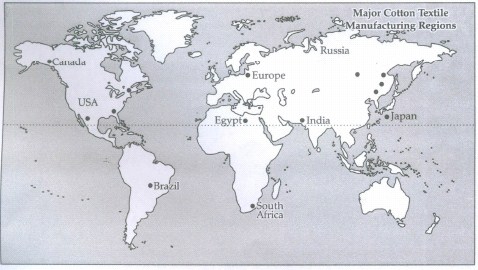
Give the distribution of cotton textile industry in the world. Also mark the same on the map of world.
51.
Why was the Calico Act enacted in England?
52.
Write down some advantages of biogas.
1.
IT includes everything that is necessary to process, store or transfer information in digital form.
The IT industry in India is largely concentrated in Bangalore.
The guiding factors behind healthy IT industries are:
(i) Availability of skilled personnel with good working experience.
(ii) Largest number of educational institutions.
(iii) The city was having a mild climate with low cost of living.
2.
The main reasons for the water problems are:
(i) Urbanization.
(ii) Industrialization.
(iii) Unplanned agriculture.
(iv) Increasing population.
(v) Electricity generation.
(vi) Domestic misuse of water.
3.
India is indeed a secular state. It means that the state has no religion of its own. The state is neither religious nor anti-religious. In the Indian Constitution, from Articles 25 to 28, right to freedom of religion has been granted to all persons residing in India. According to Article 25, subject to public order and morality, everybody is entitled to freedom of conscience and the right to freely practice and propagate the religion of their choice. The Government of India or any other person cannot interfere in the religious affairs of the individuals, otherwise the citizens have the right to go to the court.
4.
The Aligarh Muslim University was founded by Sayyid Ahmed Khan in 1875 at Aligarh. The institution offered modern education, including western science,to Muslims.It also had an enormous impact in the area of educational reform.
5.
Yes,special measures are required to address this. Government can introduce free school books, school dresses, nutritious food for all to attract the children.
6.
The main cause of the uprising against British rule in India are as follows
(i) There were many important causes for the uprising of the British rule, so there is no one main cause.
(ii) Of course, one of the main causes was the disciplinary action taken by the company on the sepoys who refused to use the new greased cartridges.
(iii) All the other problems which had been caused by the Company's actions then came to the fore in a mass rebellion.
7.
Calcutta was a colonial city developed by the British East India Company and then by the British Empire. It was the capital of the British Indian Empire untill1911 when the capital was relocated to Delhi. It grew rapidly in the 19th century to become the second city of the British Empire. In 1772, Calcutta became the capital of British India. a decision made by Governor-General Warren Hastings. Calcutta underwent rapid industrial growth from the 1850s. Many architecturally famous buildings or movements were built by the British.
Calcutta became the 'Cultural Capital of India'. The contribution of Bengal Renaissance on the national movement of independence was immense. Surendranath Banerjee. Womesh Chunder Banerjee, Sri Aurobindo, Bipin Chandra Pal. Swami Vivekananda, Bankim Chandra Chattopadhyay. Rabindranath Tagore were some prominent figures of Bengal.
8.
(a)
9.
(a)
10.
(a)
11.
(b)
12.
(a)
13.
(d)
A, B, C, D
14.
(b)
It benefits can be shared by many people
15.
(c)
illegal
16.
(b)
42nd Amendment
17.
(a)
A, C
18.
(d)
Diaries of Indians
19.
(d)
2006
20.
(d)
Abiotic resources
21.
(b)
minerals
22.
(d)
All of the above
23.
()
Viceroy Curzon,
24.
()
10%
25.
()
In Awadh, the revolt was led by Begum Hazrat Mahal.
26.
()
parent rock
27.
()
Bewar
28.
()
"Workshop of the World
29.
()
Hasting
30.
()
Water-borne disease
31.
()
Public view
32.
()
Number of years for which an average man expect to live
33.
()
That lawyer or advocate who appears in a case on behalf of the state or government.
34.
()
The subjects or issues relating to the whole nation are given in the Union List. Defence and taxes are a few examples.
35.
()
Odisha is known for having more than 60% of tribals.
36.
()
Vasco-da-Gama, a Portuguese explorer discovered the sea route of India in 1498
37.
()
The first tidal energy station was built in France
38.
()
Gurgaon, Pune, Thiruvananthapuram, Kochi and Chandigarh
39.
()
Water-borne diseases can be prevented if people have access to safe drinking water and proper sanitation facilities.
40.
()
BK Dutt was a fellow nationalist of Bhagat Singh who was accompanied with Bhagat Singh when he threw a bomb in the Central Legislative Assembly.
41.
()
Tipu and Haidar Ali defeated the English troops in the famous Battle of Polilur of 1780.
42.
()
The maximum strength of Lok Sabha is 552.
43.
(i) The Supreme Court has laid down guidelines that the police must follow at the time of arrest, detention and interrogation. These are also known as D.K.Basu guidelines.
(ii) Police investigation always has to be conducted in accordance ith law and with full respect for human rights.
(iii) The police are not allowed to torture or beat or shoot anyone during investigation.
(iv) They cannot inflict any form of punishment on a person even for petty offences.
(v) Police officials carrying out investigation should wear, clear and visible name tags with their designations.
44.
There are cases of success in government's water departments. The water supply department in Mumbai raises enough money through water charges to cover its expenses on supplying water. In Hyderabad, the department has increased coverage and improved performance in revenue collection. In Chennai, the department has started harvesting the rainwater. It has handed over the services of transporting and distributing water to private companies on government rates.
45.
These points show the differences between the Orientalists and the Anglicists:
(i) The Orientalists had a deep knowledge of the languages and culture of Asia. They favoured the development of Sanskrit and Persian language in India. But their critics, viz. Anglicists preferred English language and urged that English should be the medium of instruction in the educational institutions.
(ii) The Orientalists tried to set-up such institutions that encouraged the study of ancient Indian texts. But Anglicists like TB Macaulay urged that the British Government in India stop promoting Oriental institutions.
(iii) The Orientalists translated many Sanskrit and Persian texts into English, set-up the Asiatic Society and started a journal called Asiatick Researches. But Macaulay emphasised that teaching of English could be a way of civilising people, changing their tastes, values, and culture.
46.
Manipur has the least number of MPs in the Lok Sabha.
47.
The "Charkha" represented India and it was put at the centre of the tricolour flag of the Indian National Congress adopted in 1931.
48.
The Non-Cooperation Movement gained momentum through 1921-22. Thousands of students left government controlled schools and colleges. Many lawyers gave up their practices. British titles were surrendered, people lit public bonfires of foreign cloth. Large part of the country was on the edge of revolt.
49.
The members of the Rajya Sabha are elected by the elected members of the Legislative assemblies of various states. There are 233 elected members plus 12members nominated by the President.
50.
Distribution of Cotton Textile Industry in the World:
The cotton textile industry is one of the oldest industries in the world. It originated in the Indus Valley about 5000years ago. Till the industrial revolution, cotton cloth was made by using hand spinning techniques and handlooms. The industrial revolution in the 18th century brought a phenomenal change in the textile industry. Power looms facilitated development of cotton textile industry, first in the Great Britain and later in the other parts of the world. India, China, and Japan are the important producers of cotton textiles
51.
(i) By the early 18th century, the wool and silk makers in England were worried by the popularity of Indian textiles in England markets. They began protesting the import of Indian cotton textiles.
(ii) During this period, the textiles industries in England had just begun to develop the Calico, which was an imitation of Indian style.
(iii) Now, cloth producers in England were in a situation to compete with Indian textiles and thus wanted to seize a secure market in England by preventing the entry of Indian textile. (iv) So in 1720, the British government enacted the Calico Act that banned the use of printed cotton textiles - chintz - in England
52.
Some advantages of biogas are:
(i) It is very cheap to produce.
(ii) Biogas can be easily generated.
(iii) It can be produced by making use of bio-wastes.
(iv) It is largely used in rural areas.

8th Standard CBSE Syllabus & Materials
8th Standard CBSE
CBSE 8th Science Particulate Nature of Matter - New Model Questions Papers Study Material - QB365 Set A
NEW8th Standard CBSE
CBSE 8th Science Pressure, Winds, Stroms and Cyclones - New Model Questions Papers Study Material - QB365 Set A
NEW8th Standard CBSE
CBSE 8th Mathematics Quadrilaterals - New Model Questions Papers Study Material - QB365 Set A
NEW8th Standard CBSE
CBSE 8th Mathematics A story of Numbers - New Model Questions Papers Study Material - QB365 Set A



NCERT Books

Syllabus

Exam Pattern

Sample Question Papers

Previous year Question Papers

Important Notes

MCQ Practice test

NCERT Exemplers

Case study Questions

Image Based Questions

Passage based Questions

HOT Questions

Value Based Questions

Model Questions Papers
NCERT ( Book Back ) Questions

Assertion and Reason
Important Questions And Answers

CBSE 8th Standard CBSE Subjects
CBSE Standards


