
 100% FREE ACCESS
8th Standard CBSE Syllabus & Materials
8th Standard CBSE
CBSE 8th Social Science Theme D - Factors of Production - New Model Questions Papers Study Material - QB365 Set A
NEW8th Standard CBSE
CBSE 8th Social Science Theme C - Universal Franchise and India's Electoral System - New Model Questions Papers Study Material - QB365 Set A
NEW8th Standard CBSE
CBSE 8th Social Science Theme B - The Rise of the Marathas - New Model Questions Papers Study Material - QB365 Set A
NEW8th Standard CBSE
CBSE 8th Social Science Theme B - Reshaping India's Political Map - New Model Questions Papers Study Material - QB365 Set A
NEW8th Standard CBSE
CBSE 8th Social Science Theme A - Natural Resources and Their Use - New Model Questions Papers Study Material - QB365 Set A
NEW8th Standard CBSE
CBSE 8th Science Keeping Time with Skies - New Model Questions Papers Study Material - QB365 Set A

Published on: 29/10/2025
Download CBSE Class 8th Standard CBSE Social Science question papers, sample papers, important questions, and previous year solved papers in PDF format. Get free study materials, NCERT solutions, and exam preparation resources for Class 8th Standard CBSE Social Science
Questions + Answers key
Take MCQ Social Science Test
1.
Read the source below and answer the questions that follow:
What did Mahatma Gandhi mean by ahimsa (non-violence)? How could ahimsa become the basis of struggle? This is what Gandhiji said: Non-violence comes to us through doing good continually without the slightest expectation of return. That is the indispensable lesson in non-violence. In South Africa ... I succeeded in learning the eternal law of suffering as the only remedy for undoing wrong and injustice. It means positively the law of non-violence. You have to be prepared to suffer cheerfully at the hands of all and sundry and you will wish ill to no one, not even to those who may have wronged you.
(i) What is an important lesson of non-violence?
(ii) What is the eternal law of suffering?
(iii) What was the cause for which Mahatma Gandhi fought in South Africa?
(iv) When did he return to India from South Africa?
2.
What were the demands of the Muslim league in 1946?
3.
How did Gandhi organize Quit India Movement?
4.
What were the factors that led to the rise of national consciousness among the people of India?
5.
Look at the given picture and answer the following questions.
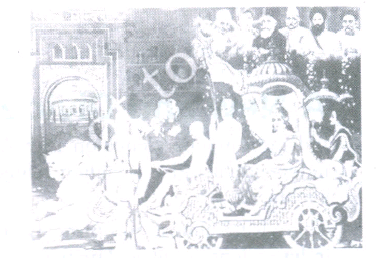
(i) Name the personality who is driving the Krishna's chariot.
(ii) Name the personality who is holding the flag.
6.
Look at the given picture and answer the following questions.
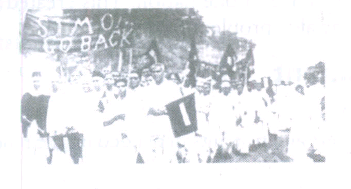
(i) What are demonstrators doing in the above picture.
(ii) What is written on demonstrators banner?
7.
How did Gandhiji emerge as a mass leader?
8.
Describe Gandhi's march to Dandi. Why Salt March was an effective symbol of resistance against colonialism?
9.
Discuss those developments of the 1937-47 period that led to the creation of Pakistan.
1.
(i) An important lesson of non-violence is that one should continuously be good to others, without expecting anything in return.
(ii) The eternal law of suffering is that we should be prepared to suffer at the hands of all and sundry without thinking ill of others, not even those who have harmed us or done wrong to us.
(iii) In South Africa, Mahatma Gandhi led Indians in non-violent marches against racist restrictions.
(iv) Mahatma Gandhi arrived in India in 1915 from South Africa.
2.
The Muslim league had moved a resolution demanding "Independent states" for Muslims in the north-western and eastern areas of the country.
(i) The resolution did not mention partition or creation of Pakistan.
(ii) From the late 1930, the league began viewing the Muslims as a separate' nation' from the Hindus.
(iii) The development of this notion may have been influenced by the history of tension between some Hindu and Muslim groups in the 1920sand 1930s.
(iv) More importantly, the provincial elections of 1937 seemed to have convinced the league that Muslims were a minority and they would always have to play second fiddle in any democratic structure. It feared that Muslims may even go unrepresented.
(v)The Congress's rejection of the league's desire to form a joint congress - league government in the United Provinces in 1937,also annoyed the league.
3.
Mahatma Gandhi decided to initiate a new phase of movements against the British in the middle of the Second World War.
(i) He told them that the British must quit India immediately. He urged the people "do or die in your effort to fight against the British-but you must fight non-violently".
(ii) Gandhi and other leaders were jailed at once when the movement spread.
(iii) It specially attracted peasants and the youth who gave up their studies to join it.
(iv) Communications and symbols of state authority were attacked on, all over the country.
(v) In many areas, people set up their own governments
4.
The factors that led to the rise of national consciousness among the people of India were:
(i) Awareness among the people that the Britishers were exercising control over them, leading to the formation of political associations. The important political association formed during 1870-1880were the Poona Sarvajanik Sabha, the Indian Association, the Madras Mahajan Sabha, the Bombay Presidency Association and the Indian National Congress.
(ii) The dissatisfaction with British rule intensified in the 1870s and 1880s. They posted various laws which agitated the people of India.
(iii) The Arms Act passed in 1878, disallowed the Indians from possessing arms.
(iv) In the same year, the Vernacular Press Act was also enacted in an effort to check those who were critical of the government. The Act allowed the government to confiscate the assets of newspapers which published anything that was found' objectionable'.
(v) In 1883, there was an attempt by the government to introduce the Ilbert Bill. The bill provided for the trial of British or European persons by Indians, and sought equality between British and Indian judges in the country. But when white opposition forced the government to withdraw the bill, Indians were enraged. The event highlighted the racial attitudes of the British in India.
5.
(i) Mahatma Gandhi is driving the Krishna's chariot.
(ii) Jawahar Lal Nehru is holding the flag.
6.
(i) Demonstrators oppose the Simon Commission in the above picture.
(ii) Simon Go Back is written on,the demonstrators banner.
7.
Certain circumstances made Gandhiji to emerge as a mass leader are as follows:
(i) Gandhiji arrived in India in 1915 from South Africa where he led Indians in non- violent marches against racialism. He was already internationally respected figure.
(ii) His struggle in South Africa had brought him in contact with various types of Indians Hindus, Muslims, Parsis and Christians, Gujarati's, Tamils, north Indians,
upper-class merchants, lawyers and workers.
(iii) He spent 1915-16 in India travelling throughout the country, understanding the people, their needs and the overall situation.
(iv) Initially, he took part in local movements in Champaran, Kheda and Ahmedabad. During this time he came into contact with Rajendra Prasad and Vailabhbhai Patel.
(v) In 1918, Gandhiji led a successful millworker's strike in Ahmedabad.
8.
Mahatma Gandhi and other prominent leaders of the Freedom Movement thought that it was sinful to tax salt because it is an essential item of our food. In 1930, Gandhiji decided to break this law. Gandhiji felt that his Salt March would become popular and would represent the general desire of freedom from a specific injustice. Gandhiji and his followers marched for over 240 miles from Sabarmati to the coastal town of Dandi where they broke the law by making salt from sea water. Salt March was an effective symbol of resistance against colonialism because:
(i) All classes could identify with salt as it was an essential food item.
(ii) Monopoly over manufacturing and selling salt was a sign of oppression of the British.
(iii) Breaking the law would affect British economy.
9.
The developments leading to the creation of Pakistan are as follows:
(i)A two-nation theory: From the late 1930s, the Muslim League began viewing the Muslims as a separate "nation" from the Hindus.
(ii) Provincial elections of 1937: The provincial elections of 1937convinced the League that Muslims were a minority, and they would always have to play second fiddle in any democratic structure. It feared that Muslims may even go unrepresented.
(iii) Rift between Congress and Muslim League: In 1937, the Congress rejected-the Muslim League's proposal for a joint Congress-League government in the United Provinces. This annoyed the League.
(iv) Wide mass support base for Muslim League: In the 1930s, the Congress failed to mobilise the Muslim masses. This allowed the Muslim League to widen its social support. It sought to expand its support in the early 1940s,when most Congress leaders were in jail.
(v) Failure of talks: At the end of the Second World War in 1945, the British opened negotiations between the Congress, the League and themselves for the independence of India. However, the talks failed as the League saw itself as the sole spokesperson of Indian Muslims, and the Congress could not accept this claim since a large number of Muslims still supported it.
(vi) Provincial elections of 1946: Elections to the provinces were again held in 1946. The Congress did well in the "General" constituencies but the League's success in the seats reserved for Muslims was spectacular. This led to increased demand for a separate nation for Muslims.
(vii) Failure of talks again: In March 1946, the British cabinet sent a three-member mission to Delhi to examine this demand and to suggest a suitable political framework for a free India. This mission suggested that India should remain united and constitute itself as a loose confederation with some autonomy for Muslim-majority areas. But it could not get the Congress and the Muslim League to agree to specific details of the proposal. Partition was now more or less inevitable.
(viii) Mass agitation and riots: After the failure of the Cabinet Mission, the Muslim League decided on mass agitation for winning its "Pakistan" demand. It announced on 16th August 1946 as "Direct Action Day". On this day, riots broke out in Calcutta, lasting several days and resulting in the death of thousands of people. By March 1947, violence had spread to different parts of Northern India.
(ix) Partition: Finally, the demand for the partition of India was sanctioned, and "Pakistan" was born.

8th Standard CBSE Syllabus & Materials
8th Standard CBSE
CBSE 8th Science Particulate Nature of Matter - New Model Questions Papers Study Material - QB365 Set A
NEW8th Standard CBSE
CBSE 8th Science Pressure, Winds, Stroms and Cyclones - New Model Questions Papers Study Material - QB365 Set A
NEW8th Standard CBSE
CBSE 8th Mathematics Quadrilaterals - New Model Questions Papers Study Material - QB365 Set A
NEW8th Standard CBSE
CBSE 8th Mathematics A story of Numbers - New Model Questions Papers Study Material - QB365 Set A



NCERT Books

Syllabus

Exam Pattern

Sample Question Papers

Previous year Question Papers

Important Notes

MCQ Practice test

NCERT Exemplers

Case study Questions

Image Based Questions

Passage based Questions

HOT Questions

Value Based Questions

Model Questions Papers
NCERT ( Book Back ) Questions

Assertion and Reason
Important Questions And Answers

CBSE 8th Standard CBSE Subjects
CBSE Standards


